ENEnglish
 VITiếng Việt
 ZH中文
 KO한국어
 JA日本語
 FRFrançais
 ITItaliano
 PTPortuguês
 ESEspañol
 HEעברית
 ARالعربية

PEBs with overhead cranes
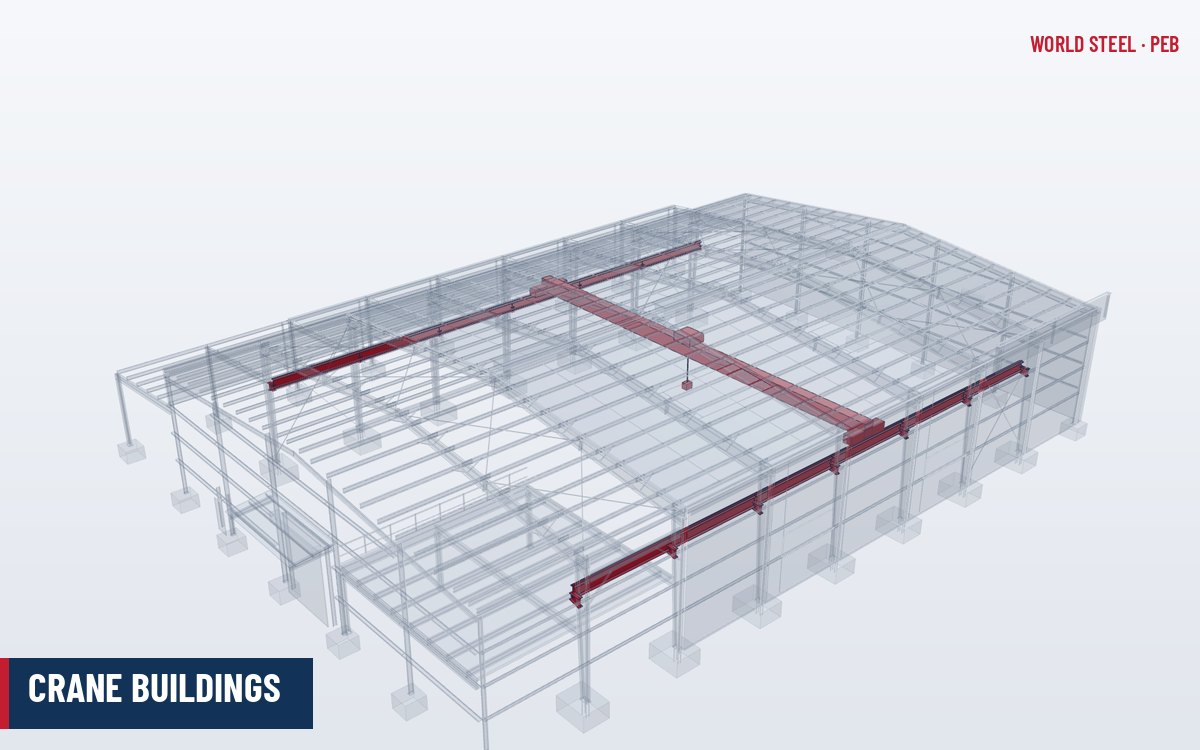
Many factories, steel stockyards, workshops and maintenance buildings need overhead cranes to move materials. A pre-engineered building can integrate cranes efficiently, provided the crane is specified before the frames are designed. The crane affects column size, base fixity, bracing, drift limits and foundations – it is not an accessory that can be added freely later.
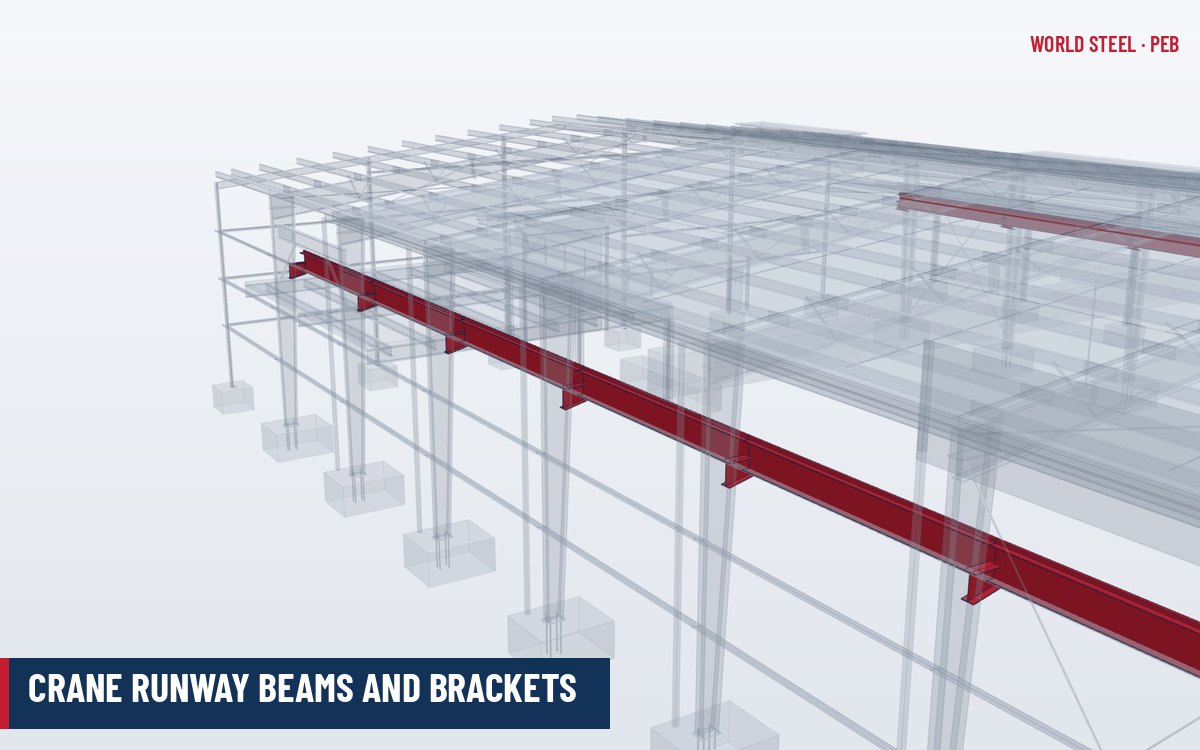
The runway itself – beams, brackets, rails, stops and fixings – is covered in crane runway beams and brackets. This article explains the building system choices.
Crane types and typical PEB ranges
| Crane type | Typical capacity in PEB | Support |
|---|---|---|
| Monorail hoist | Up to about 5 t | Hung from rafters or a separate beam |
| Underhung (under-running) bridge crane | Up to about 5–10 t | Runway hung from rafters |
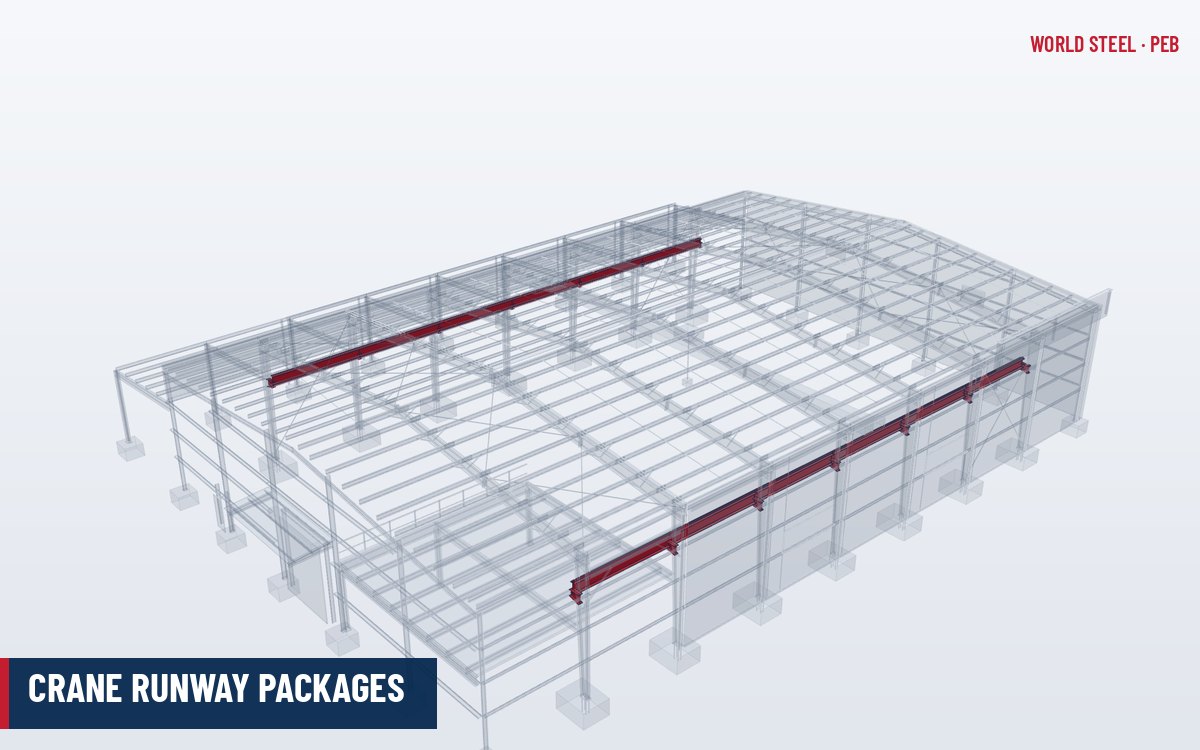
| Top-running bridge crane, bracket-supported | About 5–20 t | Runway on brackets on the main columns |
| Top-running bridge crane, stepped or separate column | About 20–50 t | Stepped columns, crane columns or laced columns |
| Jib crane | Up to about 2–5 t | Column-mounted or free-standing |
These ranges are indicative. Duty class matters as much as capacity: a 10 t crane in continuous production use may need heavier structure than a 20 t crane used occasionally for maintenance.
Crane loads and service classes
Crane manufacturers supply wheel loads, wheel spacing, rail size and service class. The structural designer then applies code-specified dynamic and horizontal loads:
- Vertical impact – an allowance on maximum wheel loads (e.g. ASCE 7 specifies 25% for cab- or remote-operated bridge cranes and 10% for pendant-operated ones).
- Lateral (trolley) force – a percentage of the lifted load plus trolley and hoist weight (20% in ASCE 7-22 for powered trolleys), applied at the rail and shared between the runways according to their lateral stiffness.
- Longitudinal (braking) force – a percentage of the maximum wheel loads (10% in ASCE 7-22), carried through the runway and crane stops into longitudinal bracing.
- Fatigue – for higher service classes (CMAA classes D–F, or equivalent classes in AS 1418.1 and EN 1991-3), runway beams, welds and brackets are checked for the number of load cycles.
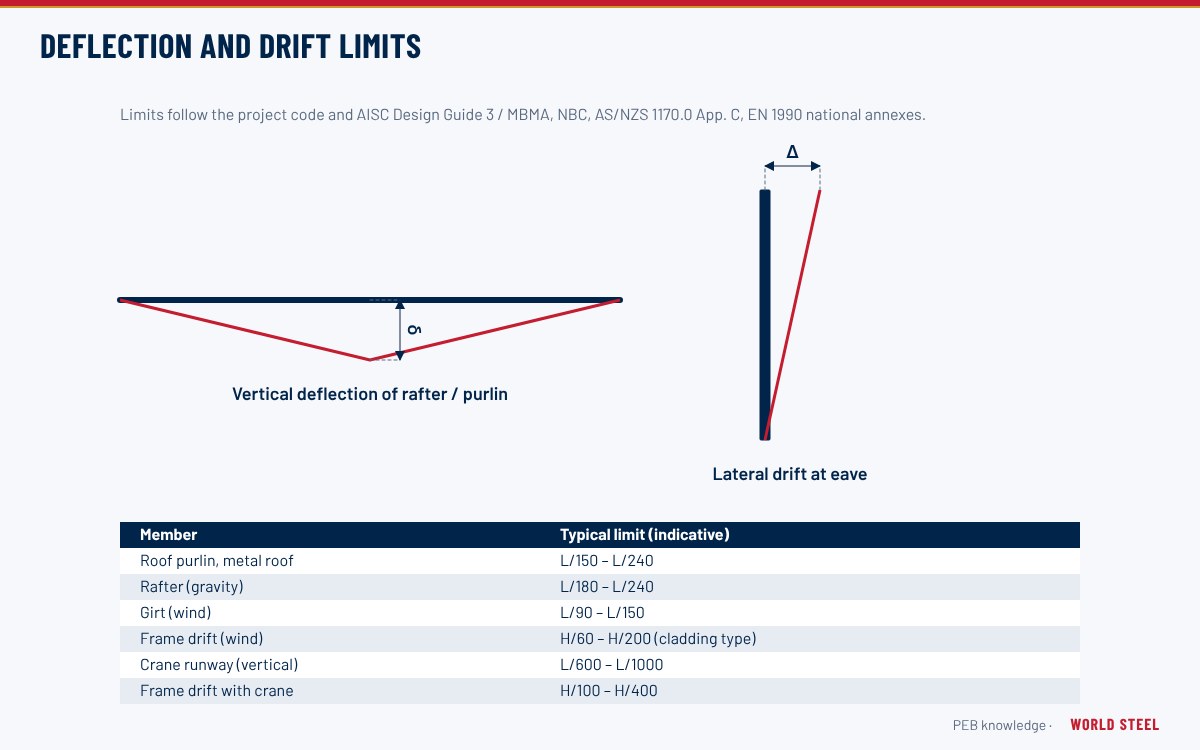
Serviceability limits are strict: runway vertical deflection is typically limited to around span/600 to span/1000 depending on service class, and lateral deflection and frame drift at runway level are also limited so the crane runs smoothly; see serviceability and deflection limits.
Crane data and serviceability criteria
A crane building cannot be designed accurately without data from the crane supplier. The minimum information to include in a PEB enquiry is:
- Crane type (top-running, underhung, monorail, jib), rated capacity and number of cranes per aisle, including any tandem operation.
- Crane span (rail centres), runway length and position of end stops.
- Maximum wheel loads, wheel base and number of wheels per end truck, bridge and trolley self-weight.
- Service or duty class (CMAA 70/74, AS 1418.1, EN 1991-3 / EN 13001 or FEM classification) and operation mode – cab, pendant or radio control.
- Hook height, end approaches and minimum clearance above the crane to the rafter or haunch.
- Rail size and fixing, conductor bar position and any walkways along the runway.
| Item | Typical limit |
|---|---|
| Top-running runway, vertical, light and medium service | Span/600 |
| Top-running runway, vertical, heavy service | Span/800 to span/1000 |
| Underhung and monorail runway, vertical | About span/450 to span/500 |
| Runway lateral deflection (top-running) | About span/400 |
| Frame drift at runway level, pendant-operated crane | About height/100 |
| Frame drift at runway level, cab-operated crane | About height/240, often with an absolute cap of around 50 mm |
Building system design
- Column bases. Crane buildings often use fixed column bases to control drift at runway level.
- Bracing. Longitudinal crane forces require a dedicated bracing line at runway level, usually portal or rod bracing in the crane bay; see bracing systems.
- Clearances. Hook height, crane end clearance and clearance between crane and rafter set the eave height.
- Frame type. Clear-span frames suit full-width cranes; multi-span frames can carry several cranes in separate aisles.
- Future cranes. If a crane may be installed later, the frames, brackets and foundations should be designed for it now.
Above roughly 20–30 t, or for high duty classes, a hybrid design with conventional crane columns and plate-girder runways is often more economical than enlarging PEB columns.
Crane buildings from World Steel
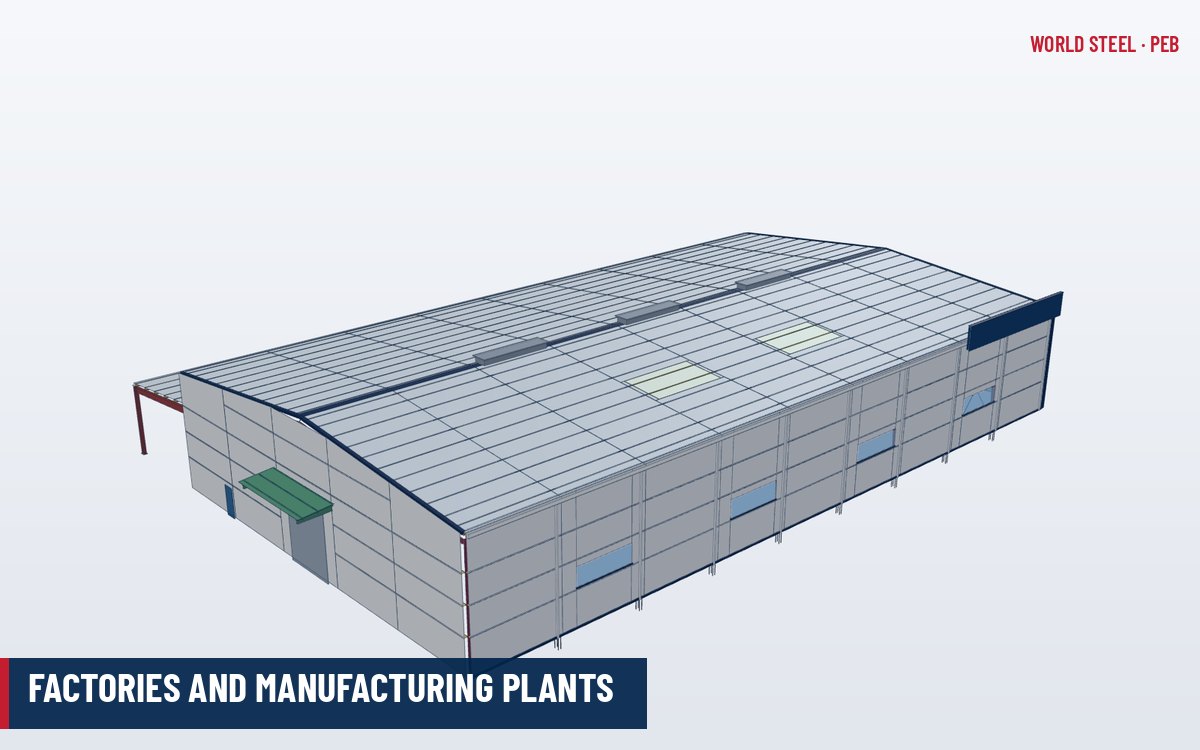
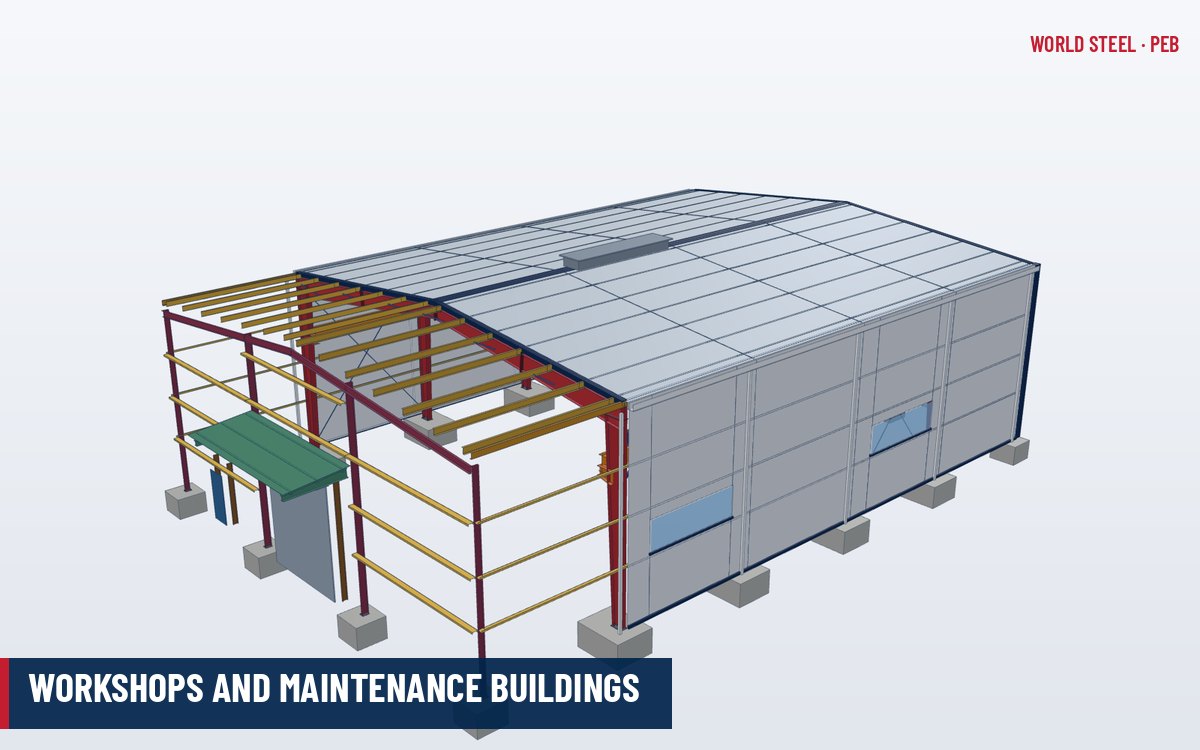
World Steel designs PEB frames for crane loads using the crane supplier's data, and fabricates runway beams, brackets, rail clips and stops with the building. Heavier crane structures are produced as conventional structural steel. Typical uses are factories and workshops and maintenance buildings.
Normas por região
| Região | Norma | Escopo |
|---|---|---|
 United States |
ASCE 7-22 / AISC Design Guide 7 | Crane loads; industrial building and crane runway design |
| United States |
CMAA 70 / CMAA 74 | Crane service classes for top-running and single-girder cranes |
 Canada |
CSA S16-19 | Crane-supporting structures and fatigue |
 Australia / NZ |
AS 1418.18 | Cranes – crane runways and monorails |
 Europe |
EN 1991-3 / EN 1993-6 | Actions induced by cranes; crane supporting structures |
Perguntas frequentes
What crane capacity can a PEB carry?
Bracket-supported runways on PEB columns are common for cranes up to about 20 t; stepped or separate crane columns extend this to roughly 50 t. Duty class must also be considered.
Can a crane be added to an existing PEB?
Only after checking the frames, bracing and foundations for the crane loads and drift limits. Buildings not designed for cranes usually need strengthening.
What information is needed to design a crane building?
Crane capacity, span, service class, wheel loads and spacing, rail size, hook height, operation type and the number of cranes per aisle.
What crane information should be sent with a PEB enquiry?
At minimum: crane type, capacity, span, number of cranes, wheel loads and wheel base, service class, operation mode (cab, pendant or radio), hook height and runway length. Without wheel loads and service class the frame and runway can only be estimated.