 ENEnglish
 VITiếng Việt
 ZH中文
 KO한국어
 JA日本語
 FRFrançais
 ITItaliano
 PTPortuguês
 ESEspañol
 HEעברית
 ARالعربية

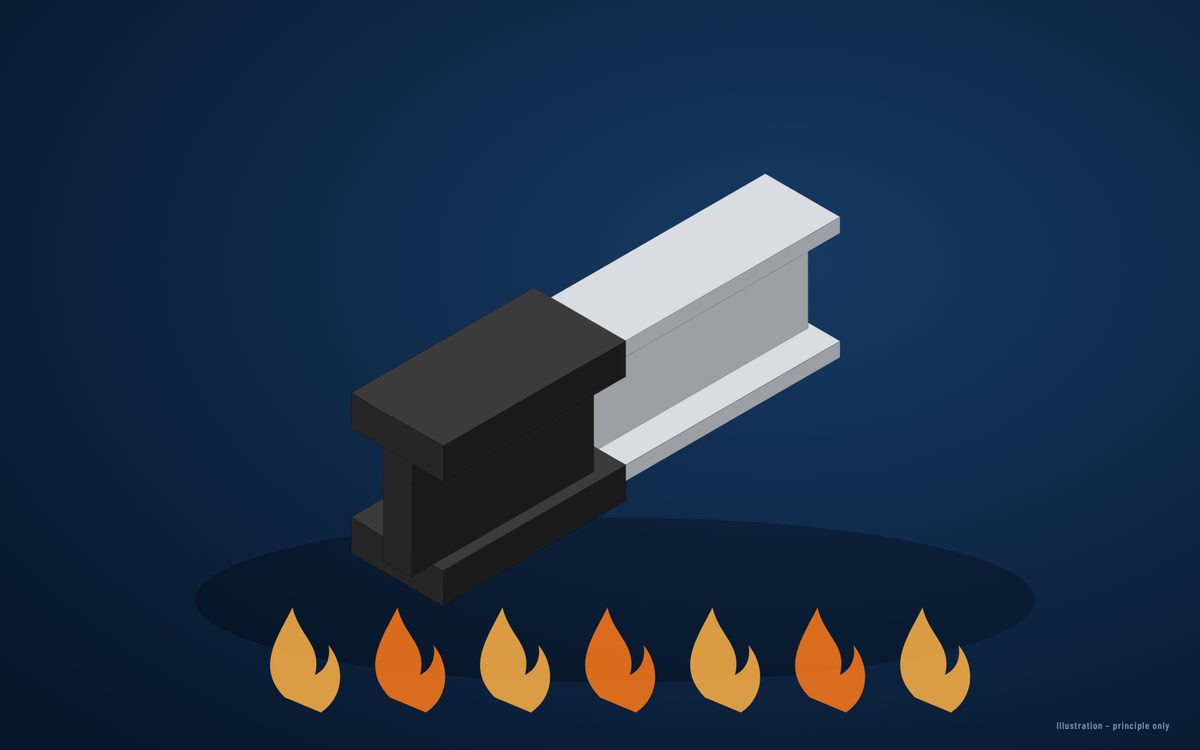
Three ingredients working together
A typical intumescent formulation contains an acid source (often a phosphate), a carbon source (a polyol) and a blowing agent (for example a melamine compound), held in a binder that softens when heated.
- The binder softens and the acid source decomposes.
- The acid reacts with the carbon source to form a carbon-rich char.
- The blowing agent releases gases that foam the softened mass.
- The result is a thick, porous char with low thermal conductivity.
The degree of expansion, the char strength and the insulation are specific to each product and are only known from its fire tests.
What the char does
The char is an insulating blanket between the fire and the steel. Heat still passes through, but much more slowly, so the steel temperature rises gradually. The coating is designed so that the steel stays below its critical temperature for the rated time.
Cellulosic and hydrocarbon fires
Building fires follow the standard (cellulosic) fire curve – ISO 834, ASTM E119, AS 1530.4. Hydrocarbon pool fires heat up much faster and hotter (UL 1709, EN 1363-2), and jet fires add erosion. Thin-film building intumescents are not designed for these conditions – epoxy systems tested for hydrocarbon and jet fires are.
What decides performance
- Dry film thickness – more coating, more char.
- Section factor – how fast the member heats up.
- Critical steel temperature – the target the steel must stay below.
- Section shape – open sections and hollow sections are tested separately.
FAQ
At what temperature does intumescent coating start to expand?
Typically from around 200–250 °C, but the exact activation temperature depends on the product.
Does the char fall off?
A correctly applied and certified system keeps a stable char for the tested duration; char stickability is part of the fire test.
Preliminary calculations are provided for estimation purposes only. Final coating thickness and fire protection system selection must be verified against the approved product documentation, applicable project requirements and relevant engineering assessments.