ENEnglish
 VITiếng Việt
 ZH中文
 KO한국어
 JA日本語
 FRFrançais
 ITItaliano
 PTPortuguês
 ESEspañol
 HEעברית
 ARالعربية

What the service covers
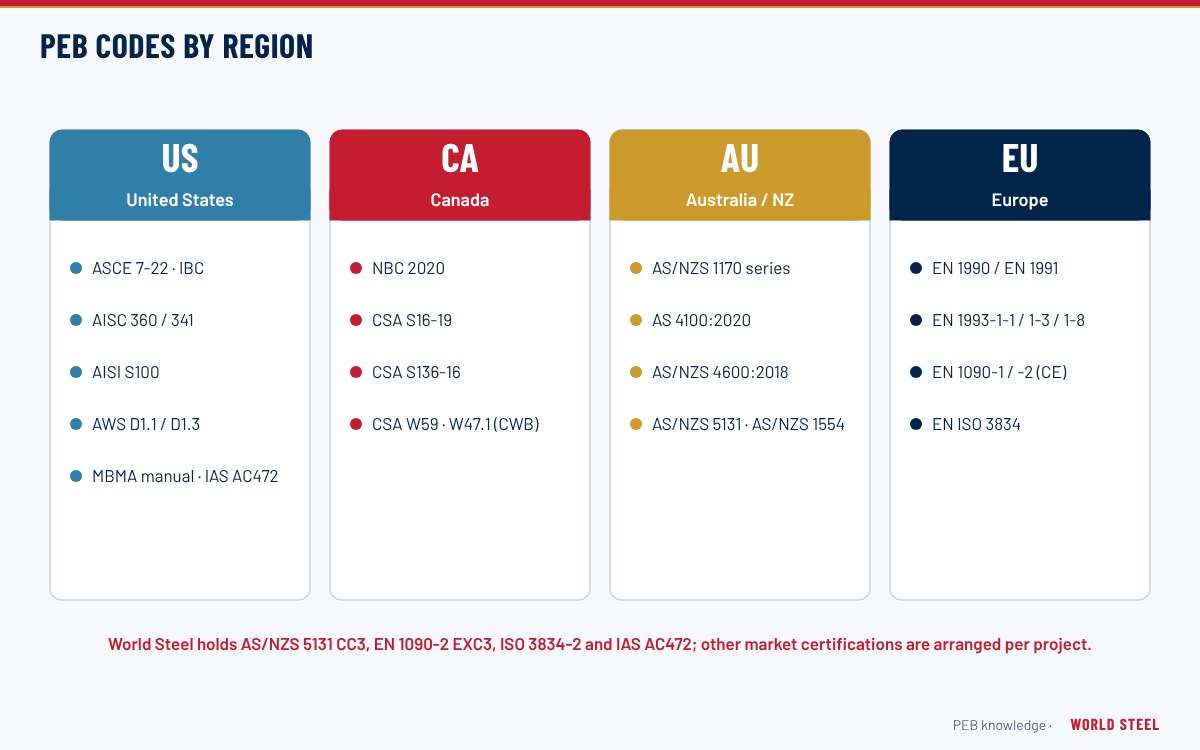
Exported steel must satisfy the design codes, fabrication standards and certification rules of the destination, and building officials and engineers will ask for evidence. World Steel's compliance service, delivered with the export supply and design solutions, covers:
- Identifying the governing codes, editions and local amendments at enquiry.
- Confirming which certifications are required and which WSC already holds.
- Arranging project-specific requirements: local engineer of record, third-party inspection, or certification held by a partner.
- Selecting materials with certificates acceptable in the market (EN 10204 3.1 MTCs, mill origin where restricted).
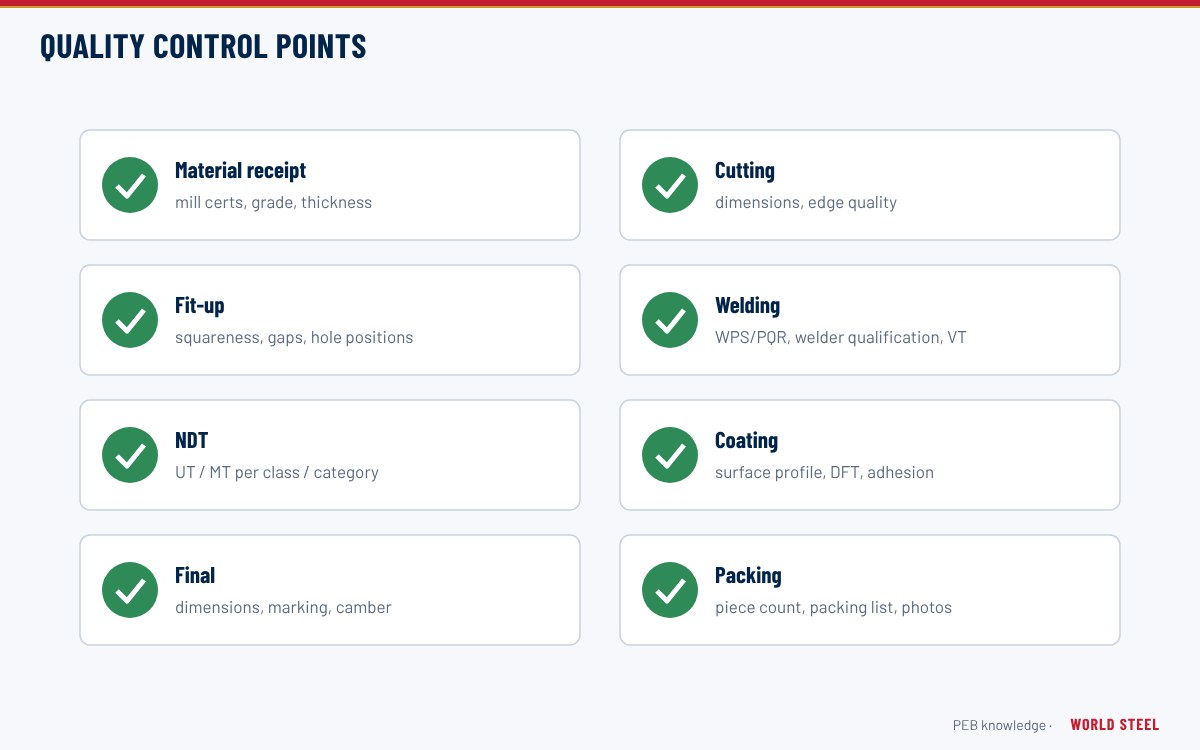
- Compiling the quality dossier: WPS/PQR, welder qualifications, NDT, coating and dimensional reports.
- Supporting the client during approval by the authority or engineer of record.
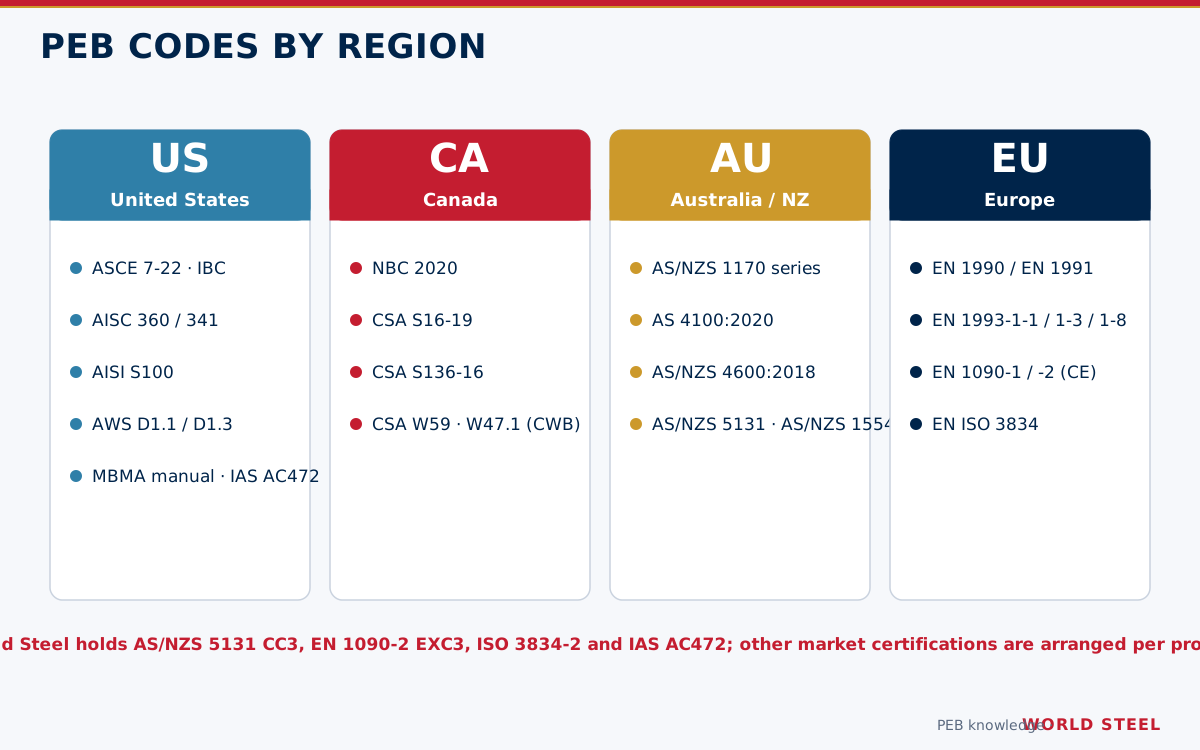
What WSC holds and what is arranged
| Market | Held by WSC | Arranged / confirmed per project |
|---|---|---|
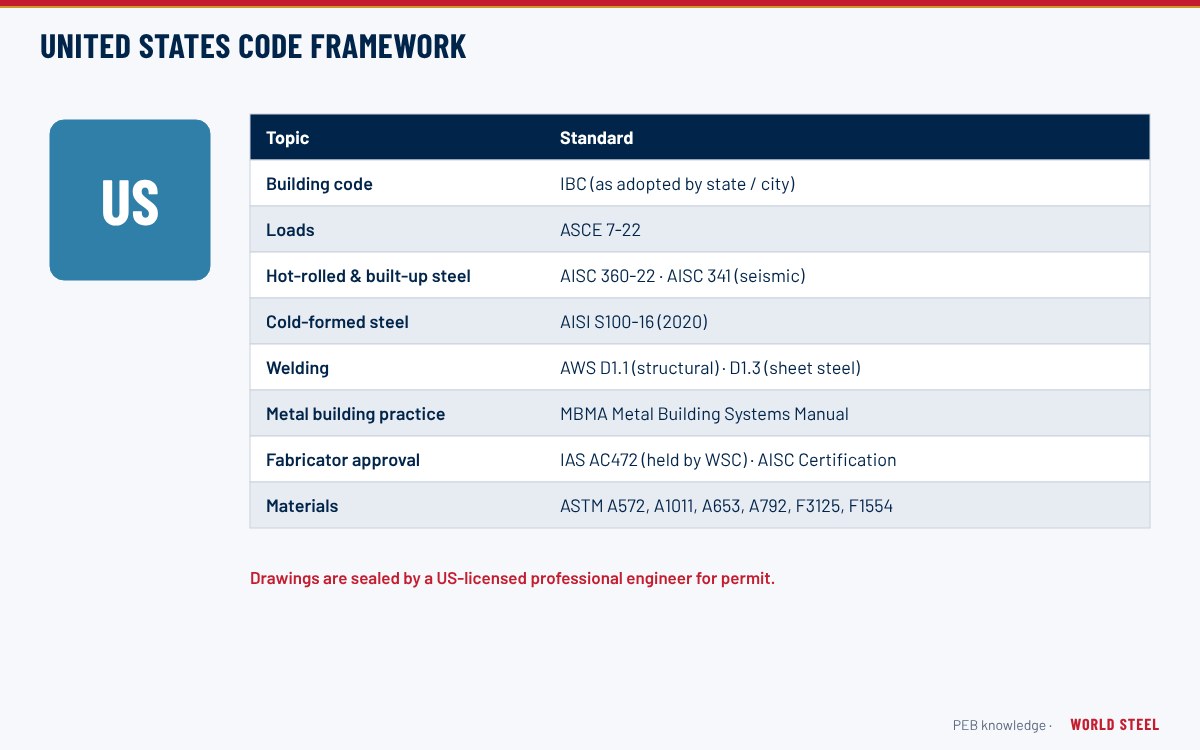
| United States | IAS AC472 (metal building systems); AWS D1.1/D1.3 welding | AISC Certification where specified; local PE seal |
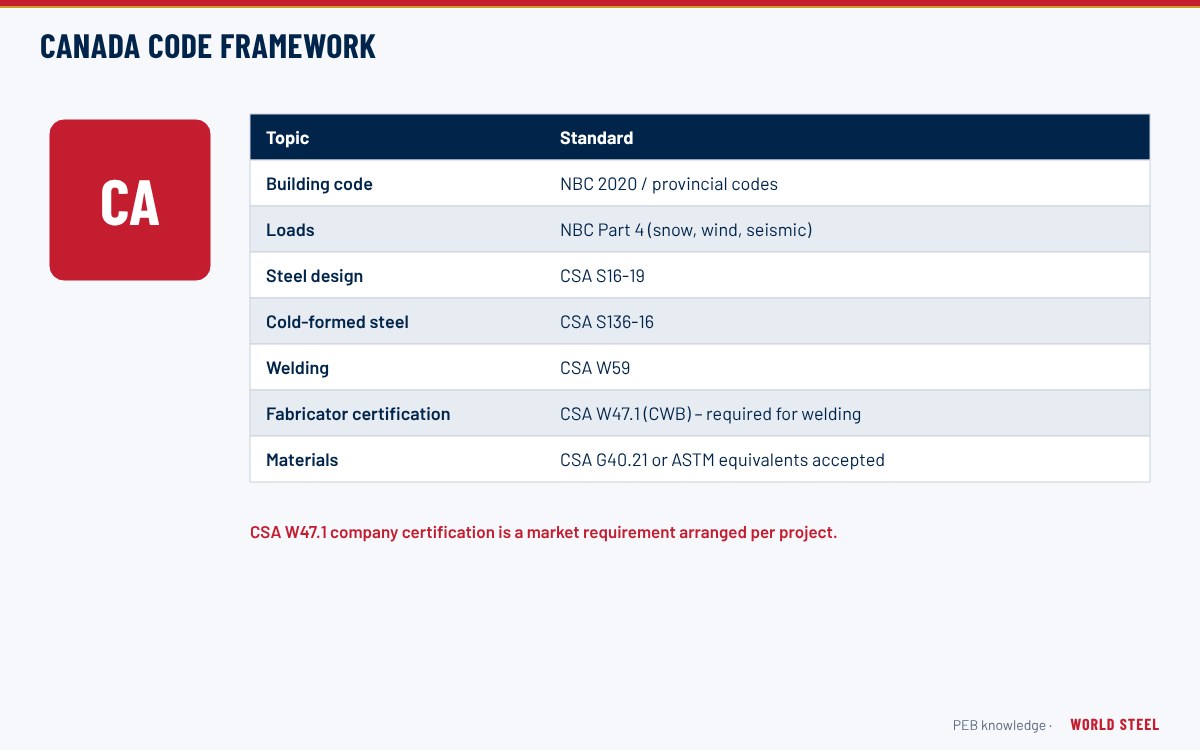
| Canada | Design to NBC 2020, CSA S16-19, CSA S136-16 | CSA W47.1 (CWB) company certification; local P.Eng. seal |
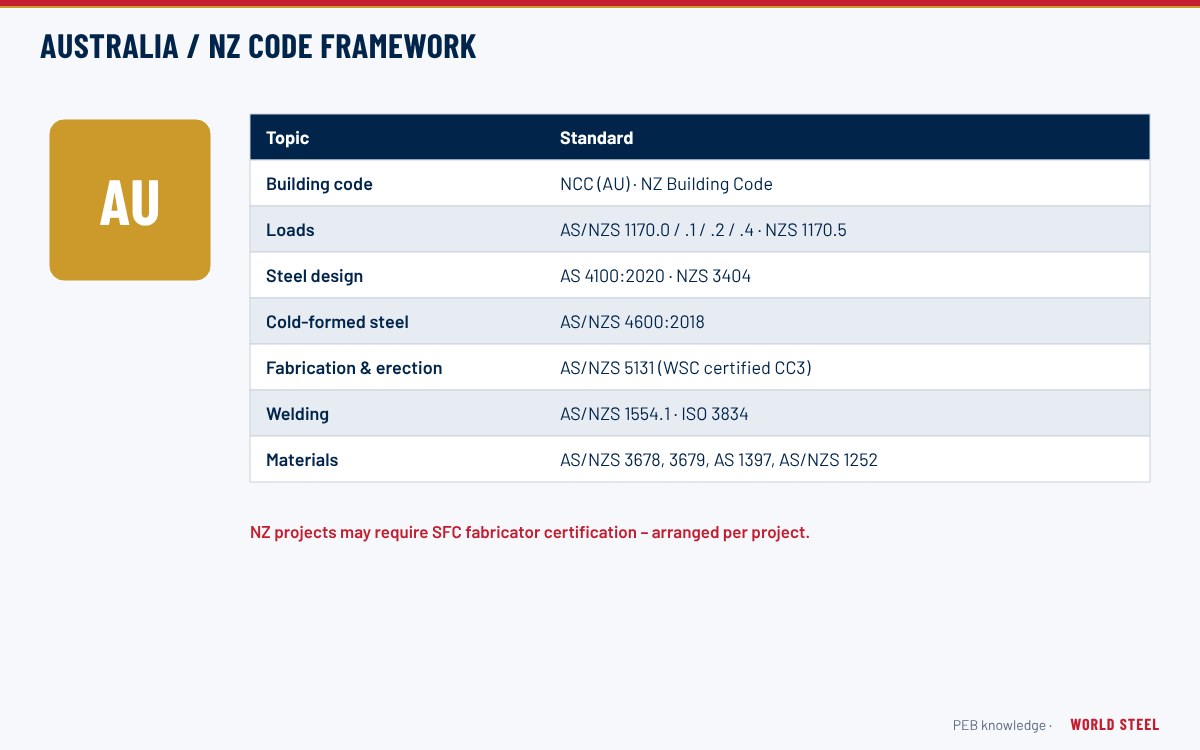
| Australia | AS/NZS 5131 CC3; welding to AS/NZS 1554.1 | Local engineer certification where required |
| New Zealand | AS/NZS 5131 CC3 | SFC certification where specified; local CPEng producer statement |
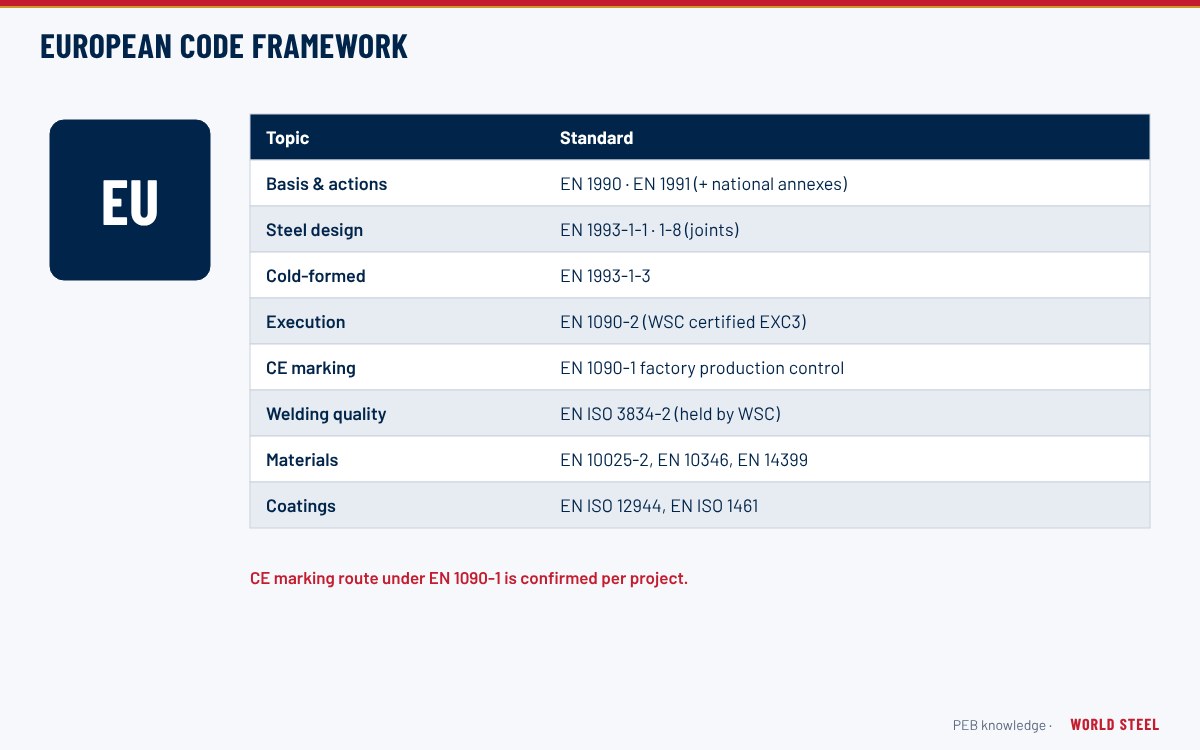
| Europe / UK | EN 1090-2 EXC3, ISO 3834-2 | CE / UKCA marking via EN 1090-1 FPC |
| Singapore | BC1 | Local QP requirements |
IAS AC472 is the IAS accreditation criteria for inspection programs of manufacturers of metal building systems; WSC was the first company in Asia to be accredited. See the market pages for the United States, Canada, Australia, New Zealand, Germany, the United Kingdom and Singapore.
Envelope and accessories. Building officials also check the products that close the building. Typical evidence by market:
| Product | United States / Canada | Australia / NZ | Europe |
|---|---|---|---|
| Roof cladding uplift | ASTM E1592, UL 580 / UL 1897, FM 4471 | AS 4040 series, cyclic tests in cyclonic regions | EN 1993-1-3 / EN 14782 with tests |
| Pre-painted sheet | ASTM A755 with B117, D2247, G154, D2794, D4145 data | AS/NZS 2728 | EN 10169 (RC and RUV categories) |
| Sandwich panels | ASTM E84, NFPA 285, FM 4880 / 4881 | AS 5637.1 | EN 14509, EN 13501-1 |
| Translucent sheets | IBC CC1 / CC2 (ASTM D635) | AS 1530.3 | EN 13501-1 / -5 |
| Large doors | ANSI/DASMA 108 / 115 | AS/NZS 4505 | EN 13241, EN 12424 |
Inputs needed from the client
- Project location and the authority having jurisdiction.
- Project specification and any named certifications or inspection agencies.
- Whether an engineer of record is already appointed and who will seal the design.
- Trade requirements: origin rules, Buy American / Buy America requirements for public projects, tariff classification.
Deliverables and quality
- Compliance matrix listing each requirement, how it is met and the evidence supplied.
- Certificates held by WSC and project quality dossier.
- Design calculations to the local code and, where arranged, sealed by a local engineer.
- Declaration of performance and CE marking documents where an EN 1090-1 route is confirmed.
The detailed code frameworks are explained in US PEB standards, Canadian PEB standards, Australian and New Zealand standards and European standards.
Why certification matters
In many markets a building official or the engineer of record will only accept fabricated steel from a certified fabricator, or will require additional inspection when the fabricator is not certified. Under the IBC, for example, fabricators approved under an accepted program may be exempt from some special inspections in the shop. In Canada, CSA S16 requires welding by companies certified to CSA W47.1. In Europe, structural steel components placed on the market must carry CE marking under the Construction Products Regulation, which requires EN 1090-1 factory production control certification. Clarifying these points at enquiry prevents delays at approval or customs.
Typical schedule
Typically, a compliance matrix is prepared with the quotation, within about 1–2 weeks of a complete enquiry. Project-specific certifications that WSC does not hold, such as CSA W47.1 or an EN 1090-1 FPC certificate for CE marking, can take several months to arrange and must be raised at the start; where they cannot be arranged in time, alternative routes such as a certified partner are discussed. All durations are indicative.
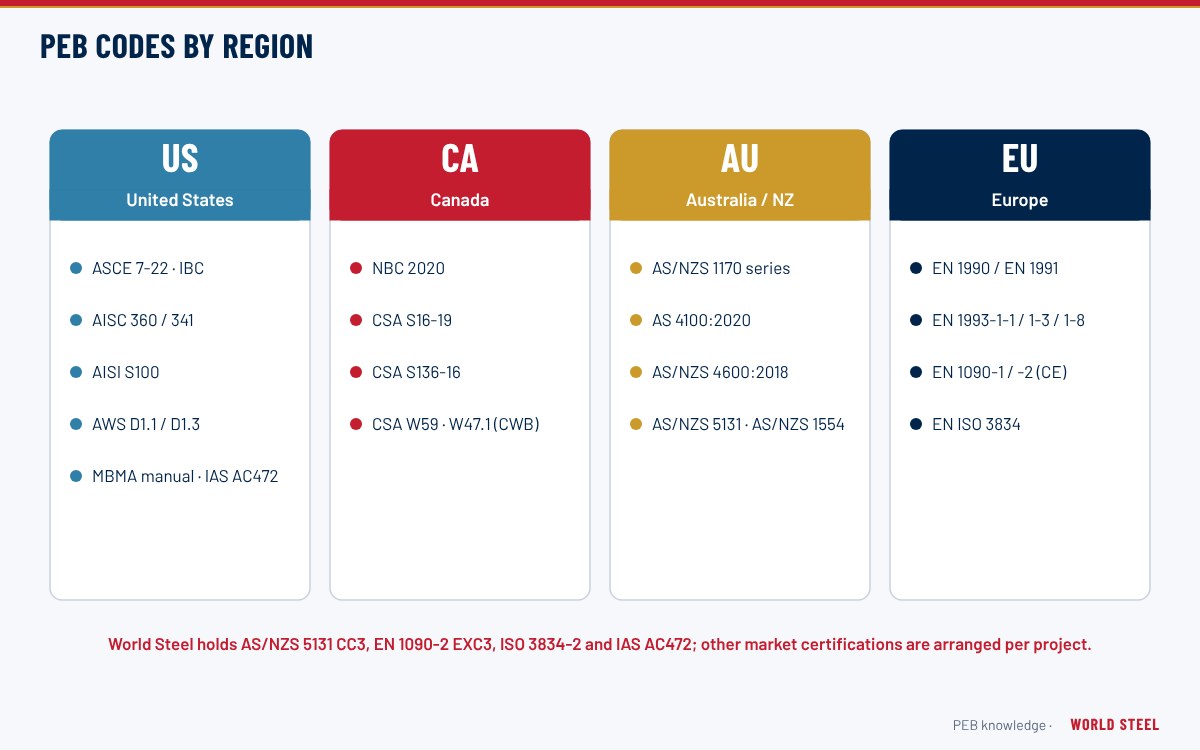
Norme per regione
| Regione | Norma | Ambito |
|---|---|---|
 United States |
IAS AC472 | Accreditation criteria for inspection programs for manufacturers of metal building systems |
 Canada |
CSA W47.1 | Certification of companies for fusion welding of steel |
 Australia / NZ |
AS/NZS 5131 | Structural steelwork – fabrication and erection |
 Europe |
EN 1090-1 | Conformity assessment of structural components |
| Europe |
EN 1090-2 | Technical requirements for steel structures |
| International | ISO 3834-2 | Quality requirements for fusion welding |
Domande frequenti
Is World Steel CWB certified?
No. CSA W47.1 company certification is a requirement for Canadian projects and is arranged per project; WSC designs to CSA S16 and S136.
Can WSC supply CE-marked steel?
WSC holds EN 1090-2 EXC3 and ISO 3834-2. CE marking also needs EN 1090-1 factory production control certification, which is confirmed per project.
What is IAS AC472?
It is the IAS accreditation for inspection programs of metal building system manufacturers, recognised under the IBC; WSC was the first company in Asia accredited.
 Germany
 New Zealand
 Singapore
 IAS AC472
 AS/NZS 5131 CC3
 EN 1090 EXC3 · CE