ENEnglish
 VITiếng Việt
 ZH中文
 KO한국어
 JA日本語
 FRFrançais
 ITItaliano
 PTPortuguês
 ESEspañol
 HEעברית
 ARالعربية

The joint AS/NZS framework
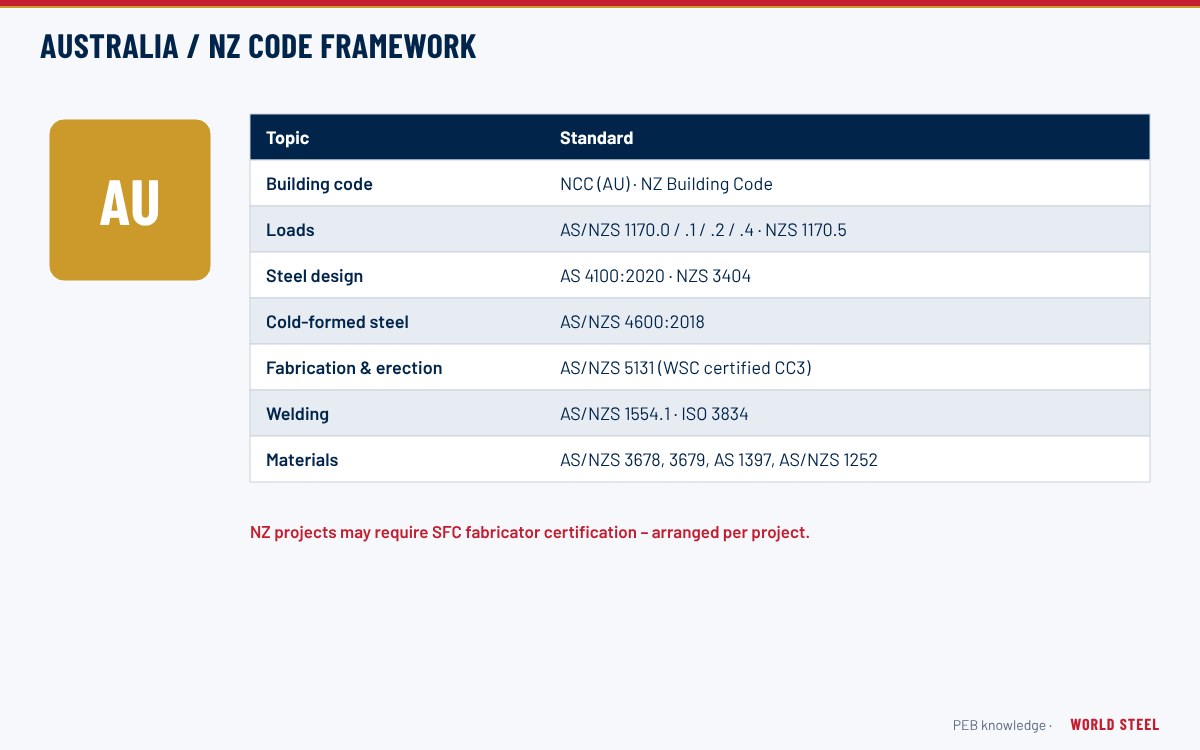
Australia and New Zealand share many structural standards, published jointly as AS/NZS, while keeping separate building codes and some country-specific standards. In Australia, the National Construction Code (NCC) – including the Building Code of Australia – sets performance requirements and references the AS/NZS 1170 loading series and the material design standards. NCC 2022 remains in force while states and territories adopt NCC 2025 on their own timetables from 2026 onward. In New Zealand, the Building Code clause B1 Structure is met through verification methods and acceptable solutions that cite AS/NZS 1170, NZS 1170.5 and NZS 3404, and building consent is issued by the local building consent authority.
Code mapping
| Topic | Australia | New Zealand |
|---|---|---|
| Building approval | NCC (Building Code of Australia) and state legislation | NZ Building Code (B1 Structure), building consent |
| Loads – general, imposed | AS/NZS 1170.0, AS/NZS 1170.1 | AS/NZS 1170.0, AS/NZS 1170.1 |
| Wind and snow | AS/NZS 1170.2:2021, AS/NZS 1170.3 | AS/NZS 1170.2:2021, AS/NZS 1170.3 |
| Earthquake | AS 1170.4 | NZS 1170.5 |
| Steel design | AS 4100:2020 | NZS 3404 (Parts 1 and 2) |
| Cold-formed design | AS/NZS 4600:2018 | AS/NZS 4600:2018 |
| Welding | AS/NZS 1554.1 | AS/NZS 1554.1 |
| Fabrication and erection | AS/NZS 5131:2016 | AS/NZS 5131:2016 |
| Materials | AS/NZS 3678, AS/NZS 3679.1, AS 1397, AS/NZS 1252 | Same, with NZ-specific durability requirements |
| Fabricator certification | AS/NZS 5131 certification (e.g. through the national compliance scheme) | SFC – Steel Fabrication Certification |
Design points specific to this region
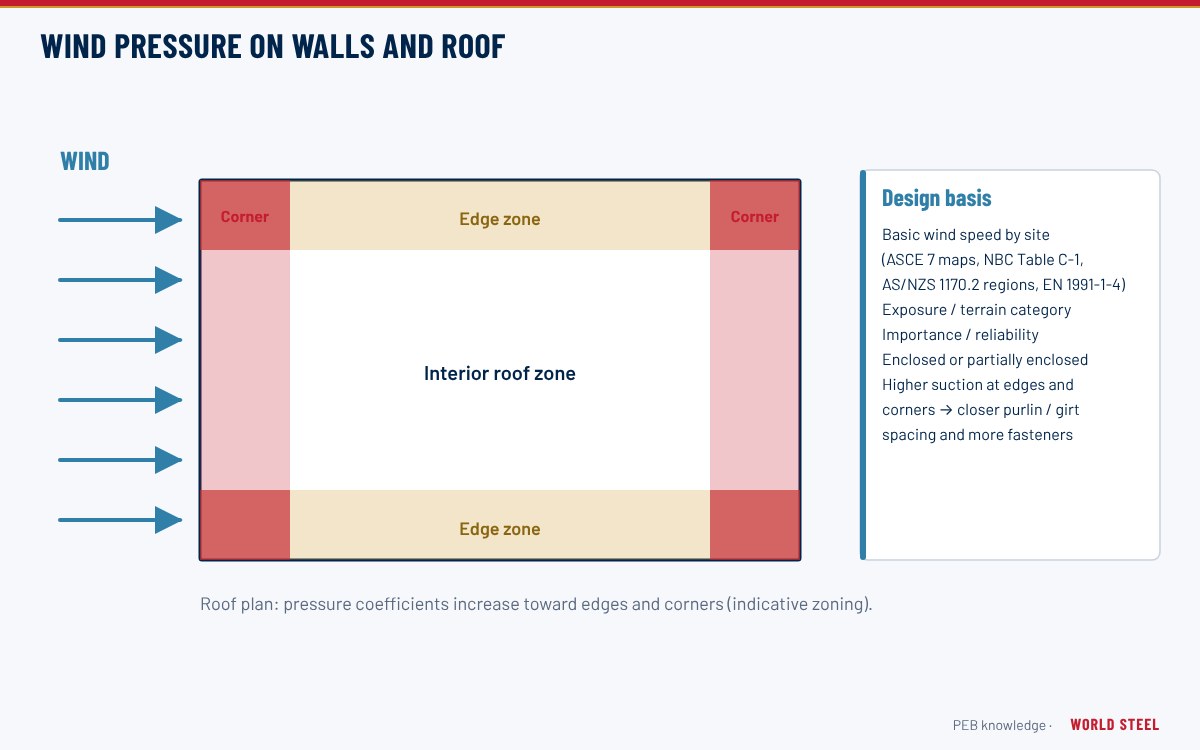
- Wind and cyclones. AS/NZS 1170.2:2021 defines wind regions including cyclonic regions C and D in northern Australia. Cladding and fixings in cyclonic regions must pass cyclic (low-high-low) testing under the NCC, and internal pressure from dominant openings is critical; see wind design.
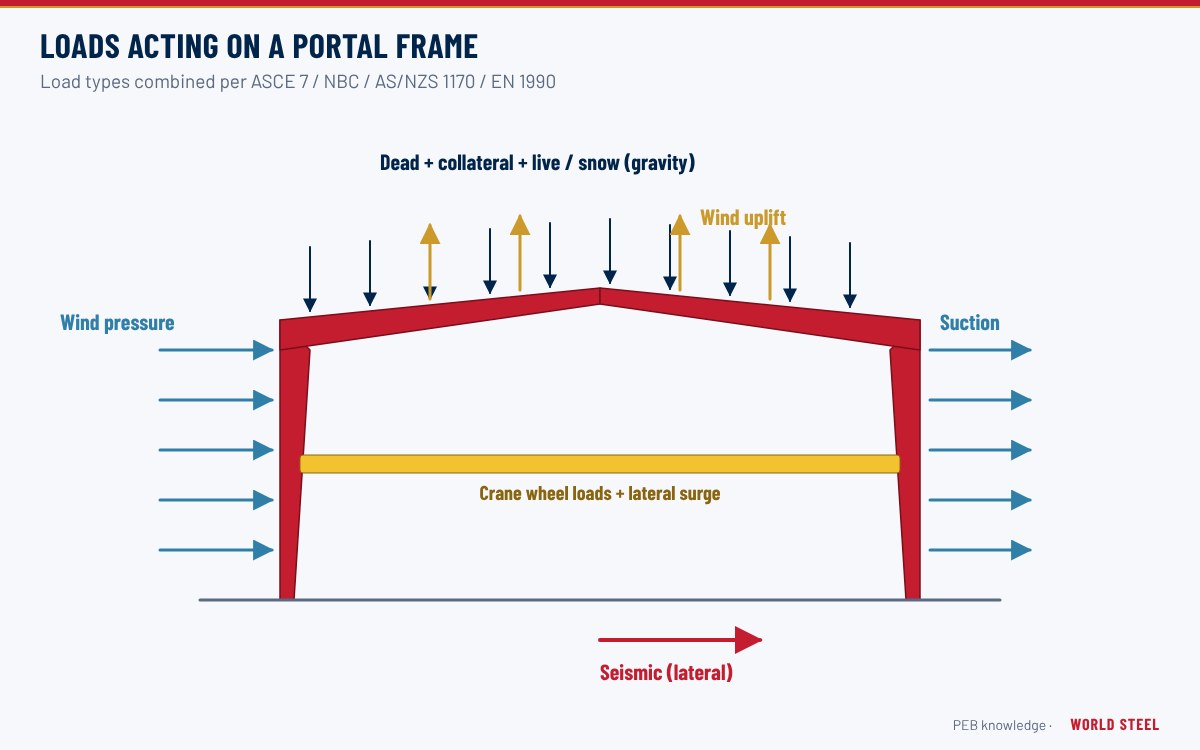
- Earthquake. New Zealand has high seismic hazard and requires ductility-based design to NZS 1170.5 and NZS 3404; Australian seismic design to AS 1170.4 is usually less onerous for light PEBs.
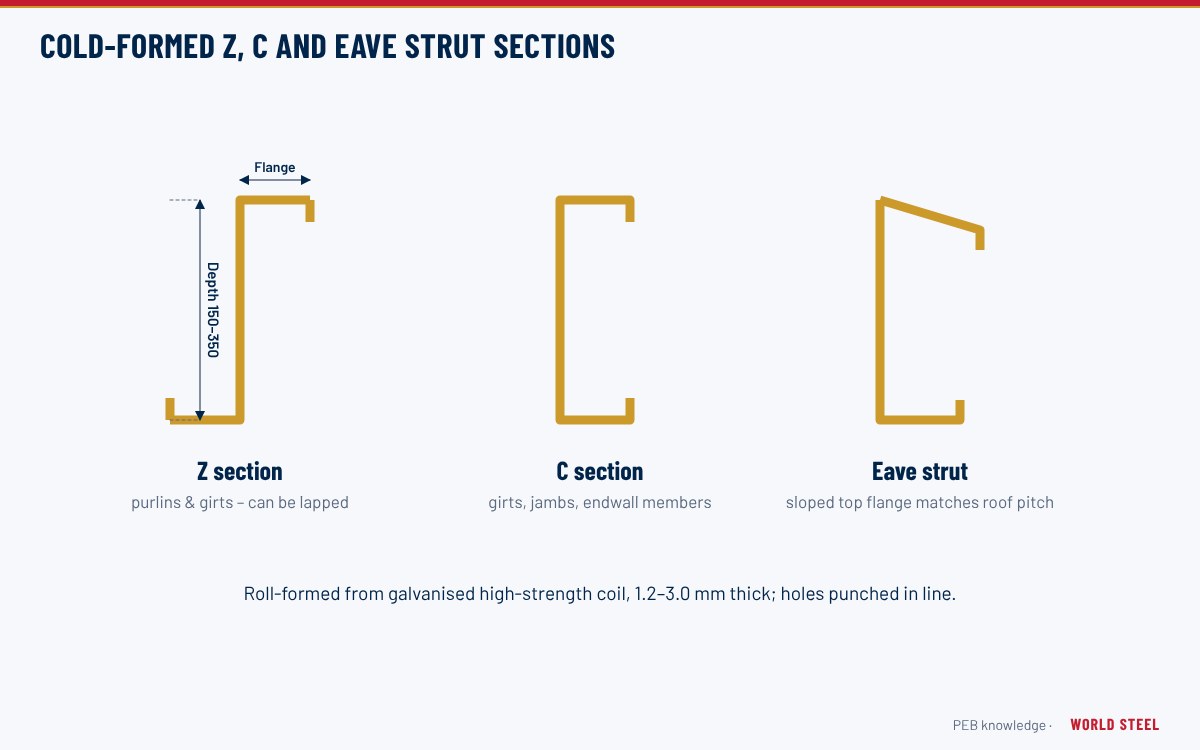
- Steel grades. Plate is typically AS/NZS 3678 Grade 350 and cold-formed strip AS 1397 G450 or G550 with Z or AZ coatings.
- Durability. AS 4312 classifies atmospheric corrosivity, and AS/NZS 2312 guides paint and galvanizing selection.
Importance levels and design events
AS/NZS 1170.0 links the design loads to the consequence of failure through importance levels (IL1 to IL4) and the design working life. The importance level sets the annual probability of exceedance used for the ultimate wind, snow and earthquake events. For the common 50-year design working life the values are:
| Importance level | Typical buildings | Wind | Snow | Earthquake |
|---|---|---|---|---|
| IL1 | Farm buildings and minor structures with low risk to life | 1/100 | 1/100 | 1/250 |
| IL2 | Normal structures – most warehouses and factories | 1/500 | 1/150 | 1/500 |
| IL3 | Buildings with large crowds or high consequences | 1/1000 | 1/200 | 1/1000 |
| IL4 | Post-disaster and essential facilities | 1/2500 | 1/250 | 1/2500 |
The NCC (Australia) and the NZ Building Code define which buildings fall into each level. Serviceability events are chosen separately – Appendix C of AS/NZS 1170.0 suggests criteria by element, and portal frame drift and purlin and girt deflection limits are normally agreed with the cladding supplier and the client; see serviceability and deflection limits.
AS/NZS 5131 construction categories and certification
AS/NZS 5131 governs fabrication and erection of structural steelwork and assigns each structure, or part of it, a Construction Category from CC1 to CC4, based on importance level, service category and fabrication category. Most industrial PEBs fall into CC2; CC3 applies to more demanding structures, for example those with higher importance levels or fatigue and seismic demands. The category sets requirements for weld inspection, traceability, tolerances and documentation. Each requirement is explained in our AS/NZS 5131 CC3 guide, starting with how the construction category is selected.
Clients and authorities increasingly require evidence that the fabricator is certified to AS/NZS 5131 at the appropriate category – in Australia commonly through the National Structural Steelwork Compliance Scheme, and in New Zealand through Steel Fabrication Certification (SFC) by Steel Construction New Zealand. Imported steel products are also expected to be verifiably compliant with AS/NZS material standards, for example through third-party product certification or test evidence.
World Steel in Australia and New Zealand
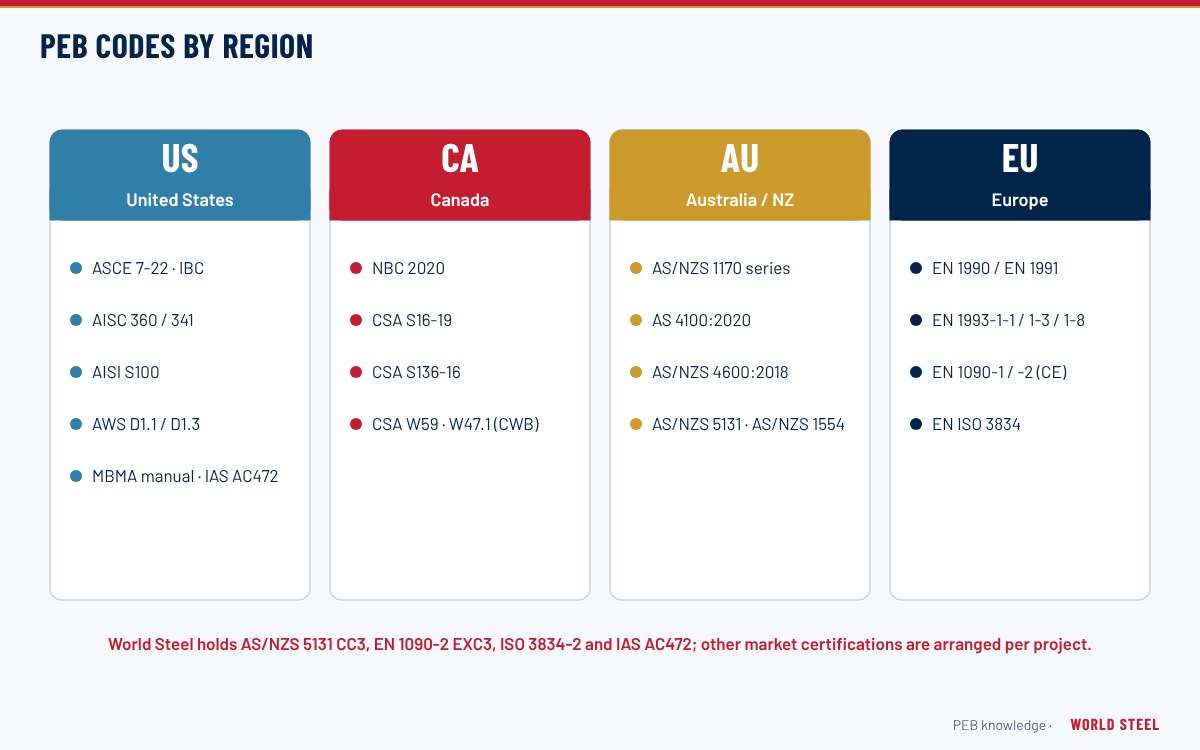
World Steel Construction holds AS/NZS 5131 Construction Category CC3 certification and fabricates under ISO 3834-2. WSC does not hold New Zealand SFC certification; where a New Zealand project requires SFC, the route must be agreed for that project. Designs are prepared to AS/NZS 1170, AS 4100 or NZS 3404, and AS/NZS 4600. See the global overview, European standards for comparison, market compliance and cold-formed steel.
Norme per regione
| Regione | Norma | Ambito |
|---|---|---|
 Australia / NZ |
AS/NZS 1170.0 / .1 / .2 / .3 | Structural design actions |
| Australia / NZ |
AS 1170.4 / NZS 1170.5 | Earthquake actions – Australia / New Zealand |
| Australia / NZ |
AS 4100:2020 | Steel structures (Australia) |
| Australia / NZ |
NZS 3404 | Steel structures standard (New Zealand) |
| Australia / NZ |
AS/NZS 4600:2018 | Cold-formed steel structures |
| Australia / NZ |
AS/NZS 5131:2016 | Structural steelwork – fabrication and erection |
| Australia / NZ |
AS/NZS 1554.1 | Structural steel welding |
| Australia / NZ |
AS/NZS 3678 / AS 1397 | Structural plate; metallic-coated steel sheet and strip |
Domande frequenti
Which construction category applies to a typical PEB in Australia?
Most industrial PEBs are CC2 under AS/NZS 5131. Higher importance levels or seismic and fatigue demands can raise parts of the structure to CC3. The designer specifies the category on the drawings.
Is AS 4100 used in New Zealand?
New Zealand uses its own steel design standard, NZS 3404, together with NZS 1170.5 for earthquake actions. AS/NZS 4600, AS/NZS 1554.1 and AS/NZS 5131 are shared by both countries.
What steel is used for PEB purlins in Australia?
High-strength metallic-coated strip to AS 1397, typically G450 or G550 with a Z (galvanized) or AZ (aluminium-zinc) coating, designed to AS/NZS 4600.
Which importance level applies to a typical PEB warehouse in Australia?
Most warehouses and factories are Importance Level 2 under the NCC, which for a 50-year design life means an ultimate wind event with an annual probability of exceedance of 1/500. Buildings with large crowds or essential functions move to IL3 or IL4.
 New Zealand
 Papua New Guinea
 AS/NZS 5131 CC3