ENEnglish
 VITiếng Việt
 ZH中文
 KO한국어
 JA日本語
 FRFrançais
 ITItaliano
 PTPortuguês
 ESEspañol
 HEעברית
 ARالعربية

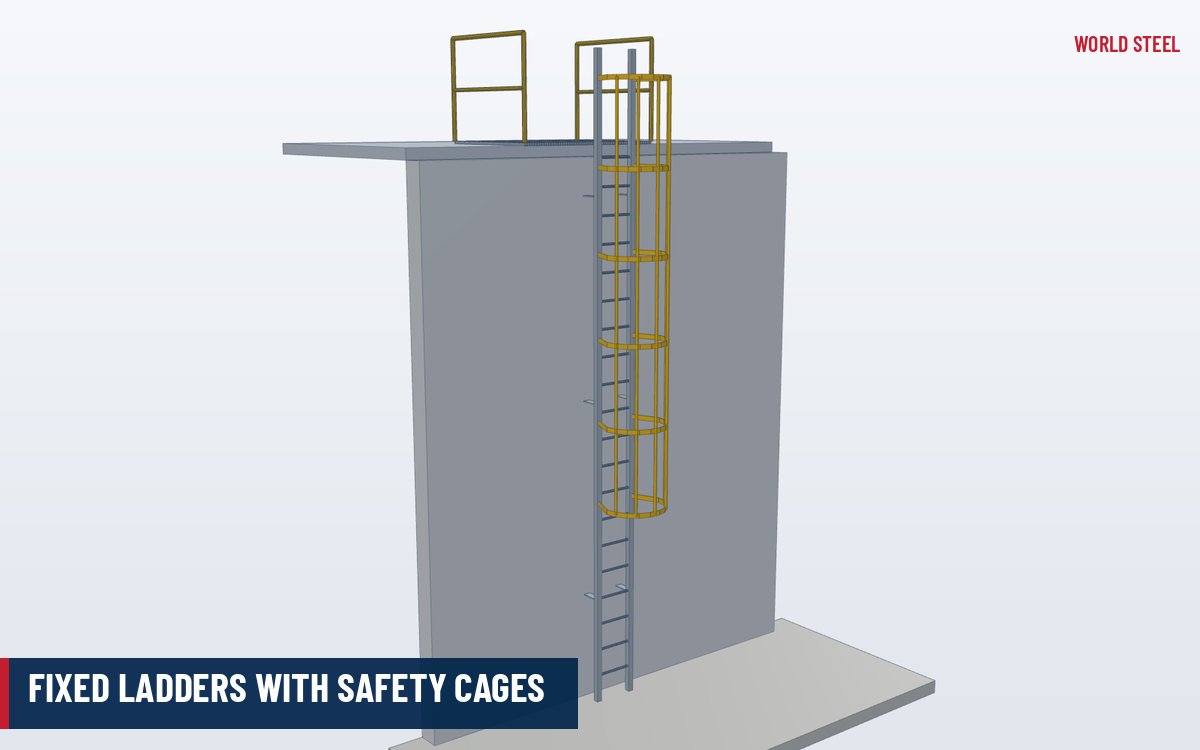
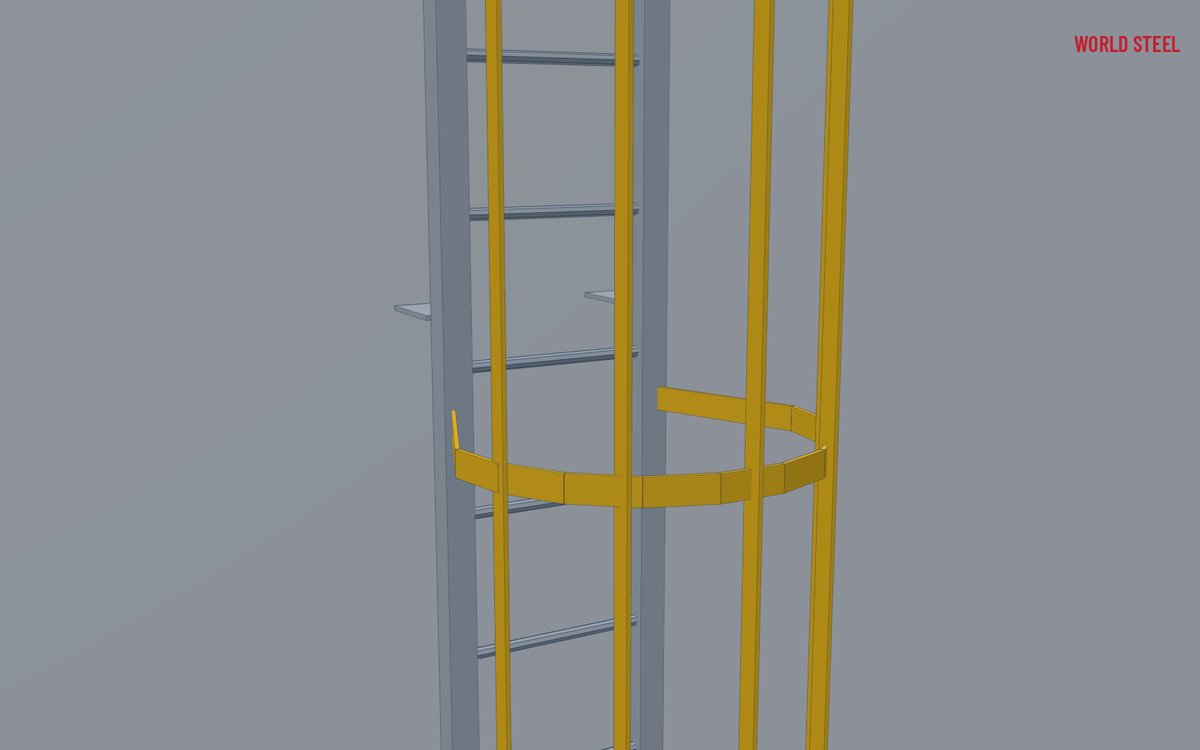
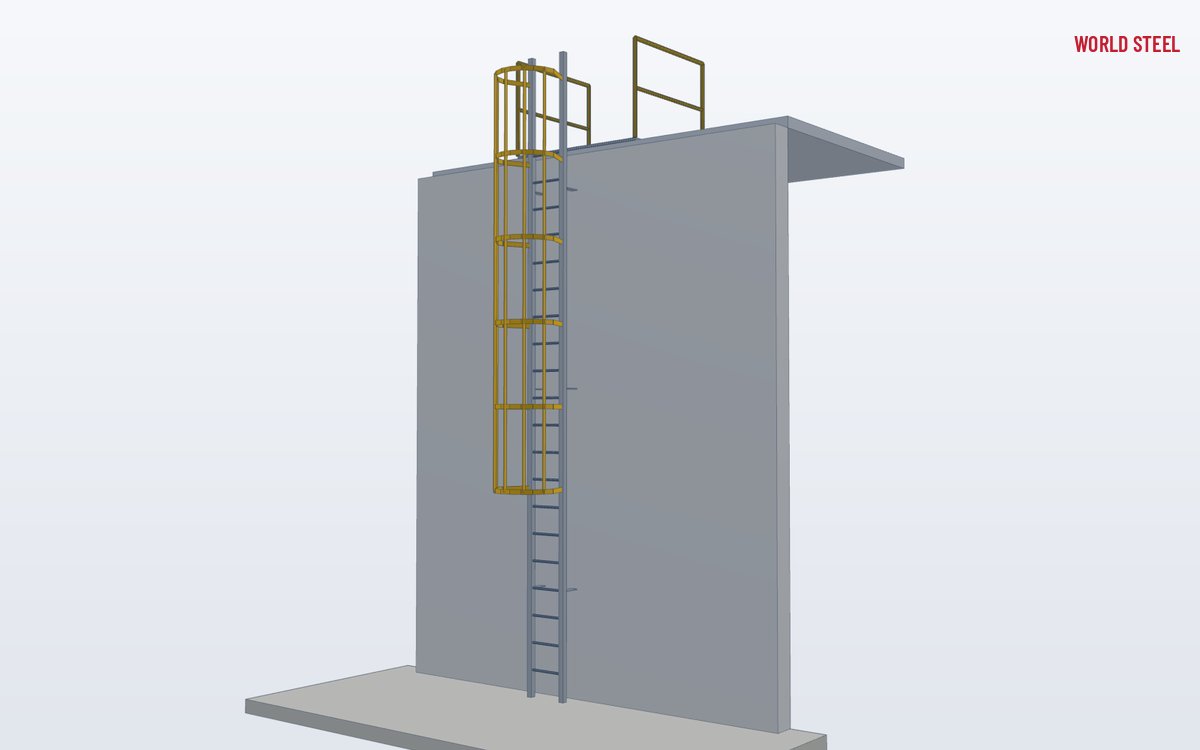
- Rung spacing and width to OSHA, AS 1657 or EN ISO 14122-4
- Safety cages, or brackets for rail or cable fall-arrest systems
- Rest platforms, top exits, gates and anti-climb doors
- Welded in modular lengths, bolted on site
- Hot-dip galvanized by qualified galvanizers
What it is
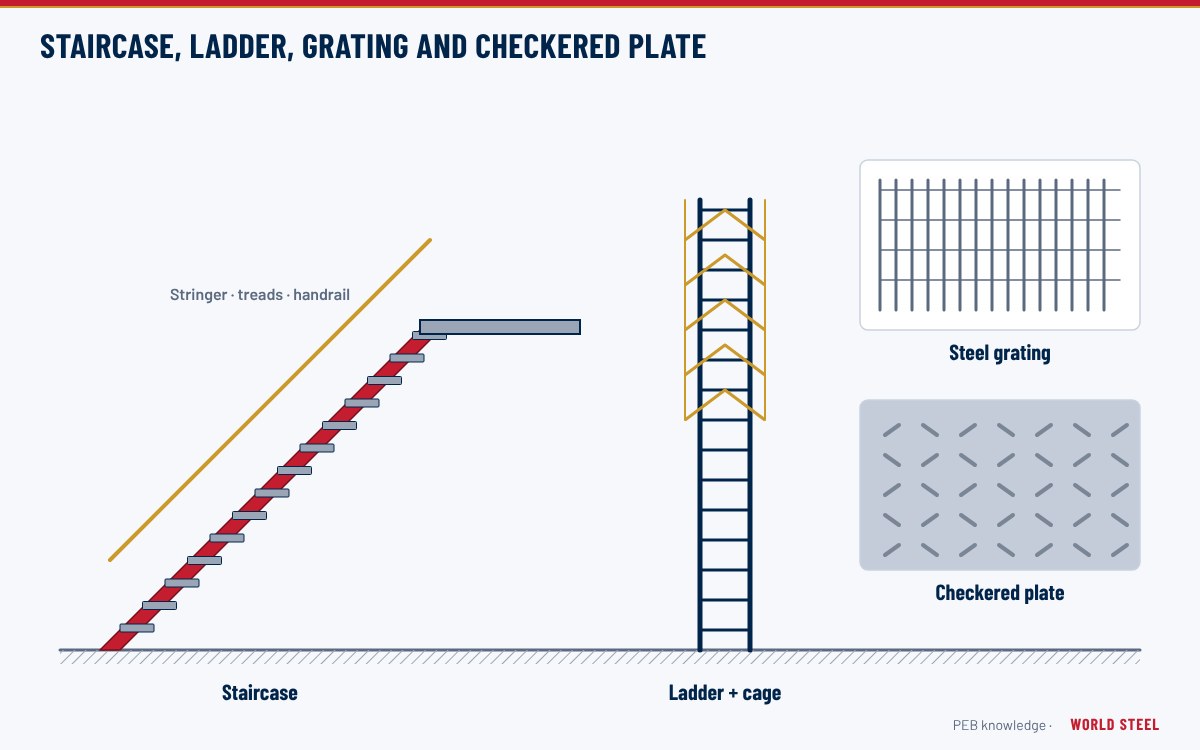
A fixed ladder is a permanently attached vertical or near-vertical ladder giving access to roofs, tanks, silos, equipment, crane runways and elevated platforms where a stair is impractical. It consists of two stiles (side rails), rungs at uniform spacing, wall brackets or stand-offs, and – depending on height and market – a safety cage, a ladder safety system (rigid rail or cable with a sliding fall arrester), rest platforms and a protected top exit through the guardrail.
Fixed ladders are the most code-sensitive item in a misc. metals package because fall-protection rules have changed in recent years and differ between markets. World Steel details each ladder to the code nominated by the client and coordinates it with the platform, guardrail openings and building cladding in the same Tekla model.
Types and options
| Configuration | Description | Typical application |
|---|---|---|
| Plain rung ladder | Stiles and rungs, no fall protection | Short climbs below the fall-protection trigger height |
| Caged ladder | Hoops and vertical straps around the climbing space | Existing practice in AU and EU; being phased out under OSHA for tall ladders |
| Ladder with safety system | Rigid rail or cable carrier with fall arrester, on WSC brackets | New US ladders over 24 ft; preferred option in many EU plants |
| Multi-flight with rest platforms | Staggered flights with intermediate landings | Tall structures, silos, stacks |
| Ladder with anti-climb door | Lockable hinged plate across the lower section | Sites with public access or security needs |
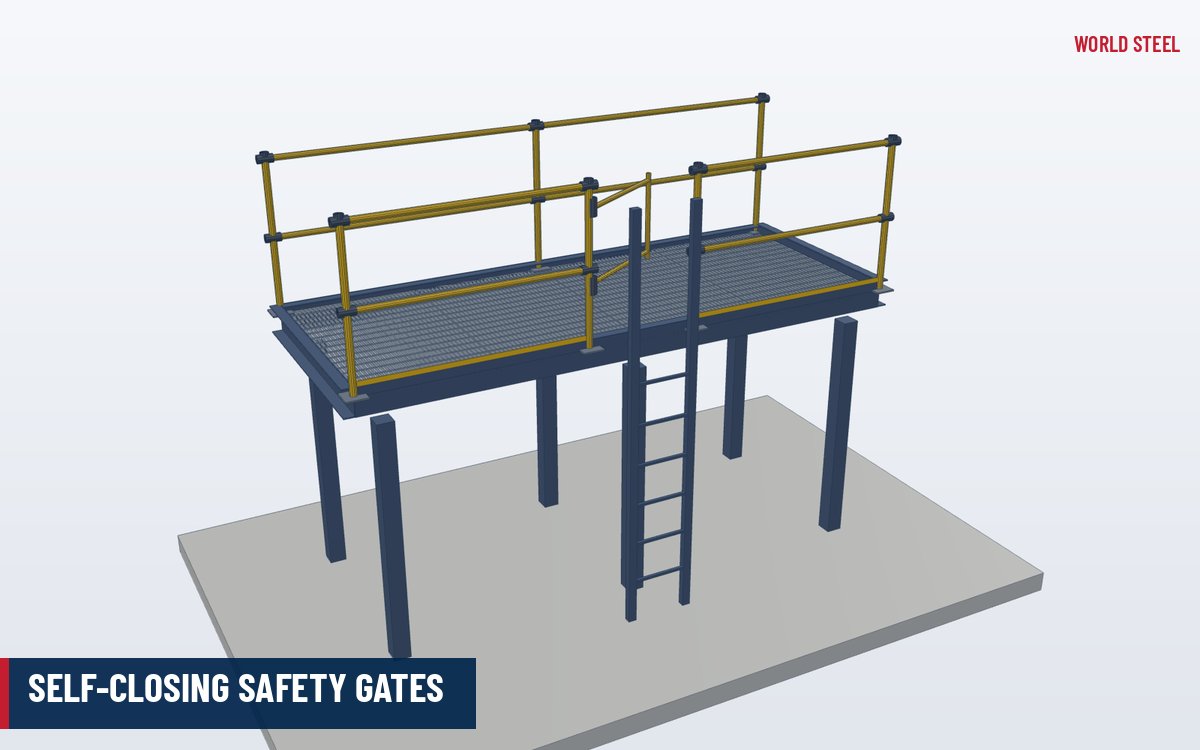
Stiles are typically flat bar or channel; rungs are solid round or square bar with a serrated or knurled top for grip. The top of the ladder is finished with extended stiles or grab handles and a self-closing gate in the platform guardrail.
Design and compliance
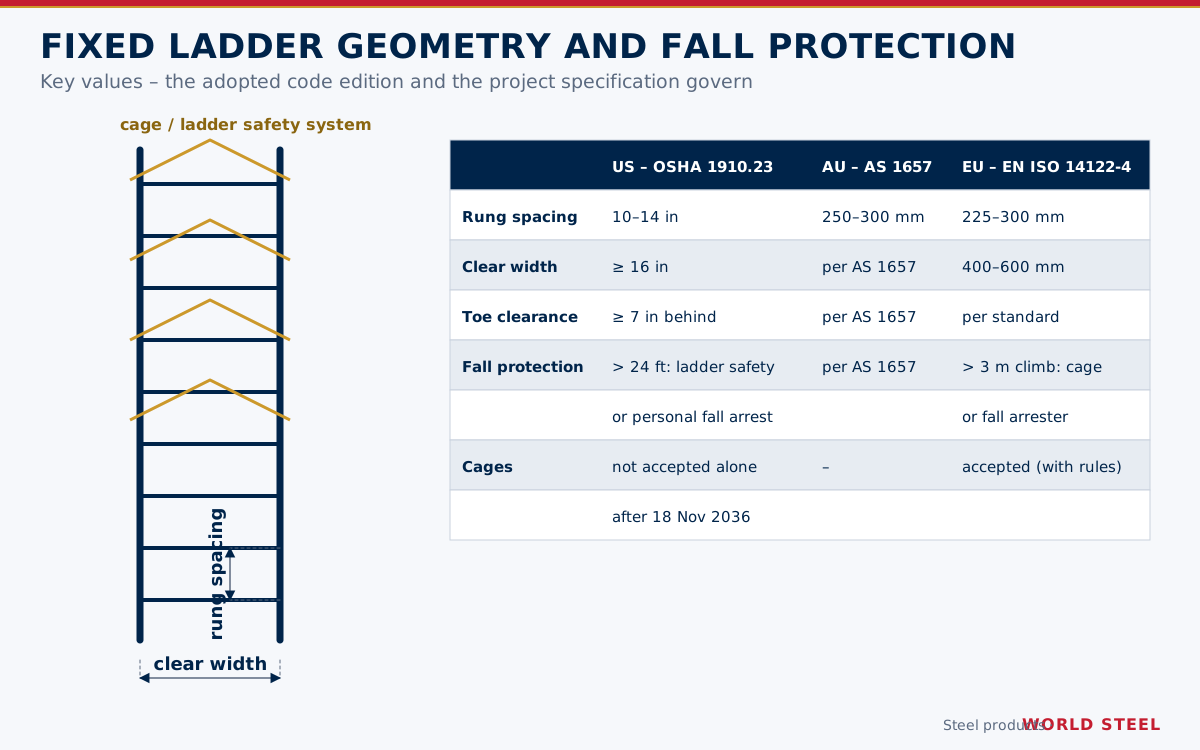
United States. OSHA 29 CFR 1910.23 requires rungs spaced 10–14 in (255–355 mm) apart and uniform, a clear width between side rails of at least 16 in (405 mm), at least 7 in (180 mm) clearance behind the ladder, side rails that extend at least 42 in (1,070 mm) above the access level, and a ladder that supports two loads of 250 lb. Under 1910.28(b)(9), fixed ladders extending more than 24 ft (7.3 m) need a personal fall arrest or ladder safety system; such ladders installed on or after 19 November 2018 must have one, and cages and wells are no longer accepted as fall protection after 18 November 2036. For new tall ladders in US facilities, World Steel therefore recommends brackets for a ladder safety system rather than a cage alone.
Australia. AS 1657-2018 sets rung spacing at 250–300 mm and covers ladder angle, width, cages, fall-arrest devices and landings; the designer selects the fall-protection method under the WHS risk-management process. See Australian standards.
Europe. EN ISO 14122-4 requires uniform rung spacing of 225–300 mm, a clear width between stiles of 400–600 mm and fall protection – a safety cage or fall arrester – where the climbing height exceeds 3 m. It applies to machinery under the Machinery Directive 2006/42/EC, replaced by the Machinery Regulation (EU) 2023/1230 from January 2027. See European standards.
Ladder safety systems (rails, cables and arresters) are proprietary tested products. World Steel fabricates the ladder and mounting brackets to the system supplier's details; the system itself is supplied and installed per its manufacturer's instructions.
Fabrication and finishing at World Steel
Rung holes are CNC drilled or punched in the stiles so spacing is exact, and rungs are inserted and welded all round to AWS D1.1, AS/NZS 1554.1 or EN ISO 3834-2 procedures. Cage hoops are rolled to a constant radius and welded to the vertical straps on jigs. Ladders are made in transportable lengths with bolted splice plates, and every item is marked to the erection drawing.
The standard finish is hot-dip galvanizing by qualified galvanizers to ASTM A123, AS/NZS 4680 or EN ISO 1461, with vent holes designed into the stiles and hoops; a duplex safety-yellow topcoat is available. Cages and ladders are nested in frames to avoid distortion during container shipping.
Installation and specifying
- Fix brackets at the spacing shown on the shop drawings; check plumb and the clearance behind the rungs.
- Install the ladder safety system and test it according to the supplier's instructions before use.
- Confirm the top exit and self-closing gate align with the platform guardrail.
- Specify the code, climb height, fall-protection method, supporting structure and finish.
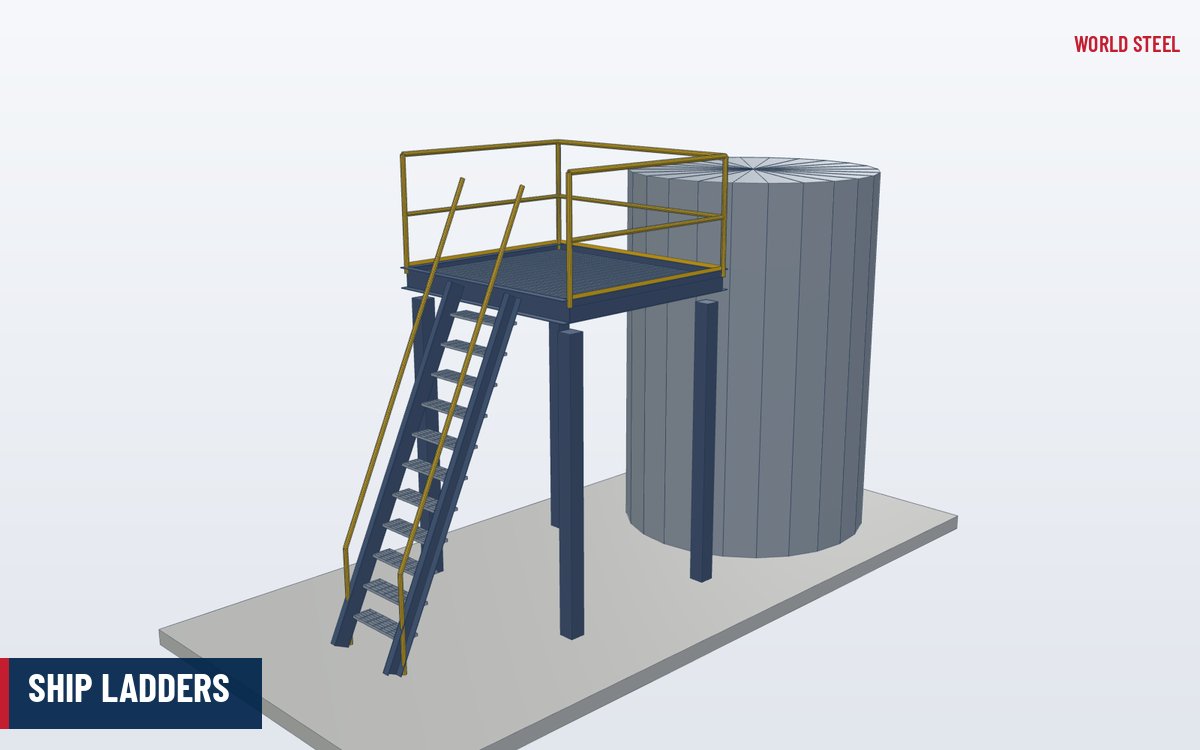
Where the climb is frequent or tools must be carried, consider a ship ladder or a steel stair instead – they are safer and faster to use.
Norme e requisiti per mercato
I codici secondo cui World Steel progetta, fabbrica e documenta questo prodotto, con i principali requisiti geometrici e di carico in ciascun mercato.
 Stati Uniti
- OSHA 29 CFR 1910.23Ladders
- OSHA 29 CFR 1910.28Duty to have fall protection
- AWS D1.1Structural welding code – steel
- ASTM A123Zinc (hot-dip galvanized) coatings
- Rung spacing
- 10–14 in, uniform (OSHA 1910.23)
- Clear width
- ≥ 16 in between side rails (OSHA 1910.23)
- Clearance behind
- ≥ 7 in (OSHA 1910.23)
- Fall protection
- Ladder safety or fall arrest system above 24 ft (OSHA 1910.28(b)(9))
 Australia / NZ
- AS 1657-2018Fixed platforms, walkways, stairways and ladders
- AS 4100Steel structures
- AS/NZS 5131 Certificata WSCFabrication and erection of structural steelwork
- AS/NZS 1554.1Structural steel welding
- Rung spacing
- 250–300 mm (AS 1657)
- Fall protection
- Cage or fall-arrest per AS 1657 and WHS risk assessment
 Europa
- EN ISO 14122-4Fixed ladders
- EN ISO 14122-1Choice of fixed means of access
- EN 1090-2 Certificata WSCExecution of steel structures
- EN ISO 1461Hot-dip galvanized coatings
- Rung spacing
- 225–300 mm, uniform (EN ISO 14122-4)
- Clear width
- 400–600 mm between stiles (EN ISO 14122-4)
- Fall protection
- Cage or fall arrester above 3 m climb (EN ISO 14122-4)
Sintesi solo orientativa: prevalgono il capitolato di progetto, l'edizione del codice adottata e l'autorità competente.
Finiture
| Finitura | Norme / note |
|---|---|
| Hot-dip galvanized | ASTM A123 · AS/NZS 4680 · EN ISO 1461 |
| Duplex (HDG + safety-yellow topcoat) | ASTM A123 + topcoat · AS/NZS 2312.1 · EN ISO 12944 |
| Blast and paint (indoor) | SSPC-SP 10 · AS/NZS 2312.1 · EN ISO 12944 |
Domande frequenti
Are safety cages still allowed in the US?
Under OSHA 1910.28(b)(9), fixed ladders over 24 ft installed on or after 19 November 2018 need a ladder safety or personal fall arrest system, and cages and wells are not accepted as fall protection after 18 November 2036. Cages may still be fitted as a guide, but not as the fall-protection system on new tall ladders.
Do you supply the fall-arrest rail or cable?
We fabricate the ladder and the mounting brackets to the system supplier's details. The proprietary system is supplied and installed per its manufacturer's instructions, either by the client or through us by agreement.
When does a ladder need fall protection in Europe?
EN ISO 14122-4 requires a safety cage or fall arrester where the climbing height exceeds 3 m.
How are long ladders shipped?
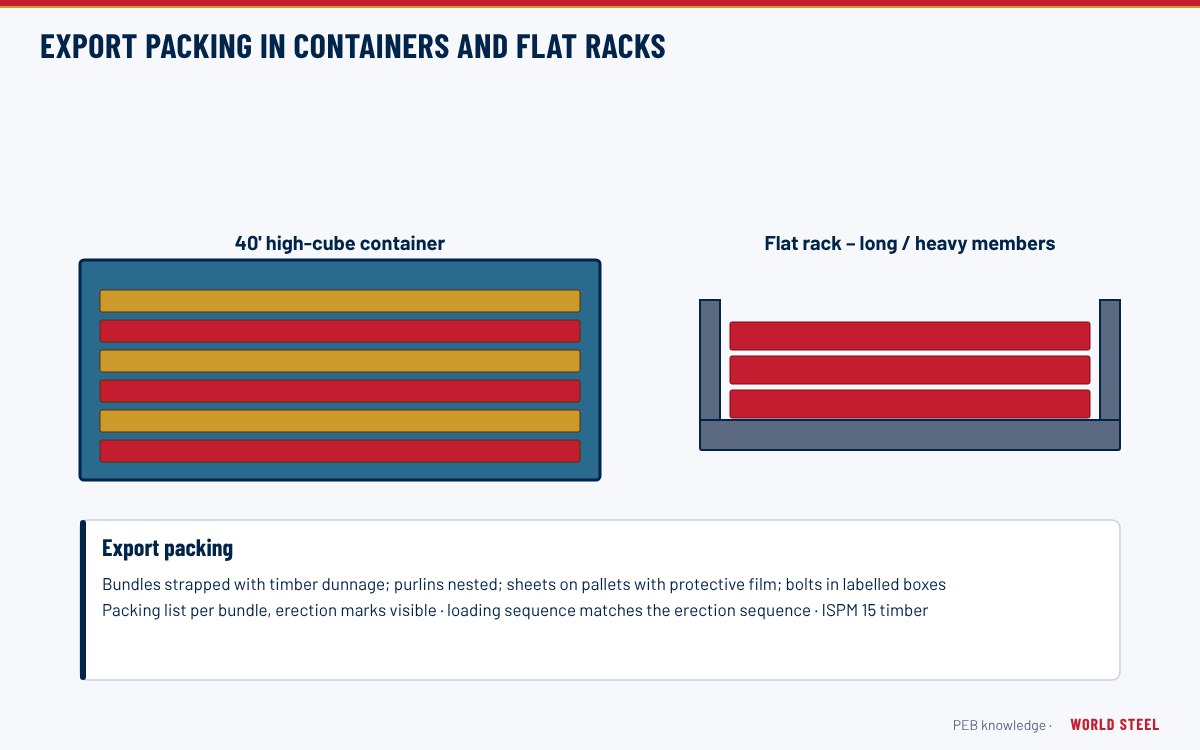
In bolted sections sized for 20 ft or 40 ft containers, with splice plates and marked parts so they assemble directly on site.
 Netherlands
 AS/NZS 5131 CC3
 EN 1090 EXC3 · CE