ENEnglish
 VITiếng Việt
 ZH中文
 KO한국어
 JA日本語
 FRFrançais
 ITItaliano
 PTPortuguês
 ESEspañol
 HEעברית
 ARالعربية

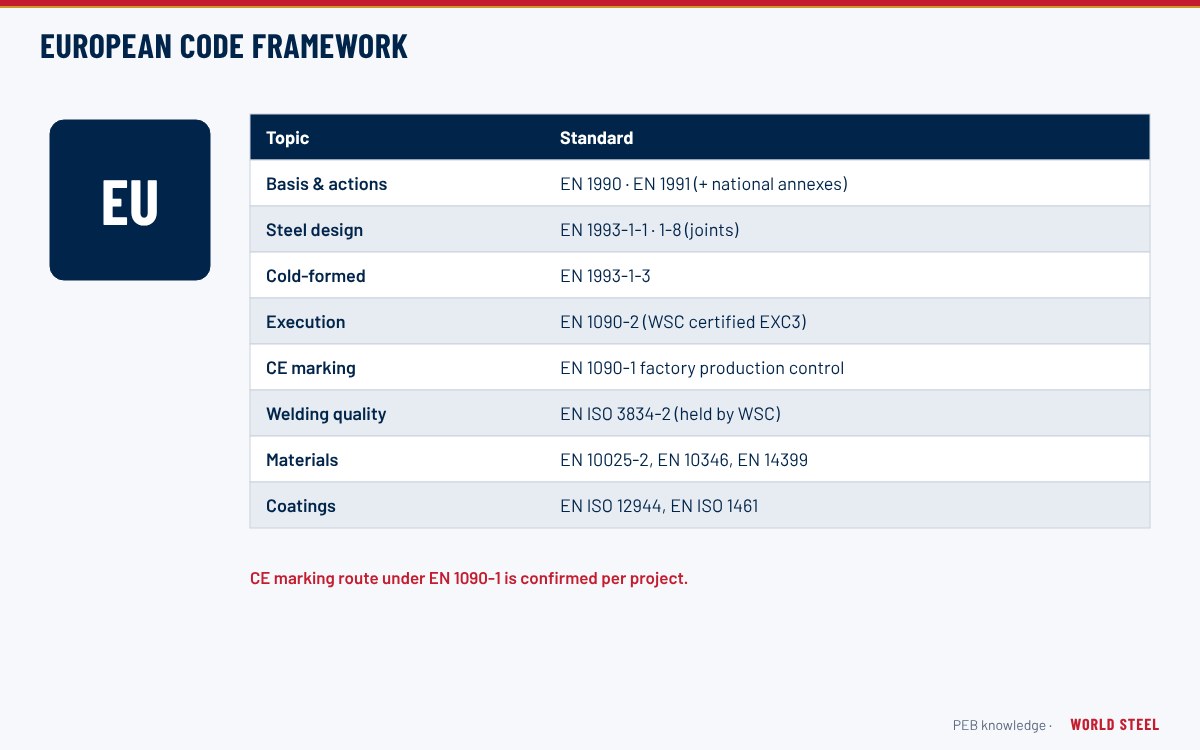
The European framework
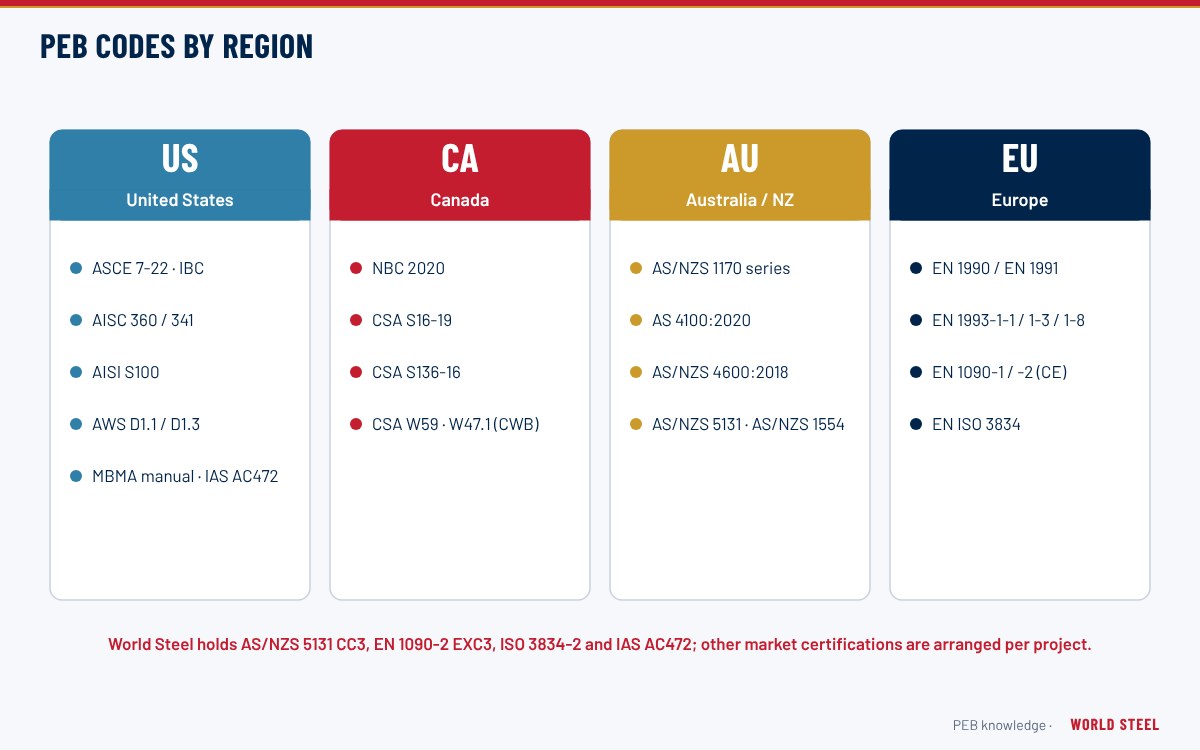
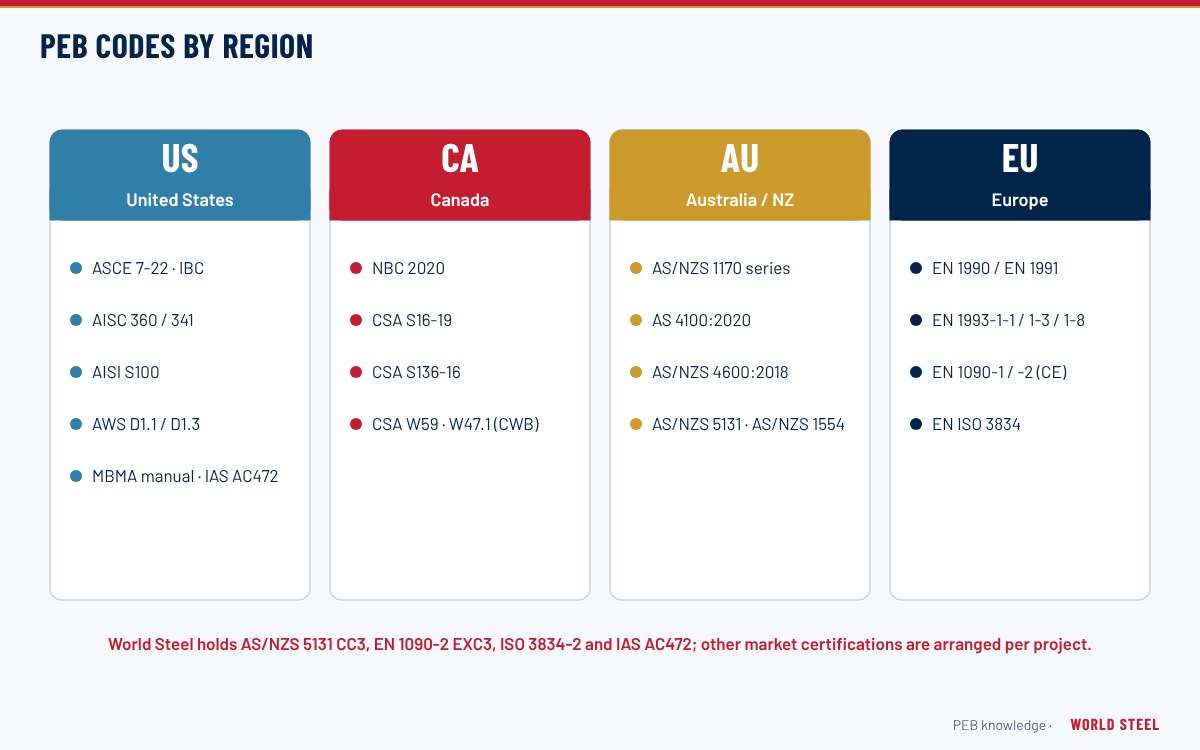
In the European Union and the wider European Economic Area, structural design follows the Eurocodes, each applied with a National Annex that sets nationally determined parameters such as partial factors, wind and snow maps. Building approval remains national, but structural steel components are construction products, so their placing on the market is governed by the Construction Products Regulation (CPR). For fabricated steelwork this means CE marking under EN 1090-1, supported by execution to EN 1090-2 (steel) and EN 1090-4 (cold-formed elements for roof, ceiling, floor and wall applications).
The framework is in transition: the revised CPR, Regulation (EU) 2024/3110, entered into force in January 2025 and applies progressively as harmonised standards are updated, and the second generation of Eurocodes is due to be implemented nationally by 2027–2028.
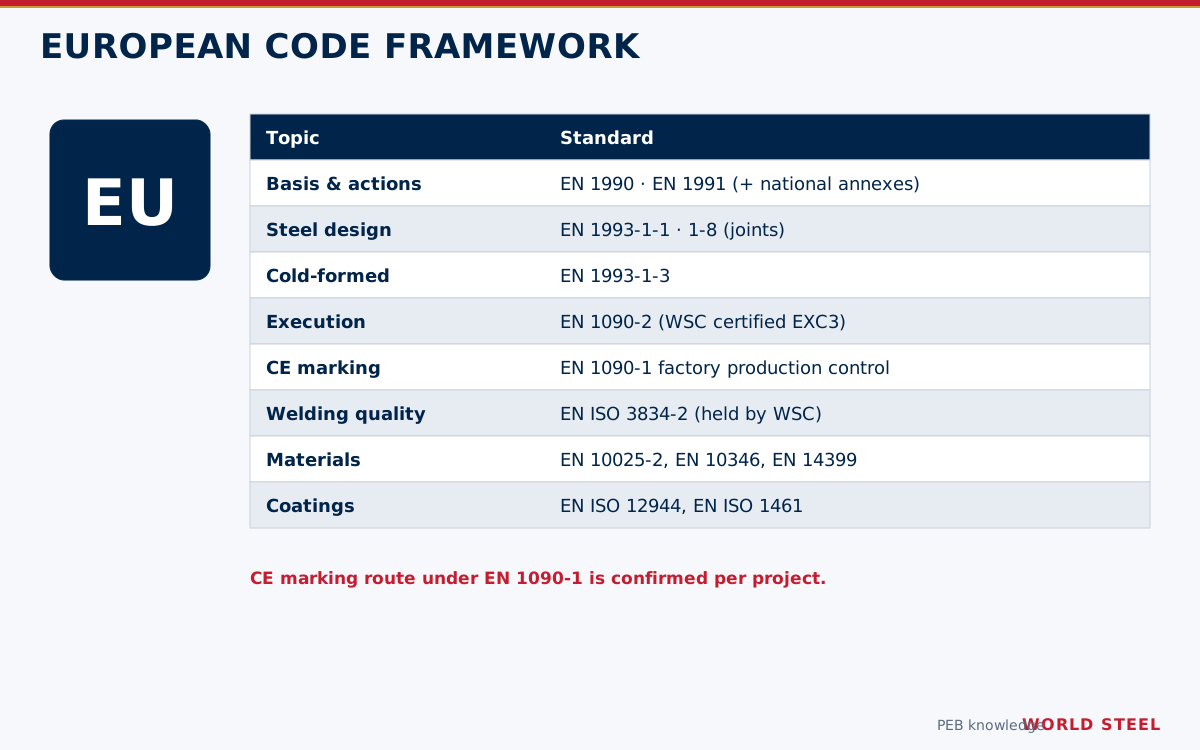
Code mapping
| Topic | Standard | Notes |
|---|---|---|
| Basis of design | EN 1990 | Load combinations, consequence and reliability classes |
| Loads | EN 1991-1-1, -1-3, -1-4; EN 1998-1 | Imposed, snow, wind and seismic actions, with National Annexes |
| Steel design | EN 1993-1-1, EN 1993-1-5, EN 1993-1-8 | Members, slender plated webs of tapered sections, joints |
| Cold-formed design | EN 1993-1-3 | Purlins, girts and sheeting |
| Welding | EN ISO 3834, EN ISO 14731, EN ISO 9606-1, EN ISO 15614-1, EN ISO 5817 | Quality system, welding coordination, welder and procedure qualification |
| Execution | EN 1090-2; EN 1090-4 | Execution classes EXC1–EXC4 |
| Conformity / CE marking | EN 1090-1 under the CPR | Factory production control certified by a notified body; Declaration of Performance |
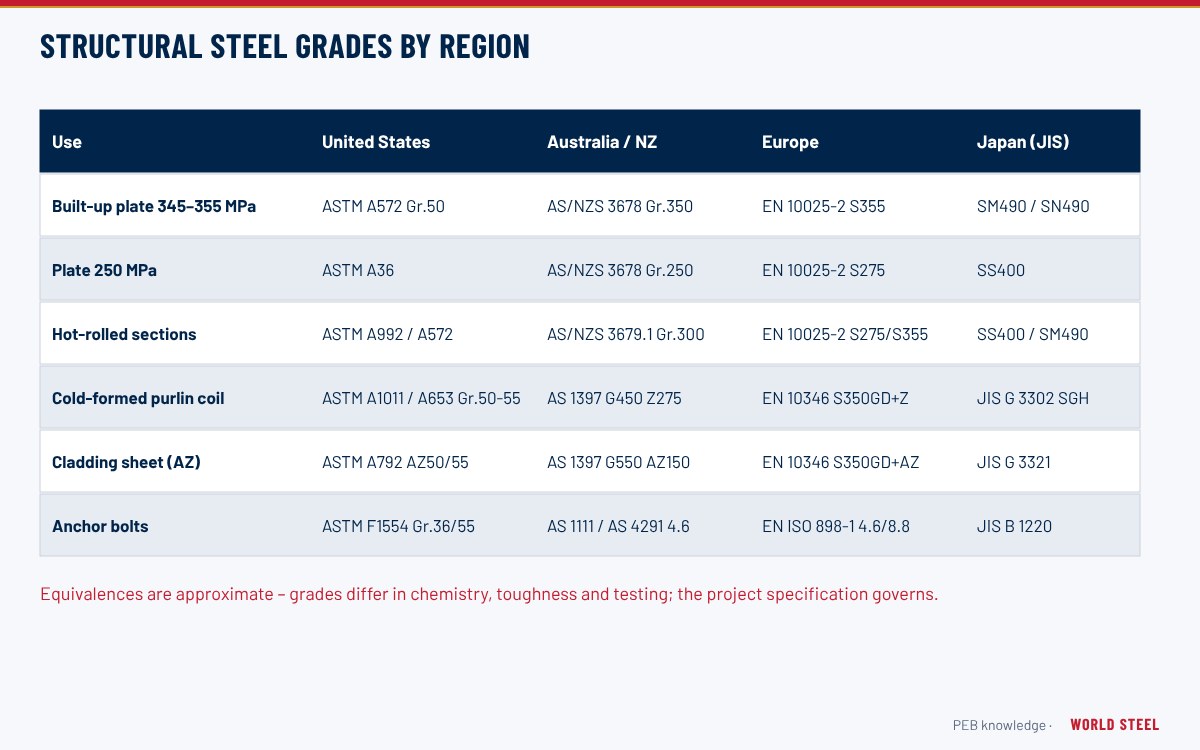
| Materials | EN 10025-2, EN 10346, EN 14399, EN 15048 | Plate and sections, coated strip, preloaded and non-preloaded bolts |
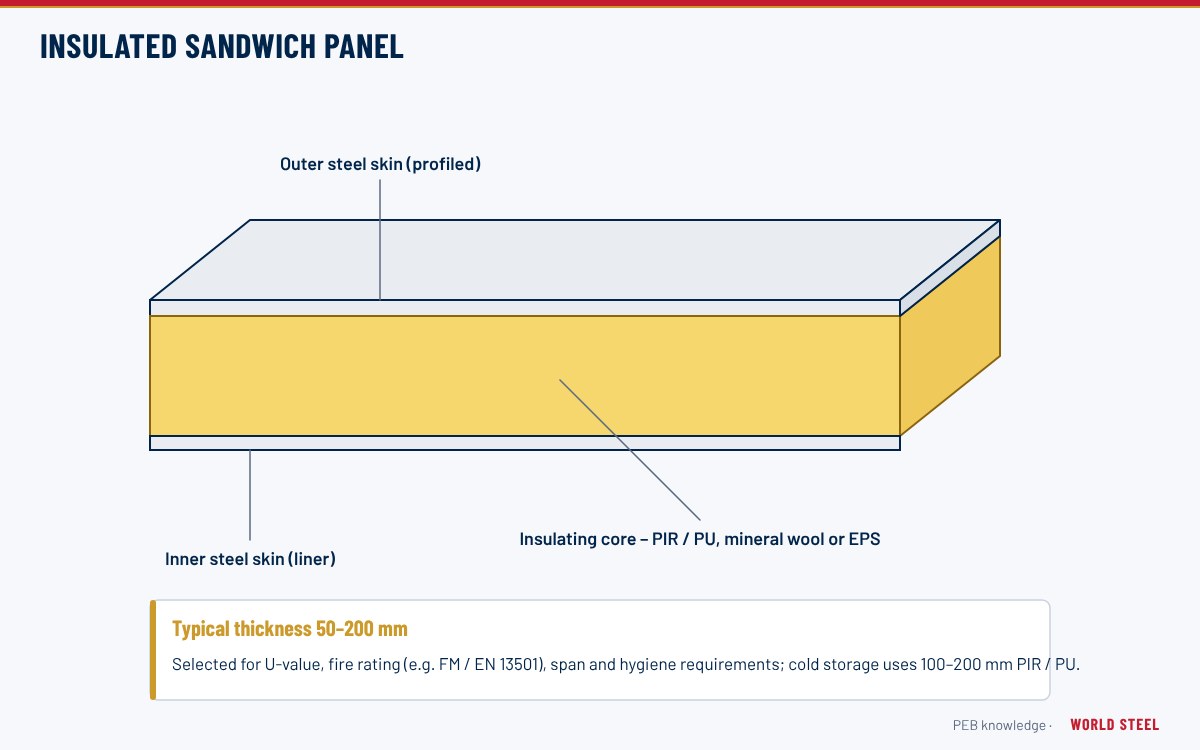
| Cladding products | EN 14782; EN 14509 | Self-supporting metal sheet; sandwich panels |
| Corrosion protection | EN ISO 12944, EN ISO 1461, ISO 8501-1 | Paint systems, hot-dip galvanizing, surface preparation |
Execution classes and CE marking
EN 1090-2 defines four execution classes, EXC1 to EXC4, which set increasingly strict requirements for welding coordination, inspection, traceability and tolerances. The designer selects the class, normally using the guidance in the Eurocodes based on consequence class and type of loading. Most single-storey industrial buildings are EXC2; EXC3 is used for higher consequence classes and for structures with significant fatigue or seismic demands.
To CE-mark fabricated components, the manufacturer must operate a factory production control (FPC) system that is assessed and certified by a notified body under EN 1090-1, appoint qualified welding coordination personnel, and issue a Declaration of Performance for each product. Without this certification, components cannot legally be CE-marked for the EU market.
| Consequence class (EN 1990) | Typical buildings | Usual execution class |
|---|---|---|
| CC1 – low consequence | Agricultural buildings not normally entered, storage sheds | EXC1 (EXC2 for welded seismic or fatigue-loaded parts) |
| CC2 – medium consequence | Most warehouses, factories, offices, single-storey commercial | EXC2 |
| CC3 – high consequence | Grandstands, large public halls, buildings with high occupancy | EXC3 |
| Special structures | Structures with extreme consequences of failure | EXC4, by project specification |
Consequence class also enters the design through the reliability (KFI) factor on actions in some National Annexes. Because a fabricator certified to a higher class may execute any lower class, a plant working to EXC3 can supply the EXC2 components typical of industrial PEBs.
Other European considerations
- United Kingdom. Great Britain uses BS EN Eurocodes with UK National Annexes and the UKCA mark for construction products. CE marking continues to be recognised in Great Britain for most construction products beyond the earlier June 2025 deadline, with any change to be announced with at least two years' notice. Northern Ireland follows EU rules.
- Non-EU EEA and neighbours. Norway applies the CPR through the EEA Agreement; Switzerland uses its own SIA standards, which are closely aligned with the Eurocodes.
- Carbon border adjustment. Fabricated steel structures under HS 7308 fall within the scope of the EU Carbon Border Adjustment Mechanism (CBAM), whose definitive period began in January 2026. Importers must account for embedded emissions, so suppliers should be ready to provide emissions data.
- Energy and fire. National energy regulations and EN 13501 fire classifications strongly affect cladding and insulation choices; see insulated sandwich panels.
World Steel in European markets
World Steel Construction holds EN 1090-2 Execution Class EXC3 and ISO 3834-2 certification and designs to the Eurocodes with the relevant National Annexes. WSC does not currently hold CE marking certification under EN 1090-1 factory production control; for EU projects that require CE-marked components, the route must be arranged or confirmed for that project. See the global overview, Australian and New Zealand standards for comparison, and market compliance and certification.
תקנים לפי אזור
| אזור | תקן | היקף |
|---|---|---|
 Europe |
EN 1990 / EN 1991 | Basis of design; actions on structures |
| Europe |
EN 1993-1-1 / -1-3 / -1-5 / -1-8 | Steel design – general, cold-formed, plated elements, joints |
| Europe |
EN 1998-1 | Design for earthquake resistance |
| Europe |
EN 1090-1 / -2 / -4 | Conformity assessment and execution of steel structures |
| Europe |
EN 10025-2 / EN 10346 | Hot-rolled structural steel; continuously hot-dip coated strip |
| International | EN ISO 3834-2 | Comprehensive quality requirements for fusion welding |
| International | EN ISO 12944 | Corrosion protection by protective paint systems |
שאלות נפוצות
What execution class is required for a PEB in Europe?
Usually EXC2 for single-storey industrial and commercial buildings. The designer may specify EXC3 for higher consequence classes or for parts with fatigue or significant seismic demands.
Is EN 1090-2 certification the same as CE marking?
No. EN 1090-2 sets the technical execution requirements. CE marking requires a factory production control system certified by a notified body under EN 1090-1 and a Declaration of Performance.
Does the UK still accept CE-marked steelwork?
Great Britain continues to recognise CE marking for most construction products beyond June 2025, alongside UKCA, with at least two years' notice of any change. Requirements should be checked at the time of the project.
 Germany
 Netherlands
 Poland
 Belgium
 Ireland
 Sweden
 Norway
 EN 1090 EXC3 · CE