ENEnglish
 KO한국어
 FRFrançais
 ITItaliano
 PTPortuguês
 ESEspañol
 HEעברית
 ARالعربية

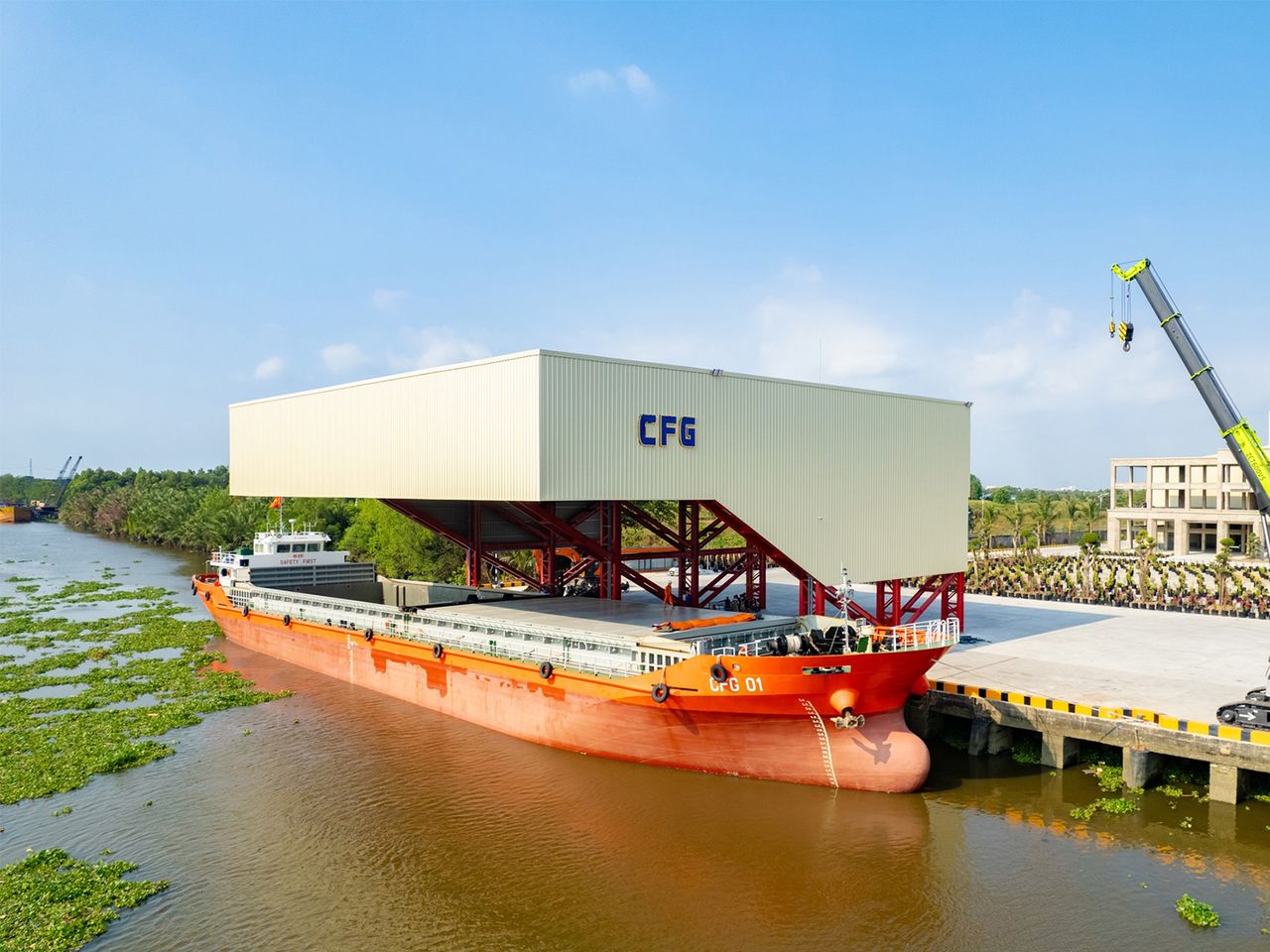
 Tay Ninh Province, Vietnam
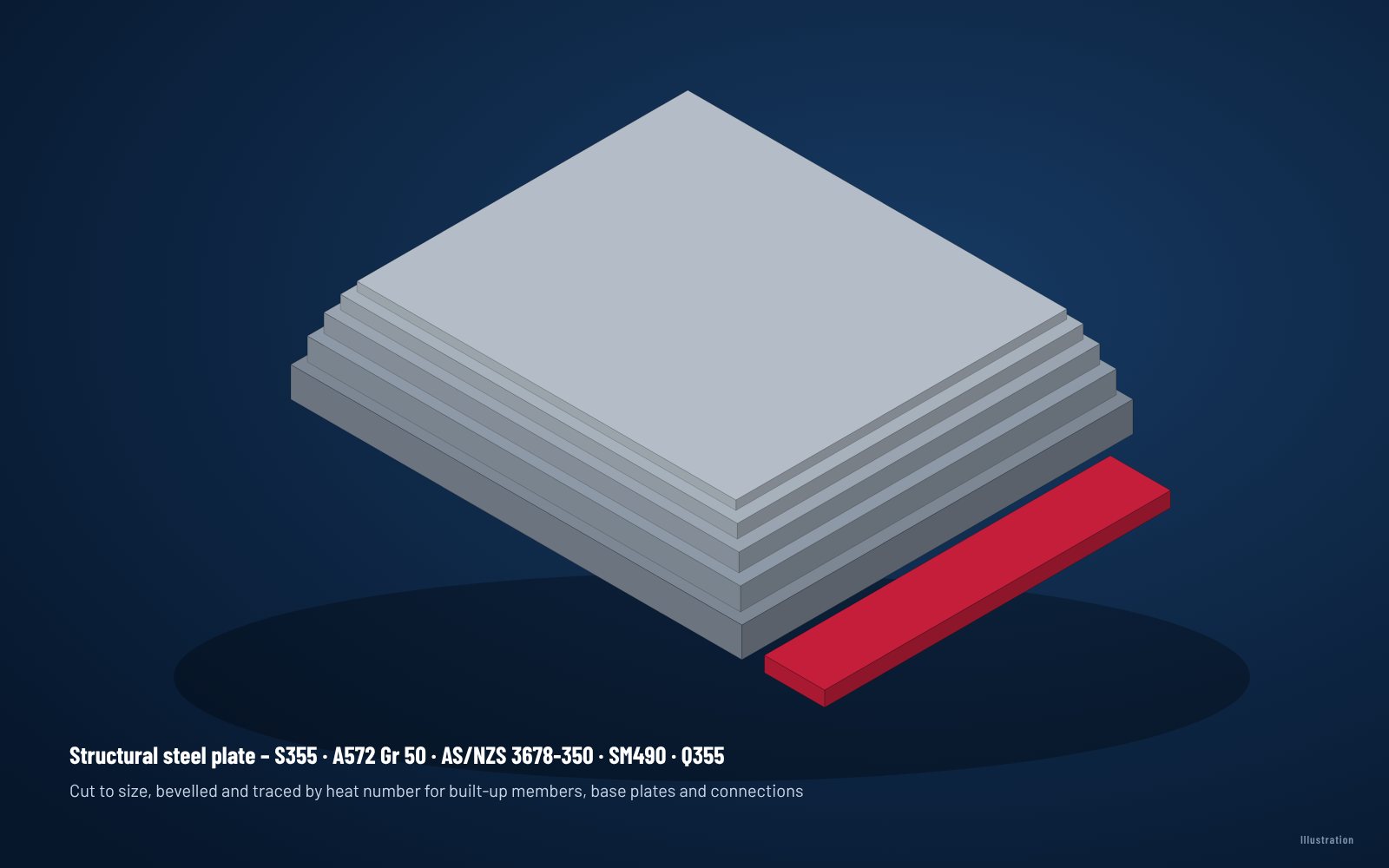
Structural steel · Plate
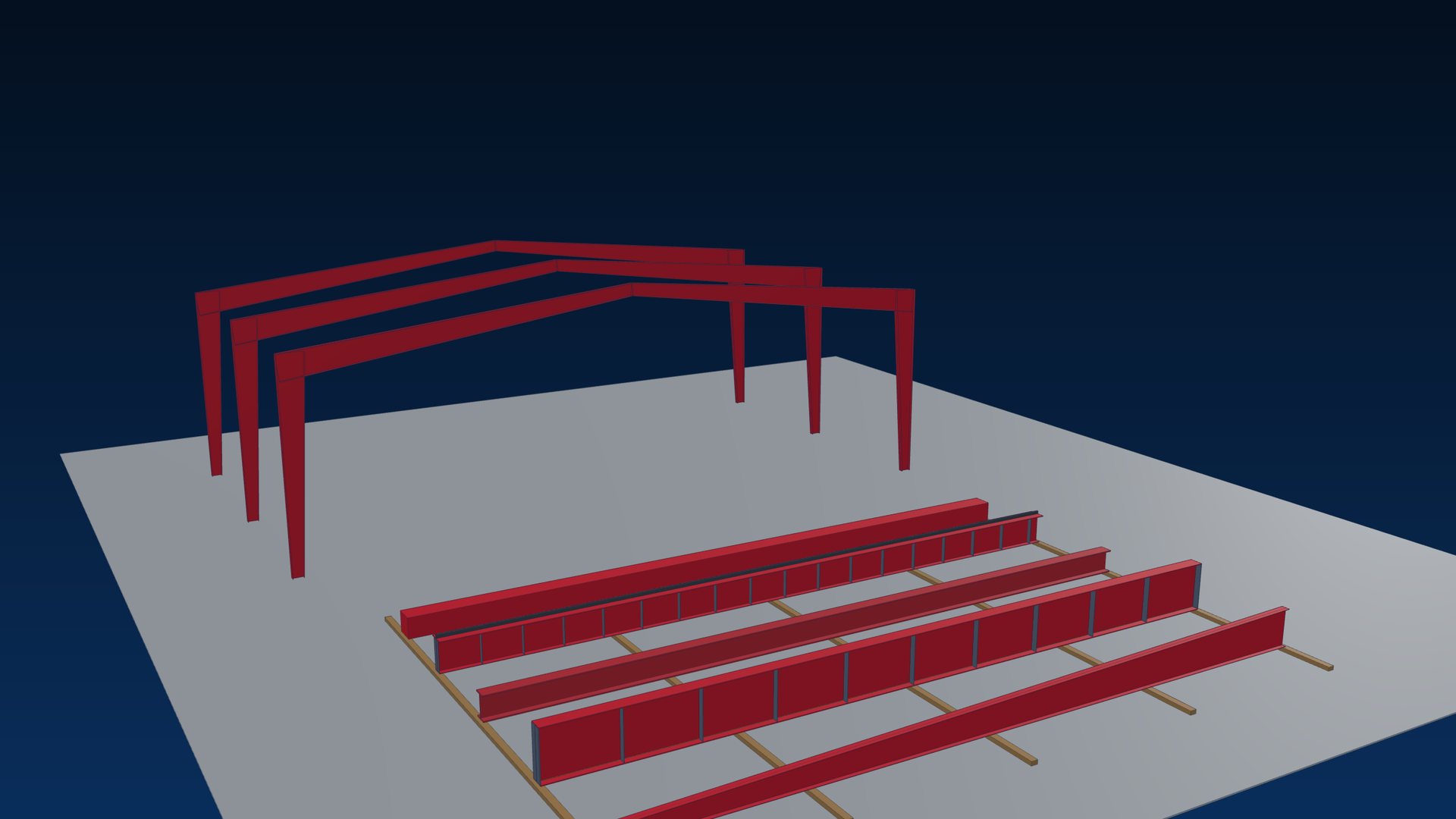
Plate is the raw material of every built-up member – plate girders, tapered portal frames, box columns, crane girders – and of base plates, gussets and connections. World Steel sources mill-certified plate to the standard your project specifies: ASTM, AS/NZS, EN, JIS or GB.
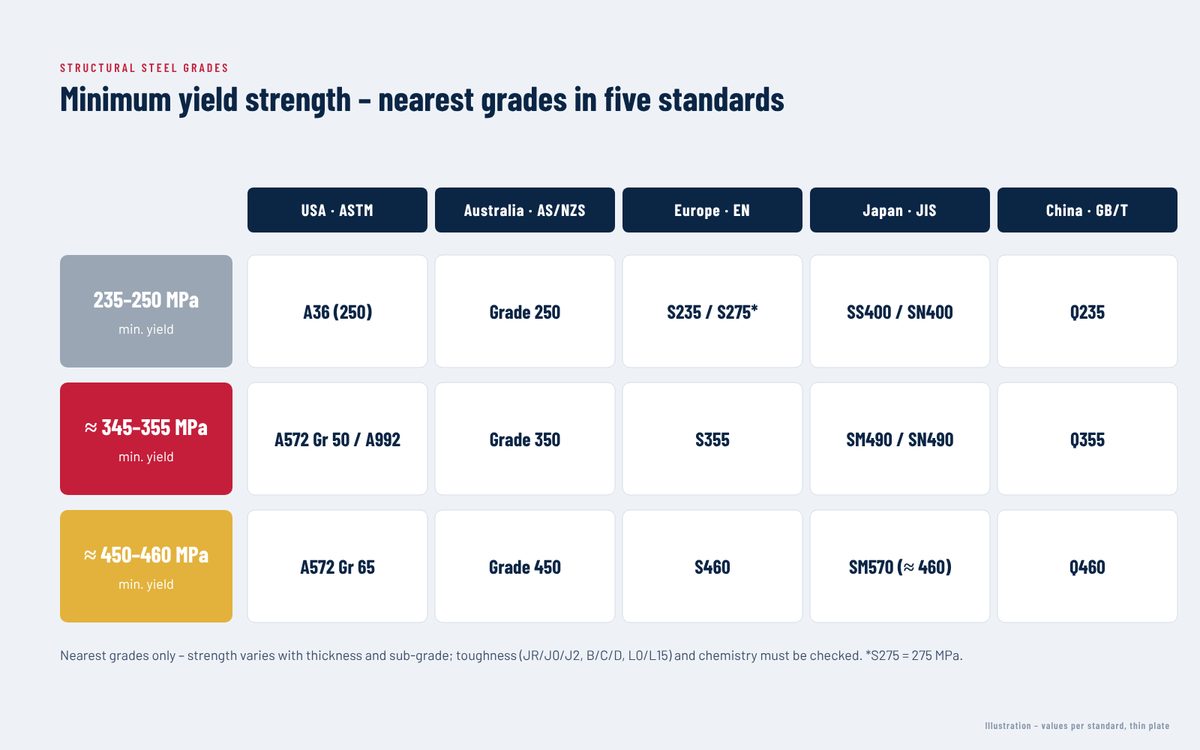
A plate grade fixes four things: strength (minimum yield and tensile strength, which fall slightly as thickness increases), toughness (Charpy impact energy at a test temperature – the sub-grade such as J2, L0 or C), weldability (carbon equivalent) and, for thick plates in welded joints, through-thickness properties (Z-grades) that resist lamellar tearing.
Most steel structures use a ≈ 350 MPa grade – S355, A572 Gr 50, Grade 350, SM490 or Q355 – for main members and a ≈ 250 MPa grade for secondary plates. Higher strengths save weight on heavy members; weathering grades avoid painting in suitable climates.
Tiêu chuẩn & tuân thủ
Product standards for structural plate in our export markets.
 United States
 Australia & New Zealand
 Europe
 Japan
 China
Nội dung chỉ mang tính tham khảo – chỉ dẫn kỹ thuật của dự án, phiên bản quy chuẩn được áp dụng và cơ quan có thẩm quyền là căn cứ quyết định.
Built-up members
Plates are cut by CNC plasma or oxy-fuel, bevelled and welded on automatic H-beam lines into flanges and webs sized to the forces – deeper where bending is high, thinner where it is not. Read the full comparison of built-up and hot-rolled members, the grade equivalents across standards and our hot-rolled UB, UC and PFC sections.
By standard
Minimum yield strength for thin plate (it reduces with thickness). Always check the full standard and the sub-grade.
| Grade | Min. yield | Use |
|---|---|---|
| ASTM A36 | 250 MPa (36 ksi) | General structural plate, base plates, connections |
| ASTM A572 Gr 50 | 345 MPa (50 ksi) | High-strength low-alloy – main members, plate girders |
| ASTM A588 Gr A | 345 MPa | Weathering steel |
| ASTM A709 Gr 50 / 50W / HPS 70W | 345 / 345 / 485 MPa | Bridges, with toughness zones |
| ASTM A514 | 690 MPa | Quenched & tempered – heavy lifting and special structures |
| ASTM A516 Gr 70 | 260 MPa | Pressure vessels and tanks |
| Grade | Min. yield | Use |
|---|---|---|
| AS/NZS 3678 Grade 250 | 250 MPa (higher for thin plate) | General structural plate |
| AS/NZS 3678 Grade 300 / 350 | 300 / 350 MPa | Main members; L0 / L15 for impact tested |
| AS/NZS 3678 Grade 400 / 450 | 400 / 450 MPa | Higher-strength members |
| AS/NZS 3678 WR350 | 350 MPa | Weathering steel |
| AS 1548 PT460 / PT490 | by thickness | Pressure equipment |
| Grade | Min. yield | Use |
|---|---|---|
| EN 10025-2 S235JR · S275JR/J0 | 235 / 275 MPa | Secondary plates and members |
| EN 10025-2 S355JR/J0/J2/K2 | 355 MPa | The standard grade for main members |
| EN 10025-3/-4 S355N/M · S420M · S460N/M | 355 – 460 MPa | Normalised / thermomechanical – thick plate, low temperature |
| EN 10025-5 S355J2W | 355 MPa | Weathering steel |
| EN 10025-6 S690Q/QL | 690 MPa | Quenched & tempered |
| EN 10164 Z15 / Z25 / Z35 | — | Through-thickness quality for welded joints |
| Grade | Min. yield | Use |
|---|---|---|
| JIS G3101 SS400 | 245 MPa | General structural |
| JIS G3106 SM400 / SM490 / SM520 / SM570 | 245 / 325 / 365 / 460 MPa | Welded structures; A/B/C toughness |
| JIS G3136 SN400B/C · SN490B/C | 235 / 325 MPa | Building structures – C with through-thickness requirements |
| JIS G3114 SMA400 / SMA490 | 245 / 365 MPa | Weathering steel |
| Grade | Min. yield | Use |
|---|---|---|
| GB/T 700 Q235B | 235 MPa | General structural |
| GB/T 1591 Q355B/C/D | 355 MPa | Main grade since 2018 (replaced Q345) |
| GB/T 1591 Q390 / Q420 / Q460 | 390 / 420 / 460 MPa | High-strength members |
| GB/T 19879 Q345GJ / Q390GJ | 345 / 390 MPa | Plates for building structures |
| GB/T 4171 Q355NH | 355 MPa | Weathering steel |
FAQ
A ≈ 350 MPa grade: S355 in Europe, A572 Gr 50 in the USA, Grade 350 in Australia, SM490 in Japan and Q355 in China.
Charpy impact test temperatures in EN 10025: 27 J at +20 °C (JR), 0 °C (J0) and −20 °C (J2). Australia uses L0 and L15, China B, C and D, Japan A, B and C.
For thick plates loaded through their thickness at welded joints – for example column flanges at beam connections – to resist lamellar tearing.
Grades, thicknesses and quantities – we source and fabricate to your standard.