 ENEnglish
 VITiếng Việt
 ZH中文
 KO한국어
 FRFrançais
 ITItaliano
 PTPortuguês
 ESEspañol
 HEעברית
 ARالعربية

 4 – 12 mm
Flat sheets
Interior and exterior walls, ceilings, soffits and wet areas.
Building materials · Boards & panels
Fibre cement board is cement and silica reinforced with cellulose fibres and cured under steam pressure – a strong, non-combustible board that does not rot, swell or attract termites. This page explains how it is made, where it is used, the leading manufacturers, its pros and cons and the certificates you need to export it to the United States, Australia, Europe and other high-end markets.
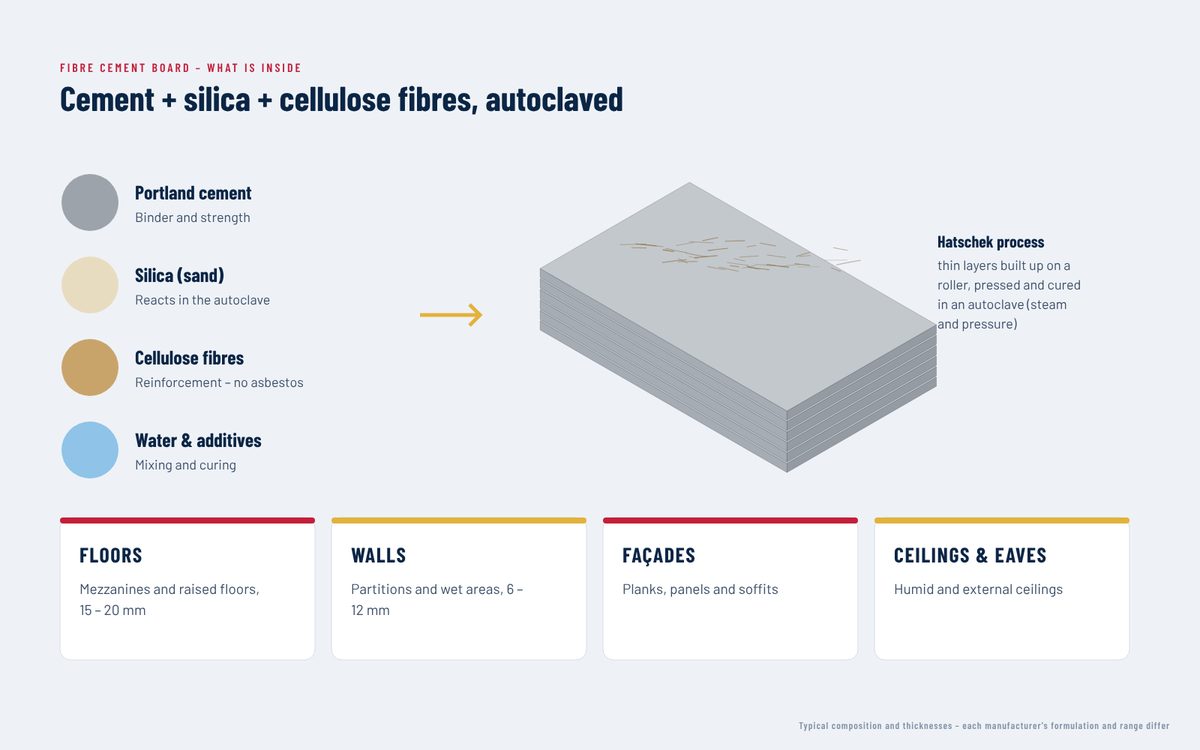
Fibre cement board – also called cement board, fiber cement sheet or, in Vietnam, tấm xi măng sợi and commonly "tấm Cemboard" – is made of Portland cement, finely ground silica sand and cellulose fibres, with water and additives. Thin layers are built up on a roller (the Hatschek process), pressed, and cured in an autoclave with high-pressure steam, which makes the cement and silica react into a stable, strong matrix.
The result is a board that behaves like a thin, tough stone: it does not burn, rot, swell in water or feed termites, it can be screwed to light steel or timber frames, and it takes paint, tiles and render. Modern fibre cement contains no asbestos – an absolute requirement in every quality market.
Product forms
Typical ranges – the World Steel fibre cement product pages will be published here.
4 – 12 mm
Interior and exterior walls, ceilings, soffits and wet areas.
 15 – 20 mm
Structural flooring on steel joists – mezzanines and modules.
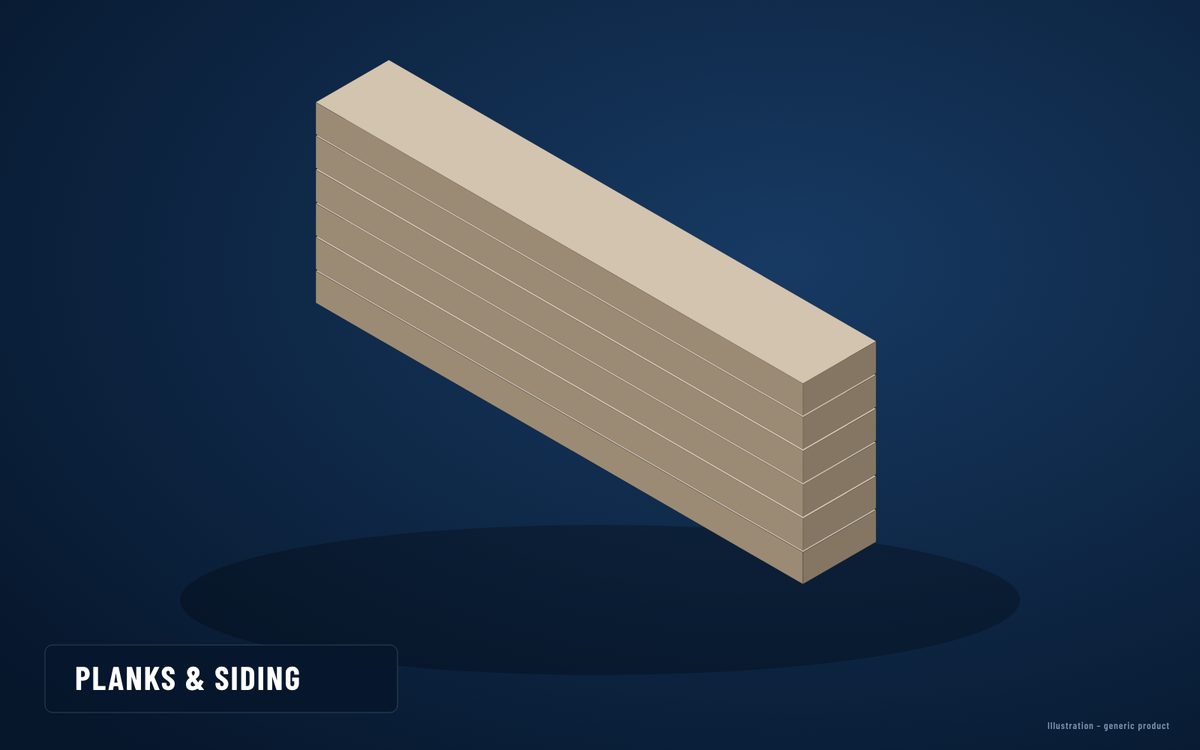 façade
Wood-grain or smooth lap siding and façade planks.
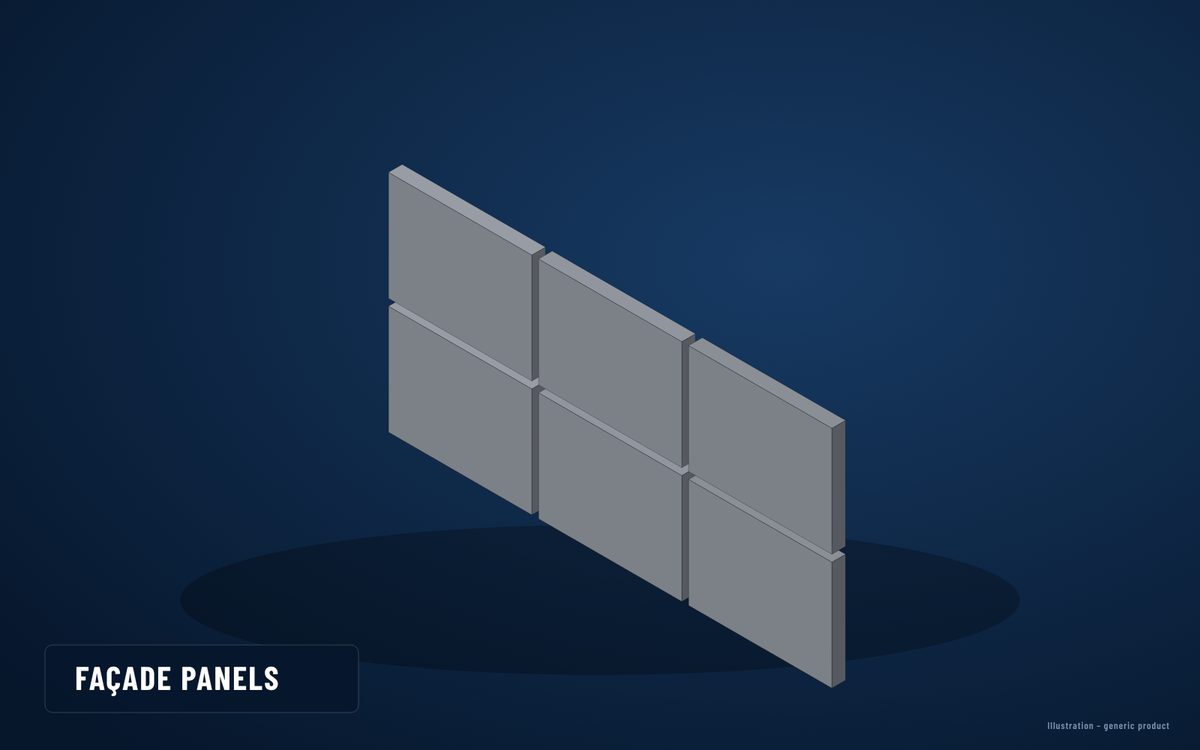 through-coloured
Large-format architectural panels on ventilated façades.
应用领域
15–20 mm boards on steel joists for mezzanines, raised floors and modular buildings.
Bathrooms, kitchens and laundries where gypsum board would suffer.
Planks, flat sheets and through-coloured panels for rain-screen façades.
Humid, exposed ceilings and canopies.
A stable substrate for wall and floor tiles.
Non-combustible linings and fire-rated systems where tested.
规范与合规
What buyers and authorities ask for in high-end markets – product standard, fire evidence, asbestos-free proof and code approvals.
 United States
 Australia & New Zealand
 Europe
 Japan & international
摘要仅供参考——以项目技术规格书、所采用的规范版本及主管机构要求为准。
Leading manufacturers
Some of the best-known producers – listed for information; World Steel supplies boards to the brand and standard your project specifies.
Australia / global
A world leader in fibre cement siding and backer boards, strong in North America and Australia.
Belgium
Architectural façade panels, flat sheets and lap siding across Europe.
Japan
Fibre cement wall panels and siding for Japan and North America.
Thailand
Fibre cement boards and planks widely used in Southeast Asia.
Thailand
Fibre cement boards, planks and decorative products.
Vietnam
Fibre cement boards produced and sold in Vietnam.
Denmark
Fibre cement sheets and façade panels for Northern Europe.
Trademarks belong to their owners. Listing a manufacturer does not imply a partnership with World Steel.
Fibre cement or gypsum?
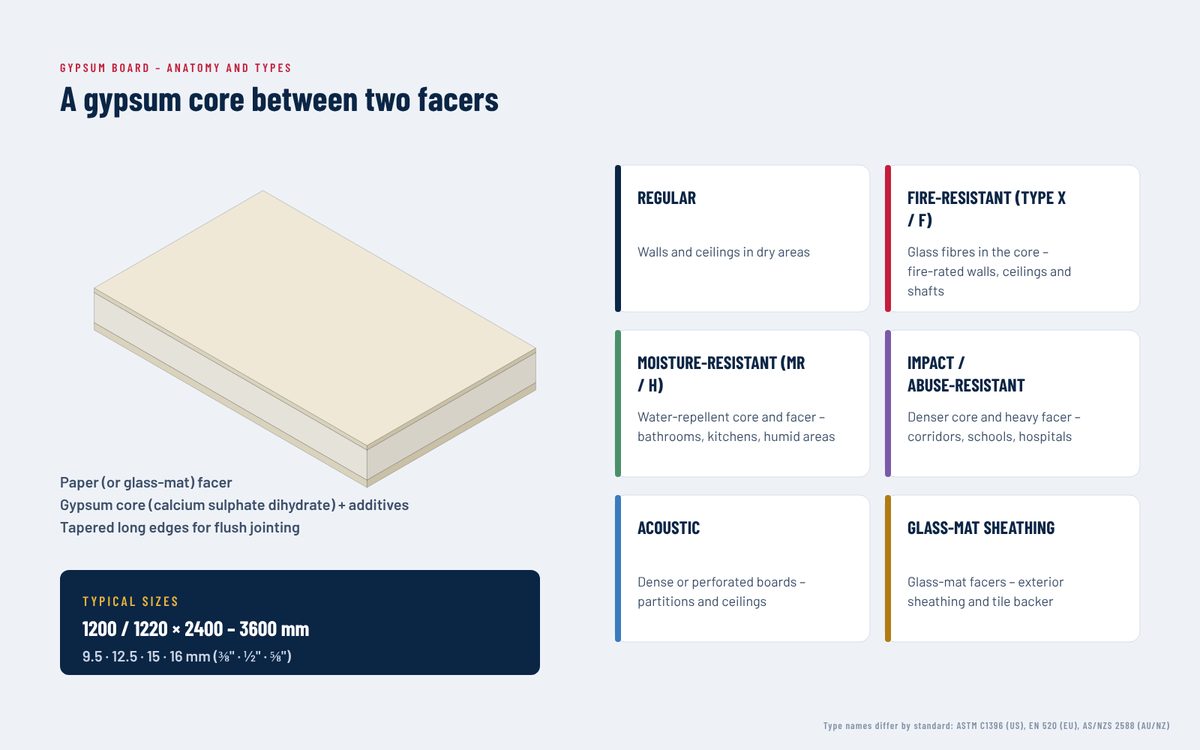
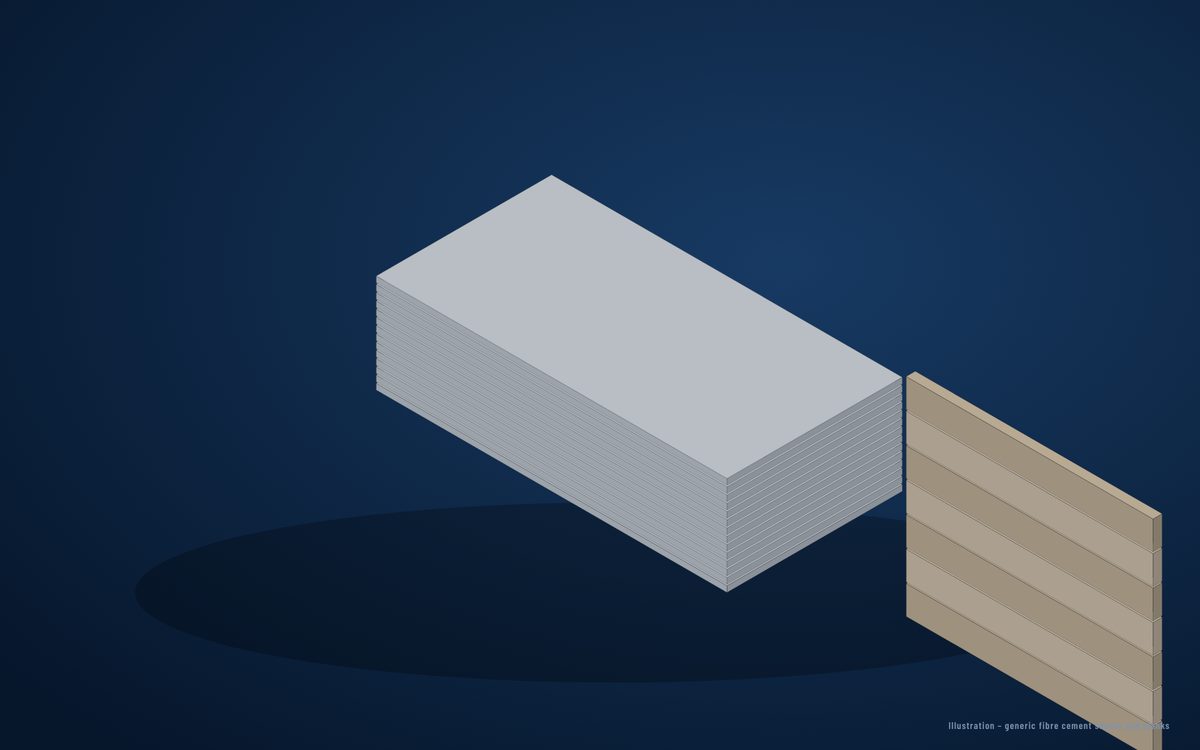
Inside dry rooms, gypsum board is lighter, cheaper and gives the smoothest finish. Where boards get wet, take impact, carry floor loads or face the weather, fibre cement is the durable choice. Many projects use both – gypsum in offices and rooms, fibre cement in wet areas, floors, soffits and façades.
World Steel · building envelope hub
World Steel supplies fibre cement boards with the steel structure, light steel framing, mezzanine joists and insulation – sized on the same model and shipped together. For modular homes and site buildings we use fibre cement floors and wet-area linings on factory-built steel frames.
Pros and cons
A durable board – with weight and workmanship to plan for.
| Advantage | Why it matters |
|---|---|
| Non-combustible | A1 / A2 reaction to fire – suitable for façades and escape routes where allowed |
| Water-resistant | Does not swell or lose strength in wet areas and outdoors |
| Rot- and termite-proof | No organic decay – ideal for tropical climates |
| Strong and impact-resistant | Floors, high-traffic walls and façades |
| Dimensionally stable | Far less movement than wood-based boards |
| Long life, low maintenance | Decades of service when detailed and painted correctly |
| Disadvantage | What to do |
|---|---|
| Heavy (≈ 1,200 – 1,500 kg/m³) | Design frames for the weight; plan lifting and handling |
| Silica dust when cutting | Score-and-snap or shears; dust-extracting saws and respiratory protection |
| Brittle edges and corners | Careful handling; fixings at the specified edge distances |
| Movement at joints | Follow the manufacturer's joint and fixing details |
| Low thermal insulation | Add mineral wool in the wall or façade cavity |
| Higher cost than gypsum board | Use it where water, impact or exposure require it |
FAQ
In Vietnam "Cemboard" is commonly used for fibre cement board – cement, silica and cellulose fibres cured under steam pressure. It is used for floors, walls, wet areas, soffits and façades.
Modern fibre cement uses cellulose fibres and must be asbestos-free. Australia applies zero tolerance and expects NATA-accredited test evidence for imports.
It does not swell or rot in water and is used in wet areas and outdoors, but joints, edges and the surface still need the specified sealing, paint or tiling system.
Compliance with ASTM C1186 (or C1288 for backer boards), fire test evidence such as ASTM E136 / E84 and, for siding and cladding, usually an ICC-ES evaluation report; hurricane zones may also require Florida or Miami-Dade approval.
CE marking under EN 12467 with a Declaration of Performance, the reaction-to-fire class to EN 13501-1 and REACH compliance.
Yes, with steel structures, modular homes and light steel framing – to the brand and standard your project specifies.
Send us the floor, wall and façade schedule and the export market – we quote boards with framing and steel and prepare the certificates your buyer needs.