建立信任,确保成功 客户门户 dang.victor@worldsteelgroup.com +84 902 881 833
World SteelBuilding trust, Assuring success

各市场标准

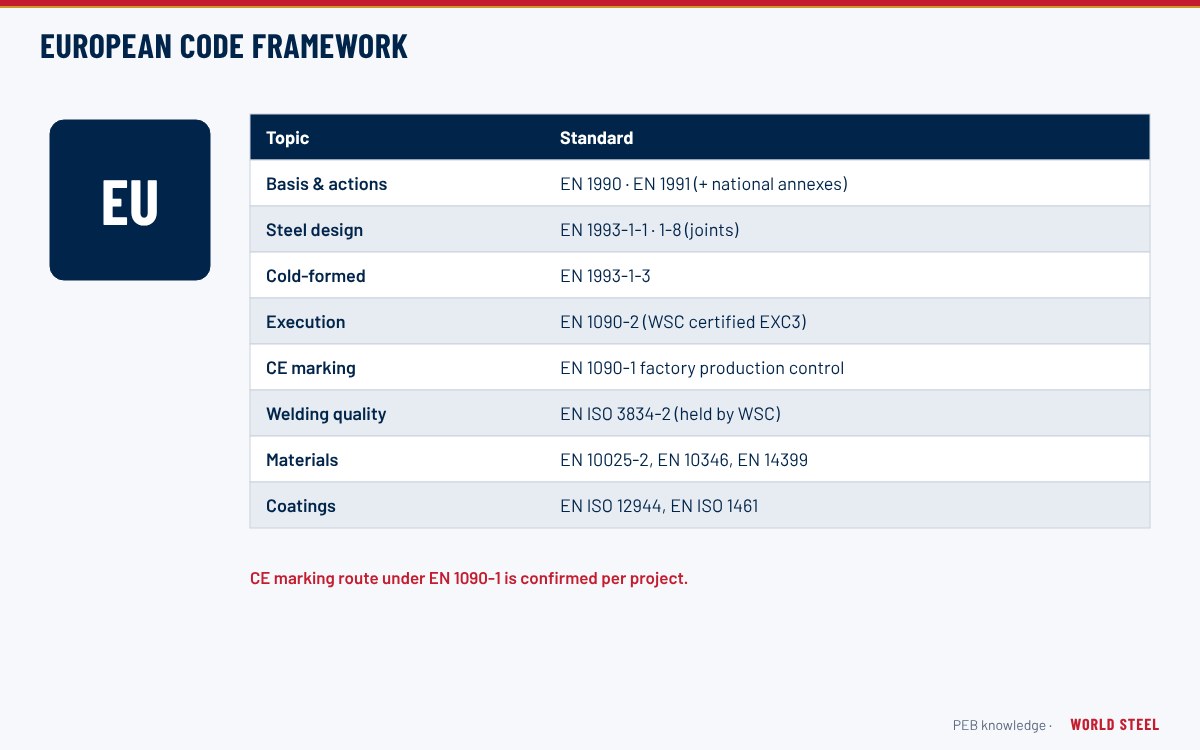
European standards for structural steel, PEB and steel products

CE marking under EN 1090-1, EN 1090-2 execution classes and the Eurocodes explained – and how World Steel supplies EXC3 steelwork with a DoP.

标准
56
WSC 已认证
3
认证
1
Europe
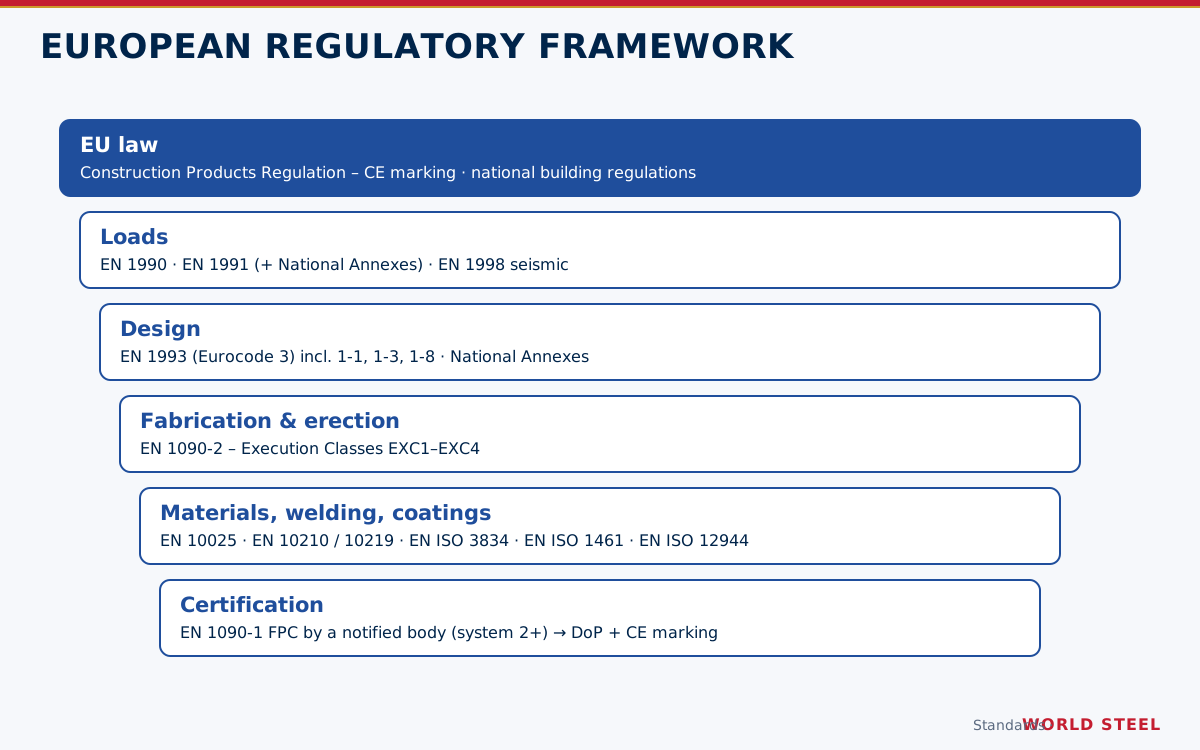
European regulatory hierarchy: Construction Products Regulation and national building regulations, then Eurocode actions with National Annexes, EN 1993 design, EN 1090-2 execution, EN 10025 materials, EN ISO 3834 welding, EN 14399 bolting, EN ISO 12944 and EN ISO 1461 coatings, and EN 1090-1 CE marking with a notified body FPC certificate
The European compliance framework: CE marking of the product under the CPR, and design and execution to the Eurocodes and EN 1090-2.

How the European system works

Europe regulates steel structures through two layers that work side by side. The first is the Construction Products Regulation (CPR), which governs how construction products are placed on the market across the European Economic Area. Fabricated structural steel components are covered by the harmonised standard EN 1090-1, so load-bearing steel components supplied to the EU must carry CE marking and be accompanied by a Declaration of Performance (DoP). The second layer is national building law: each country keeps its own building regulations and approval procedures, and decides how the structure as a whole is designed and checked.

Design is carried out to the Eurocodes – EN 1990 for the basis of design, EN 1991 for actions, EN 1993 for steel and EN 1998 for earthquake resistance – each applied together with the National Annex of the country where the structure is built. National Annexes set Nationally Determined Parameters such as partial factors, snow and wind maps and, in many countries, guidance on execution classes, so the same building can have different design inputs in Germany, Sweden or Spain. The second generation of Eurocodes is being published by CEN and will be introduced nationally over the coming years; the edition to use is set by each country.

Fabrication and erection follow EN 1090-2, which defines four execution classes, EXC1 to EXC4. The designer selects the execution class from the consequence class of the structure and the service and production conditions, and states it in the execution specification. The class drives almost every fabrication requirement: welding quality system, welder and procedure qualification, weld quality level, extent of NDT, traceability and tolerances.

The CPR itself is being replaced. The new Construction Products Regulation, Regulation (EU) 2024/3110, applies from 8 January 2026. During a transition period, harmonised standards adopted under the previous Regulation (EU) No 305/2011 – including EN 1090-1 – continue to be used for CE marking until new harmonised technical specifications are adopted for each product family. In practice, CE marking of steel components under EN 1090-1 with a DoP remains the route today, and World Steel follows the transition as new specifications are published.

CE marking under EN 1090-1 – World Steel's route

EN 1090-1 uses attestation system 2+. The manufacturer is responsible for determining the product characteristics, operating a factory production control (FPC) system and issuing the DoP. A notified body carries out the initial inspection of the plant and its FPC, issues the FPC certificate, and continues surveillance of the FPC through periodic audits. The certificate states the execution class up to which the manufacturer may CE mark components.

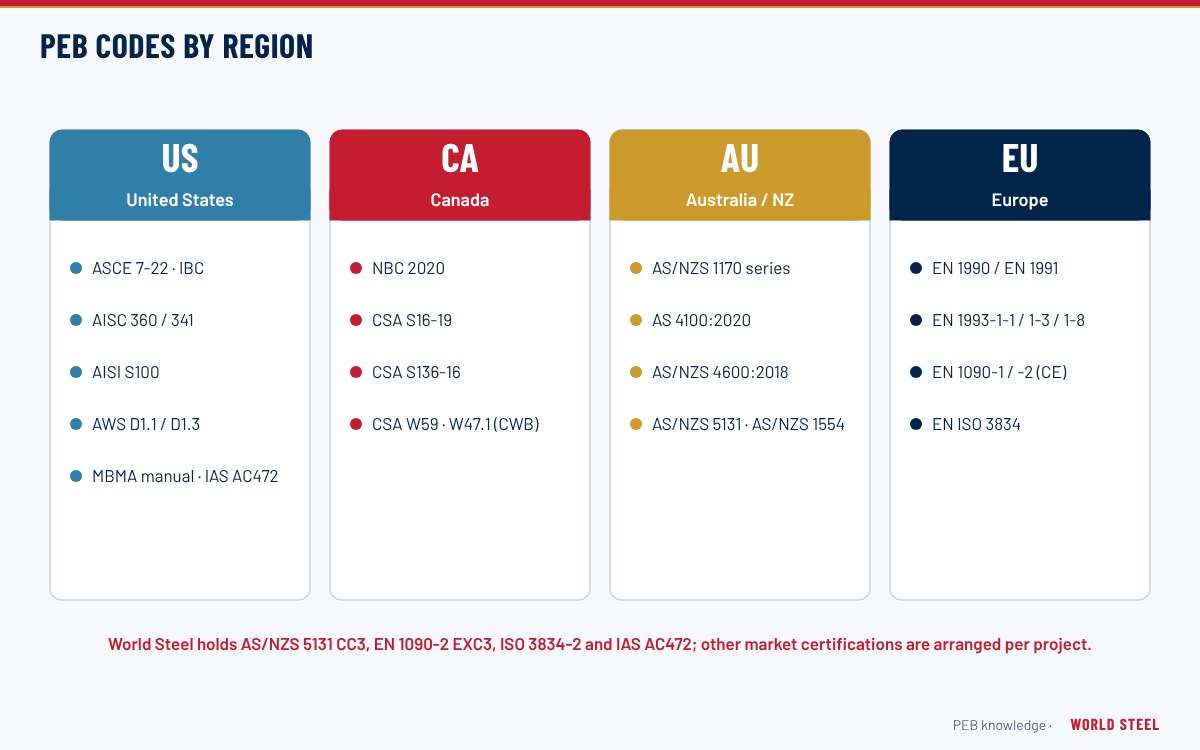
World Steel holds EN 1090-2 certification up to EXC3 with CE marking under EN 1090-1, together with ISO 3834-2 for comprehensive welding quality – the welding quality level EN 1090-2 calls for at EXC3 and EXC4. World Steel can therefore supply CE-marked components for structures specified from EXC1 to EXC3, issuing a DoP and CE marking label for each delivery.
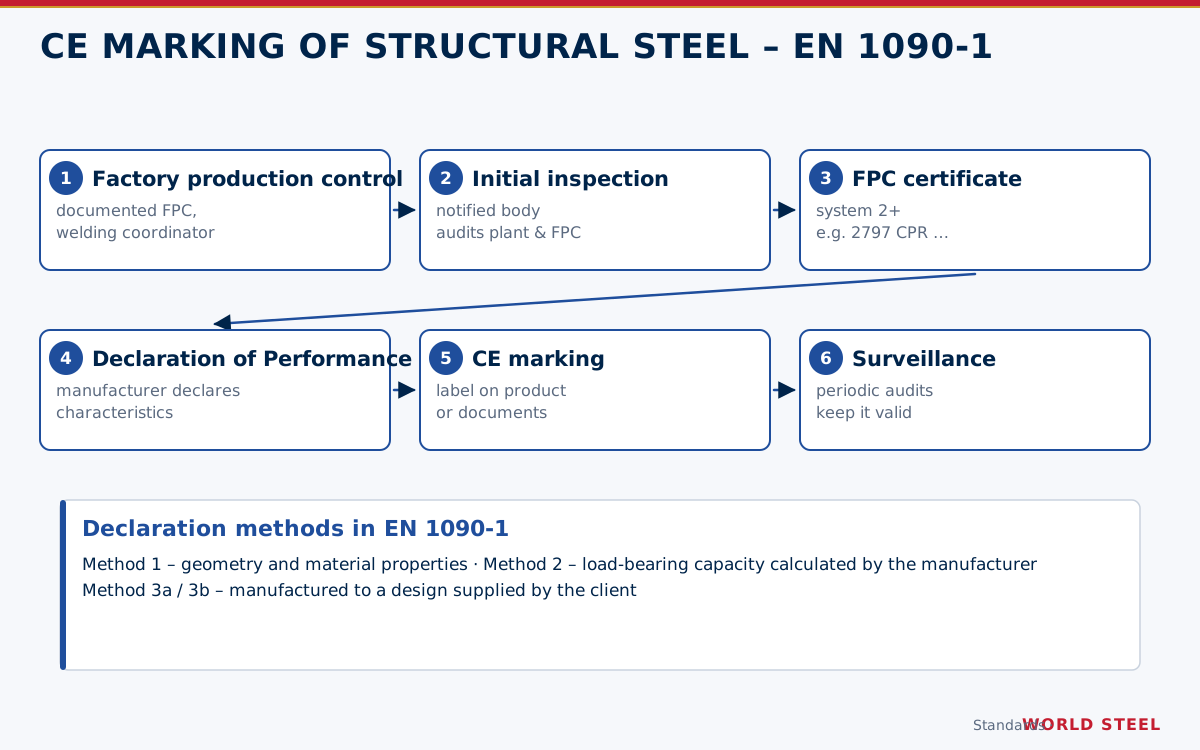
CE marking route under EN 1090-1: factory production control, notified body initial inspection and FPC certificate, continuous surveillance, Declaration of Performance and CE label
The system 2+ route to CE marking of structural steel components under EN 1090-1.

World Steel's FPC certificate is 2797 CPR 827443, issued by BSI Group The Netherlands B.V. (Notified Body 2797) for design, manufacture and installation up to and including EXC3. Confirm with the client at tender stage which items are inside the CE scope – load-bearing components such as frames, stairs and platforms normally are; the status of gratings and guard-rails depends on the product and the governing standard.

Execution classes and how World Steel complies
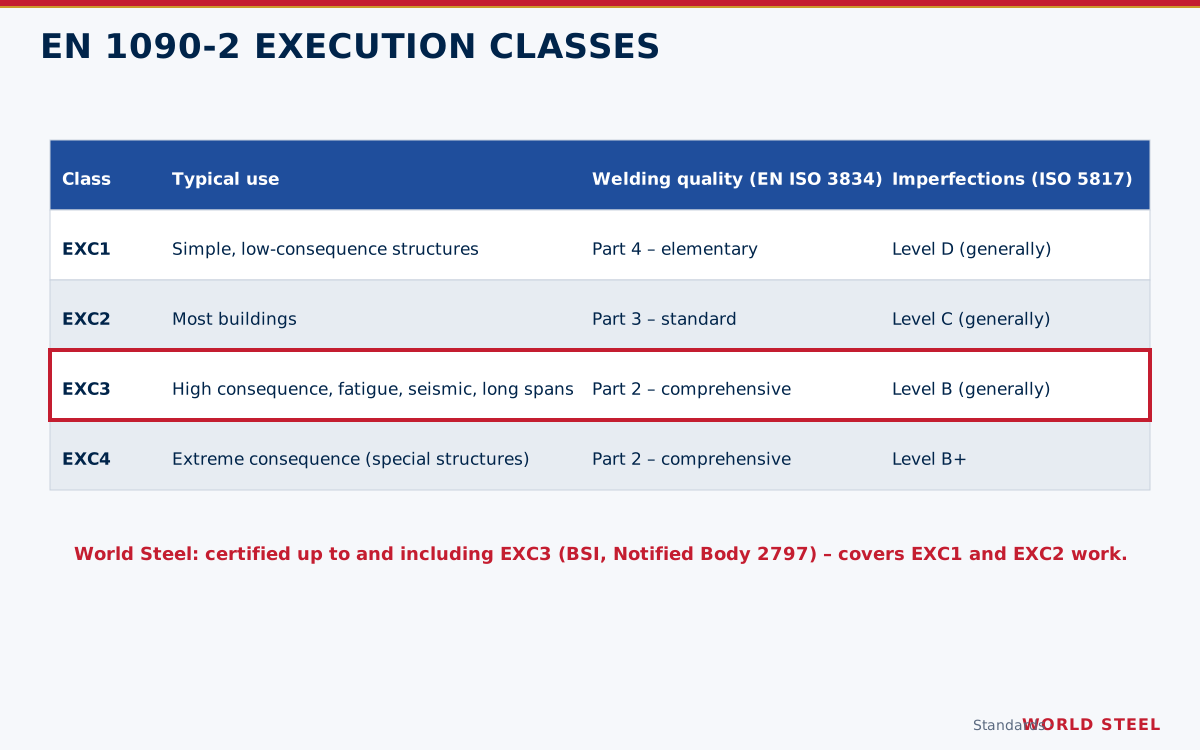
EN 1090-2 execution classes EXC1 to EXC4 and how requirements for welding, inspection and traceability increase with the class
Execution classes EXC1 to EXC4 under EN 1090-2.
EN 1090-2 execution classes – overview (the designer selects the class for each project)
ClassTypical applicationWelding quality requirementsWorld Steel
EXC1Simple structures with low consequences of failureEN ISO 3834-4Covered
EXC2Most buildings, industrial halls and PEBEN ISO 3834-3Covered
EXC3Higher-consequence structures, large spans, fatigue-loaded members such as crane runwaysEN ISO 3834-2Certified
EXC4Structures with extreme consequences of failureEN ISO 3834-2Not offered
  • Design – pre-engineered buildings are designed by World Steel to EN 1993 with the National Annex of the project country; for structural steel designed by others, World Steel produces shop drawings and IFC models from the execution specification.
  • Materials – EN 10025-2 S235, S275 and S355 plate and sections, EN 10210 and EN 10219 hollow sections, with inspection documents to EN 10204 (type 3.1 as standard) and traceability as required by the execution class.
  • Welding – SAW, FCAW and GMAW under procedures qualified to EN ISO 15614-1, welders qualified to EN ISO 9606-1 and operators to EN ISO 14732, with responsible welding coordination to EN ISO 14731 and acceptance to the EN ISO 5817 quality level set by the class.
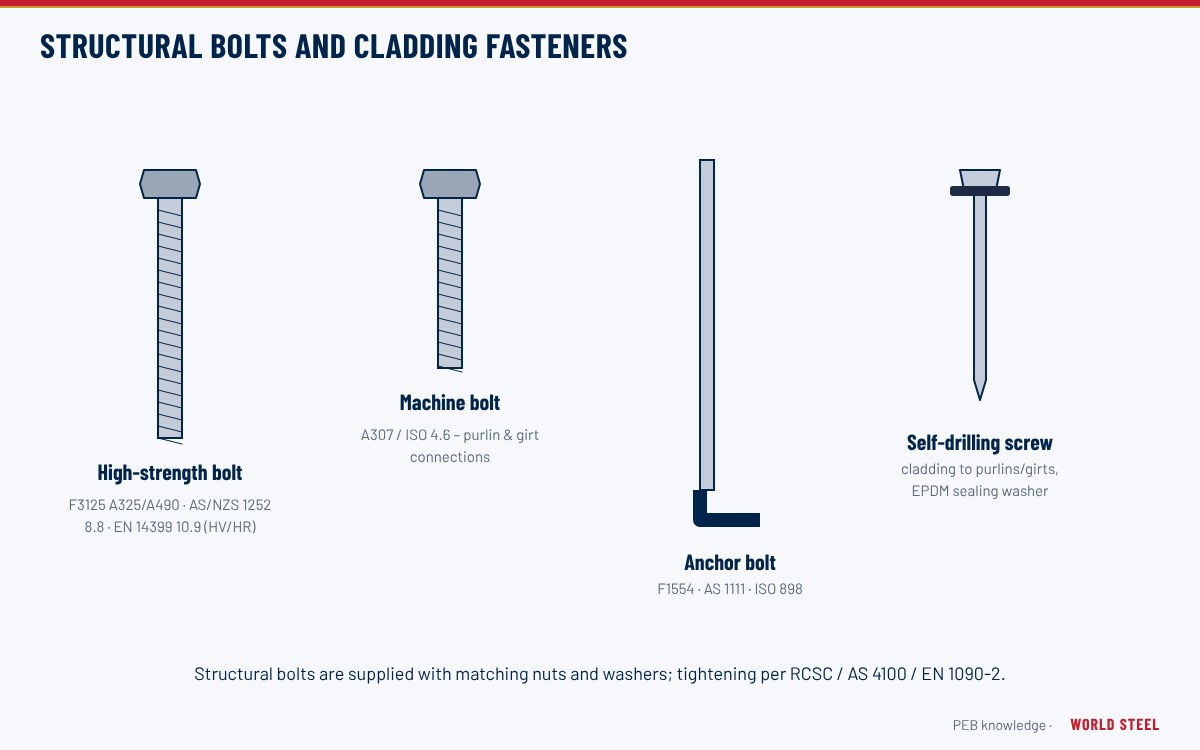
  • Bolting – preloaded assemblies to EN 14399 and non-preloaded assemblies to EN 15048, tightened and inspected to EN 1090-2.
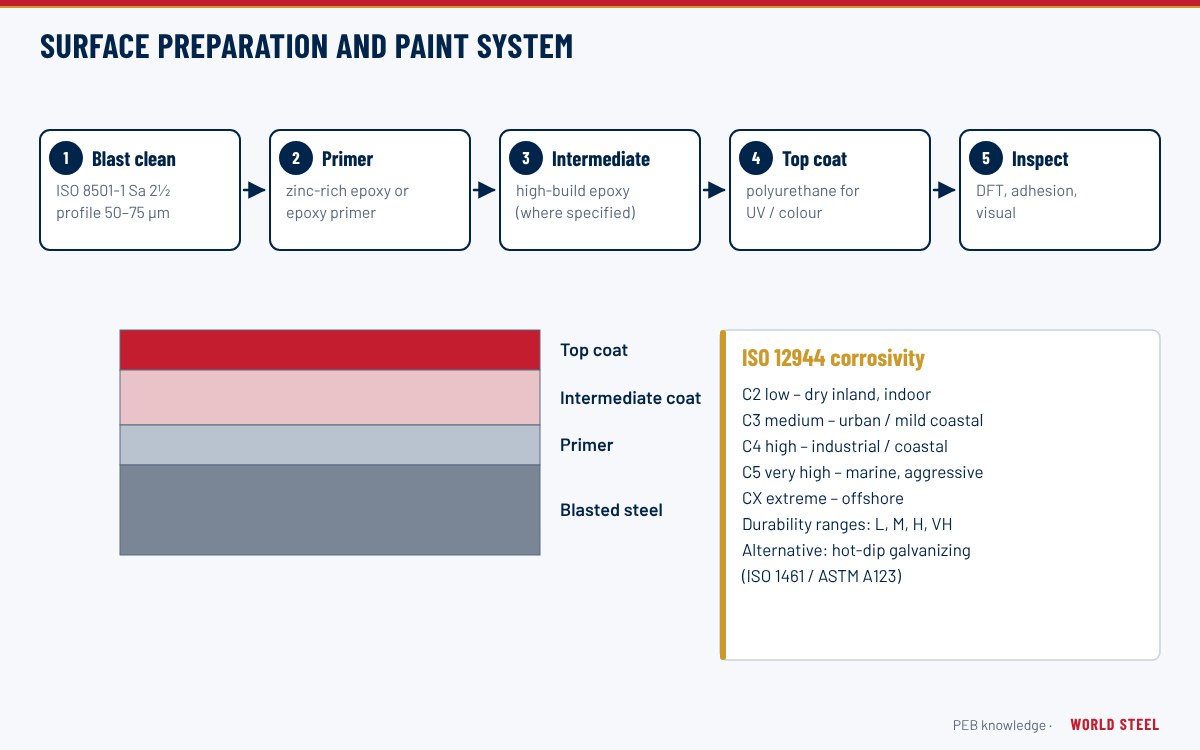
  • Coatings – surface preparation to EN ISO 8501-1 (typically Sa 2½) and paint systems to EN ISO 12944 for the corrosivity category C1 to CX; hot-dip galvanizing to EN ISO 1461 by qualified galvanizers. See paint and coating systems.
  • Inspection – visual inspection of all welds and NDT to the extent required by the class, by personnel qualified to EN ISO 9712, plus dimensional checks against EN 1090-2 tolerances.

Steel products and permanent means of access

Platforms, stairs, ladders and guard-rails that give access to machinery and plant are designed to EN ISO 14122 parts 1 to 4, the harmonised standard series under the Machinery Directive 2006/42/EC, which is replaced by the Machinery Regulation (EU) 2023/1230 from January 2027. Stairs and balustrades in buildings follow national building regulations, with horizontal loads on barriers from EN 1991-1-1 and the National Annex. Gratings are commonly specified to DIN 24537-1 and RAL-GZ 638, and covers and gratings in traffic areas to the EN 124 classes.

Key EN ISO 14122 requirements (summary)
ItemRequirement
Guard-railHeight at least 1100 mm, at least one knee-rail, gaps no more than 500 mm, toe-plate at least 100 mm
Stairs20°–45° (preferably 30°–38°); 600 mm ≤ g + 2h ≤ 660 mm; width at least 600 mm, preferably 800 mm
Walkways and platformsClear width at least 600 mm, preferably 800 mm; clear height at least 2100 mm
Fixed laddersRungs 225–300 mm apart; fall protection where the climbing height exceeds 3 m

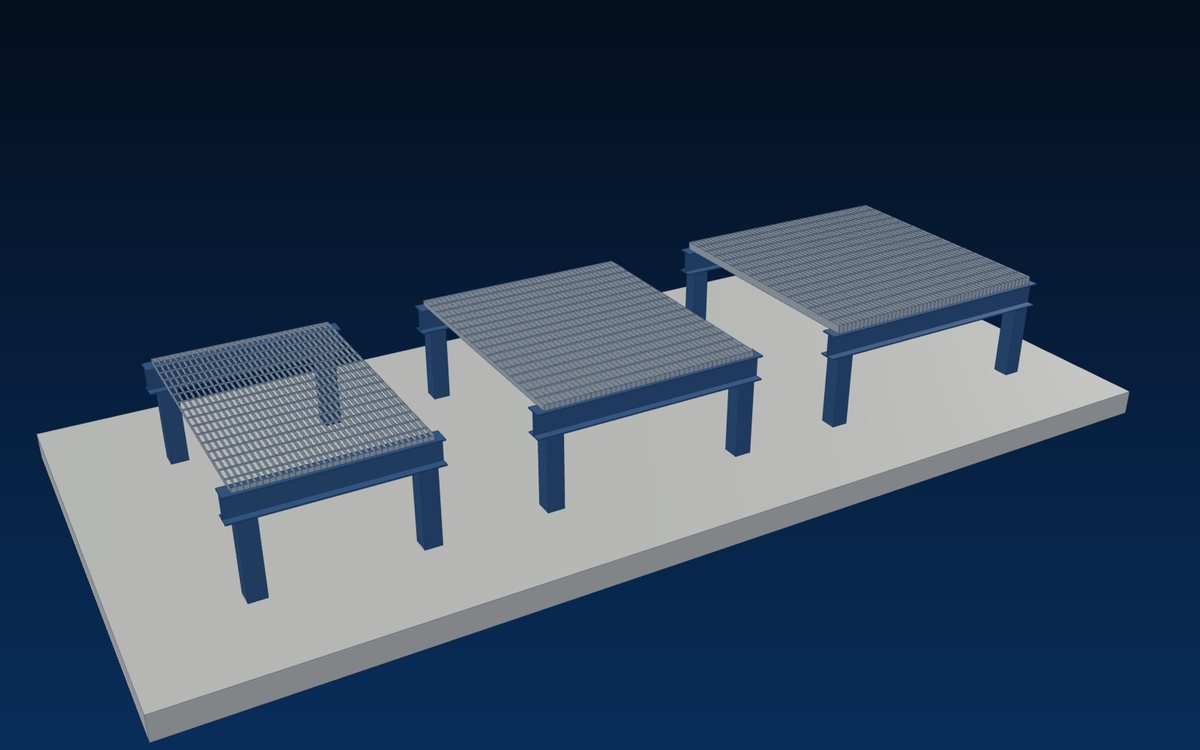
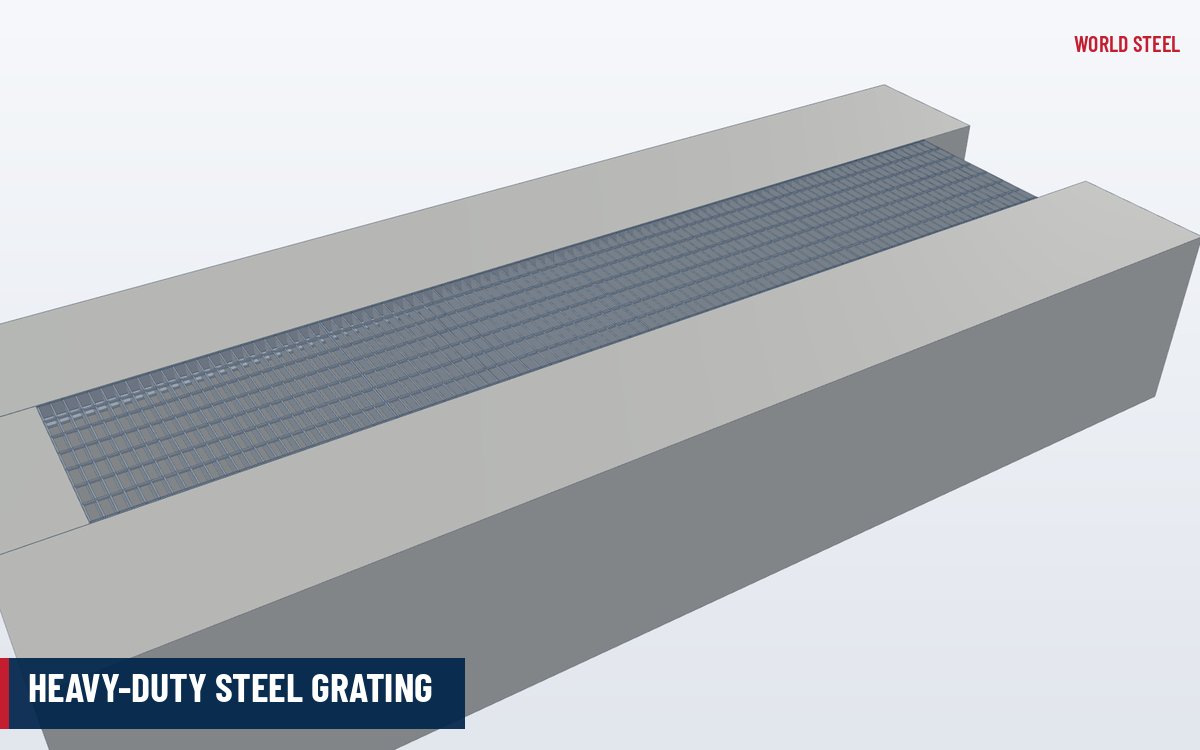
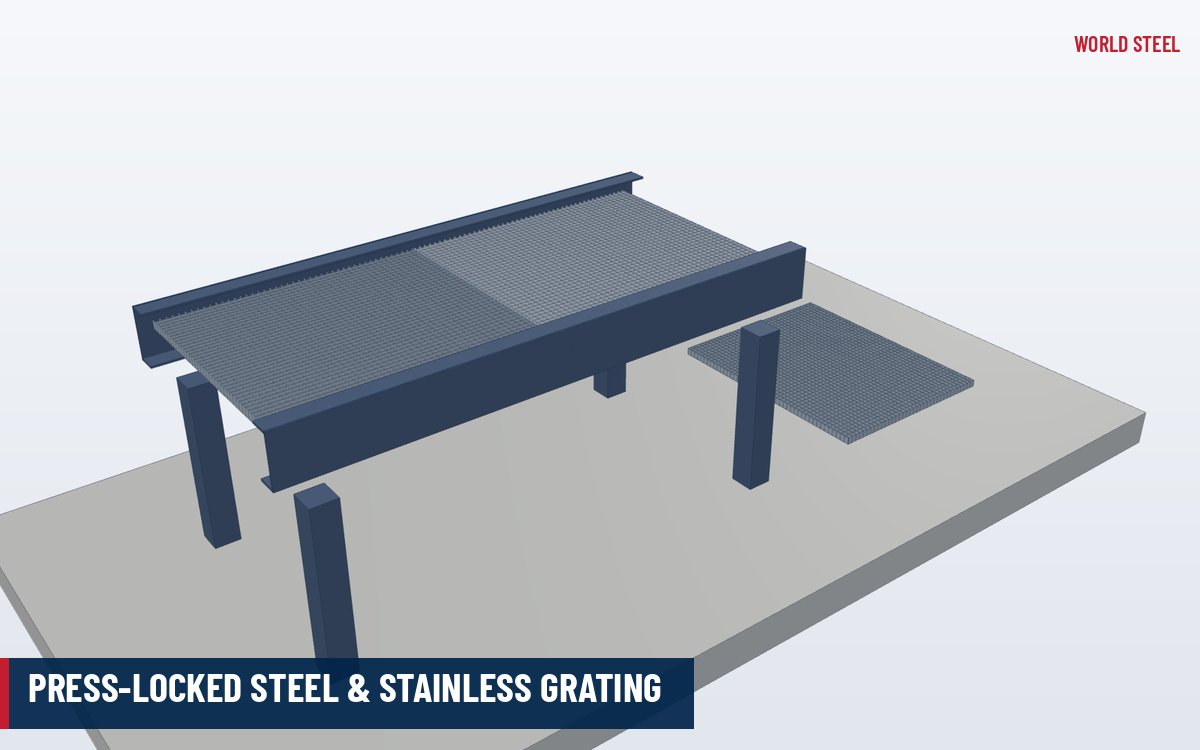
World Steel supplies crossover platforms, egress stairs, industrial handrails and heavy-duty grating for European projects, fabricated within the EN 1090-2 system and CE marked where they fall within the EN 1090-1 scope.

United Kingdom, EEA and national differences

Norway, as an EEA member, applies the CPR and CE marking in the same way as EU member states. In Great Britain, construction products fall under the UK's own Construction Products Regulation with UKCA marking, designated standards (BS EN 1090-1) and UK National Annexes to the Eurocodes; the UK Government has extended acceptance of CE-marked construction products, so the marking required should be confirmed for each project. Northern Ireland follows EU rules. UK specifications often also reference the National Structural Steelwork Specification for Building Construction. See the United Kingdom and Germany market pages for country notes.

Specifying World Steel in European tenders

  • State the execution class for each part of the works (for example EXC2 for the hall, EXC3 for crane runways) and the National Annex to be used.
  • Require CE marking to EN 1090-1 with a DoP, and a fabricator certified to EN 1090-2 at or above the specified class with EN ISO 3834-2 welding quality.
  • Give the corrosivity category and durability range to EN ISO 12944, or galvanizing to EN ISO 1461, and any fire protection requirement.
  • For access items, state whether EN ISO 14122 or national building rules apply in each area.

World Steel's export supply service and the European metal building standards article give further detail; compare the Australian and US frameworks.
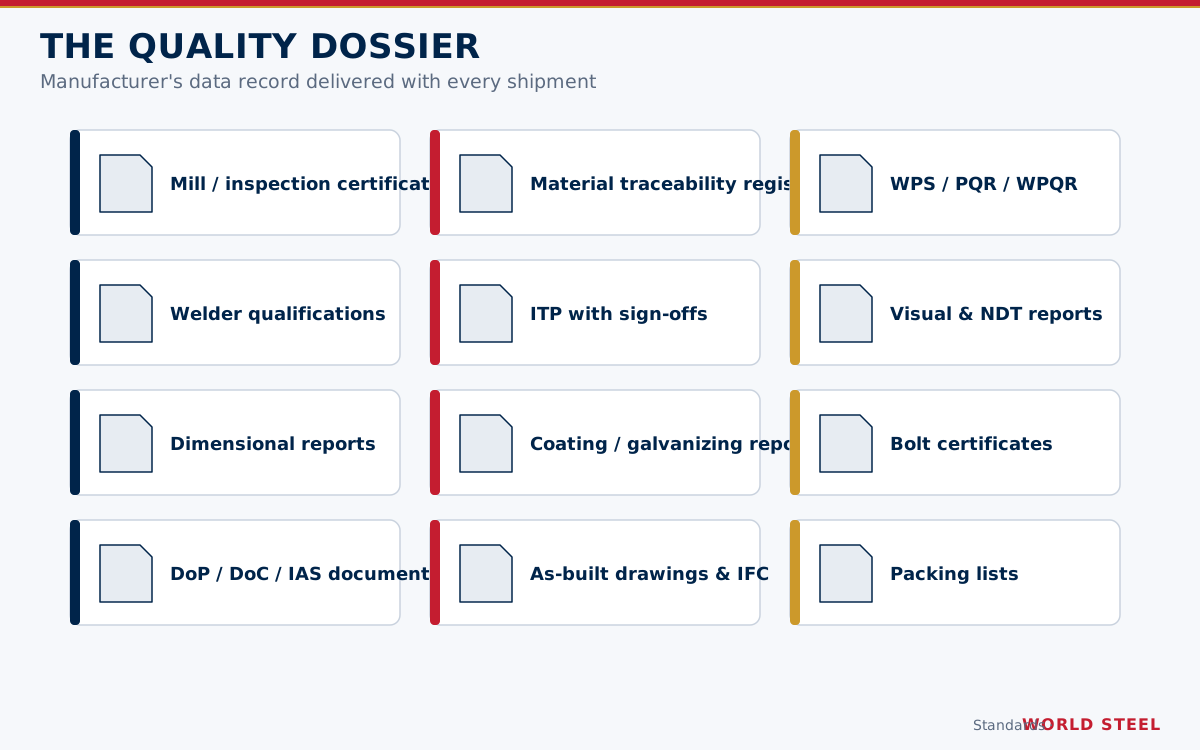
World Steel quality dossier for Europe: DoP, CE label, EN 10204 3.1 certificates, WPQR, welder certificates and inspection reports
Documents supplied with every European delivery.

World Steel 遵循的Europe标准

  • WSC certified World Steel holds a certificate for this standard
  • Applied by WSC World Steel designs, fabricates or supplies to this standard
  • Market requirement Required in this market – project-specific, confirm at tender
  • National regulation Statutory framework the project must comply with

Regulation and building codes

Regulation (EU) No 305/2011Construction Products RegulationHarmonised standards under it remain in use during the transition 法规
Regulation (EU) 2024/3110New Construction Products RegulationApplies from 8 January 2026 法规
National building regulationsBuilding regulations of the project countryApproval and checking of the works 法规
Directive 2006/42/ECMachinery DirectiveReplaced by Regulation (EU) 2023/1230 from January 2027 法规
UK CPR / UKCAUK Construction Products Regulation and UKCA markingGreat Britain – confirm CE/UKCA acceptance per project 法规

Loads and actions

EN 1990Eurocode – Basis of structural design WSC 采用
EN 1991-1-1Actions on structures – Densities, self-weight, imposed loads for buildingsIncluding horizontal loads on barriers WSC 采用
EN 1991-1-3Actions on structures – Snow loads WSC 采用
EN 1991-1-4Actions on structures – Wind actions WSC 采用
EN 1991-3Actions induced by cranes and machineryCrane runways WSC 采用
EN 1998-1Design of structures for earthquake resistance – General rules, seismic actions and rules for buildings WSC 采用

Structural design

EN 1993-1-1Design of steel structures – General rules and rules for buildings WSC 采用
EN 1993-1-2Design of steel structures – Structural fire designWhere fire resistance is required 市场要求
EN 1993-1-3Design of steel structures – Cold-formed members and sheetingPurlins and girts WSC 采用
EN 1993-1-5Design of steel structures – Plated structural elementsTapered built-up members WSC 采用
EN 1993-1-8Design of steel structures – Design of joints WSC 采用
EN 1993-1-9Design of steel structures – FatigueCrane runways and fatigue WSC 采用
EN 1993-1-10Design of steel structures – Material toughness and through-thickness properties WSC 采用
EN 1992-4Design of fastenings for use in concreteAnchors – foundation designer 市场要求

Execution and CE marking

EN 1090-1Execution of steel structures and aluminium structures – Requirements for conformity assessment of structural componentsCE marking, attestation system 2+ WSC 已认证 →
EN 1090-2Execution of steel structures and aluminium structures – Technical requirements for steel structuresCertified up to EXC3 WSC 已认证 →
EN 1090-4Execution of steel structures – Technical requirements for cold-formed structural steel elements and structuresCold-formed elements for roofs, walls and floors WSC 采用

Materials

EN 10025-2Hot rolled products of structural steels – Non-alloy structural steelsS235, S275, S355 WSC 采用
EN 10210-1Hot finished structural hollow sections WSC 采用
EN 10219-1Cold formed welded structural hollow sections WSC 采用
EN 10346Continuously hot-dip coated steel flat products for cold formingCoated strip for purlins and cladding WSC 采用
EN 10164Steel products with improved deformation properties perpendicular to the surfaceZ-quality where specified 市场要求
EN 10088Stainless steelsStainless items 市场要求
EN 10204Metallic products – Types of inspection documentsType 3.1 as standard WSC 采用

Welding and inspection

EN ISO 3834-2Quality requirements for fusion welding of metallic materials – Comprehensive quality requirements WSC 已认证
EN ISO 14731Welding coordination – Tasks and responsibilities WSC 采用
EN ISO 15614-1Specification and qualification of welding procedures – Welding procedure test – Arc and gas welding of steels WSC 采用
EN ISO 15609-1Specification and qualification of welding procedures – Welding procedure specification – Arc welding WSC 采用
EN ISO 9606-1Qualification testing of welders – Fusion welding – Steels WSC 采用
EN ISO 14732Qualification testing of welding operators and weld setters WSC 采用
EN ISO 5817Fusion-welded joints in steel – Quality levels for imperfections WSC 采用
EN ISO 9712Non-destructive testing – Qualification and certification of NDT personnel WSC 采用
EN ISO 14555Arc stud welding of metallic materialsShear studs WSC 采用

Bolting and anchors

EN 14399High-strength structural bolting assemblies for preloadingHR and HV systems WSC 采用
EN 15048Non-preloaded structural bolting assemblies WSC 采用
EN ISO 898-1Mechanical properties of fasteners – Bolts, screws and studs WSC 采用

Corrosion protection

EN ISO 12944Paints and varnishes – Corrosion protection of steel structures by protective paint systemsCorrosivity C1 to CX WSC 采用
EN ISO 8501-1Preparation of steel substrates – Visual assessment of surface cleanlinessTypically Sa 2½ WSC 采用
EN ISO 1461Hot dip galvanized coatings on fabricated iron and steel articlesBy qualified galvanizers WSC 采用
EN ISO 14713Zinc coatings – Guidelines for the protection of iron and steel against corrosion WSC 采用

Steel products, access and cladding

EN ISO 14122-1Permanent means of access to machinery – Choice of fixed means of access WSC 采用
EN ISO 14122-2Permanent means of access to machinery – Working platforms and walkways WSC 采用
EN ISO 14122-3Permanent means of access to machinery – Stairs, stepladders and guard-rails WSC 采用
EN ISO 14122-4Permanent means of access to machinery – Fixed ladders WSC 采用
DIN 24537-1Gratings as floor covering – Metal gratingsGermany and widely used WSC 采用
RAL-GZ 638Quality assurance for gratingsWhere specified 市场要求
EN 124Gully tops and manhole tops for vehicular and pedestrian areasClasses A15 to F900 市场要求
EN 845-2Specification for ancillary components for masonry – LintelsLintels – harmonised standard 市场要求
EN 14782Self-supporting metal sheet for roofing, external cladding and internal liningProfiled metal sheet 市场要求
EN 14509Self-supporting double skin metal faced insulating panelsSandwich panels 市场要求

Fire

EN 13501-2Fire classification of construction products and building elements – Classification using data from fire resistance testsFire-rated elements 市场要求

版本及采用情况因司法管辖区而异。以项目技术规格书及主管机构要求为准;World Steel 在投标时确认适用版本。

常见问题

Do steel components supplied from Vietnam need CE marking?

Yes, where they are structural components within the scope of EN 1090-1 placed on the EU market. The origin of the manufacturer does not matter; what matters is an FPC certified by a notified body, a DoP and the CE marking. World Steel supplies all three.

Which execution class should my project use?

The designer chooses it from the consequence class and the service and production conditions, using the Eurocode guidance and the National Annex. Most buildings are EXC2; EXC3 is common for large spans and fatigue-loaded members such as crane runways. World Steel is certified up to EXC3.

What changes with the new Construction Products Regulation?

Regulation (EU) 2024/3110 applies from 8 January 2026, but during the transition harmonised standards such as EN 1090-1 continue to be used for CE marking. For steel components the DoP and CE marking route is unchanged today; new requirements will follow as new harmonised specifications are adopted.

Are gratings and handrails CE marked?

It depends on the product and the governing standard. Load-bearing stairs, platforms and frames are normally within the EN 1090-1 scope. Agree at tender stage whether gratings and guard-rails are inside the CE scope for your project.

Can you deliver to the UK?

Yes. Design uses the UK National Annexes, and the required marking – UKCA or CE – is confirmed for each project because UK rules for construction products differ from the EU's.

What corrosion protection do you offer?

Paint systems to EN ISO 12944 selected for the corrosivity category and durability range, after blast cleaning to EN ISO 8501-1, or hot-dip galvanizing to EN ISO 1461 by qualified galvanizers, with coating reports or galvanizing certificates in the dossier.

下一个项目

计划在海外建造钢结构?

请发送您的图纸或 IFC 模型——我们的报价团队将回复加工范围、工期及到岸价格。