ENEnglish
 VITiếng Việt
 ZH中文
 KO한국어
 JA日本語
 FRFrançais
 ITItaliano
 PTPortuguês
 ESEspañol
 HEעברית
 ARالعربية

From approved drawings to a production order
Fabrication of a pre-engineered steel building starts only when the design is frozen. Approved anchor bolt plans, erection drawings and shop details (see design deliverables) are converted into a production order: a bill of materials split into built-up members, cold-formed secondary members, cladding, accessories and fasteners. Each piece receives a unique piece mark that follows it through cutting, welding, painting, packing and finally erection on site.
Because the members of a PEB are tailored to the actual bending moment along the frame, there are few standard parts in the primary framing. Production is therefore driven by CNC data: nesting files for plate cutting, weld programmes for the beam lines and punching patterns for the roll formers are generated directly from the detailing model, which keeps hand marking and manual layout to a minimum.
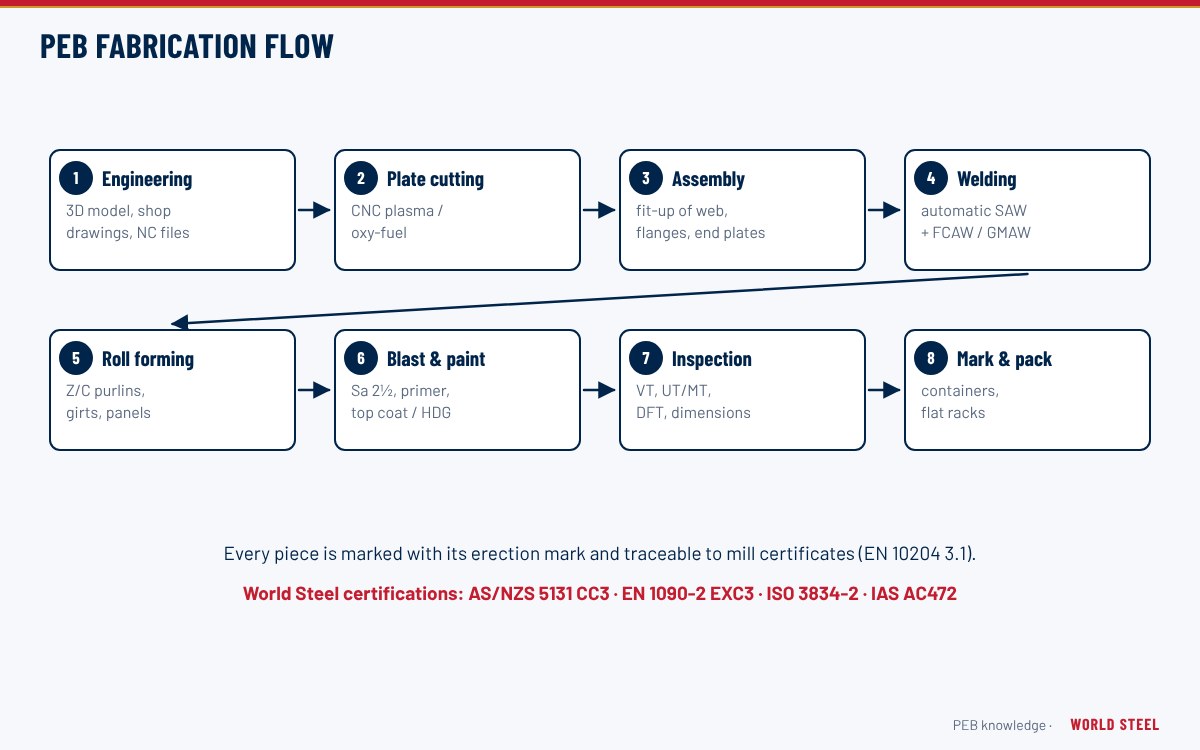
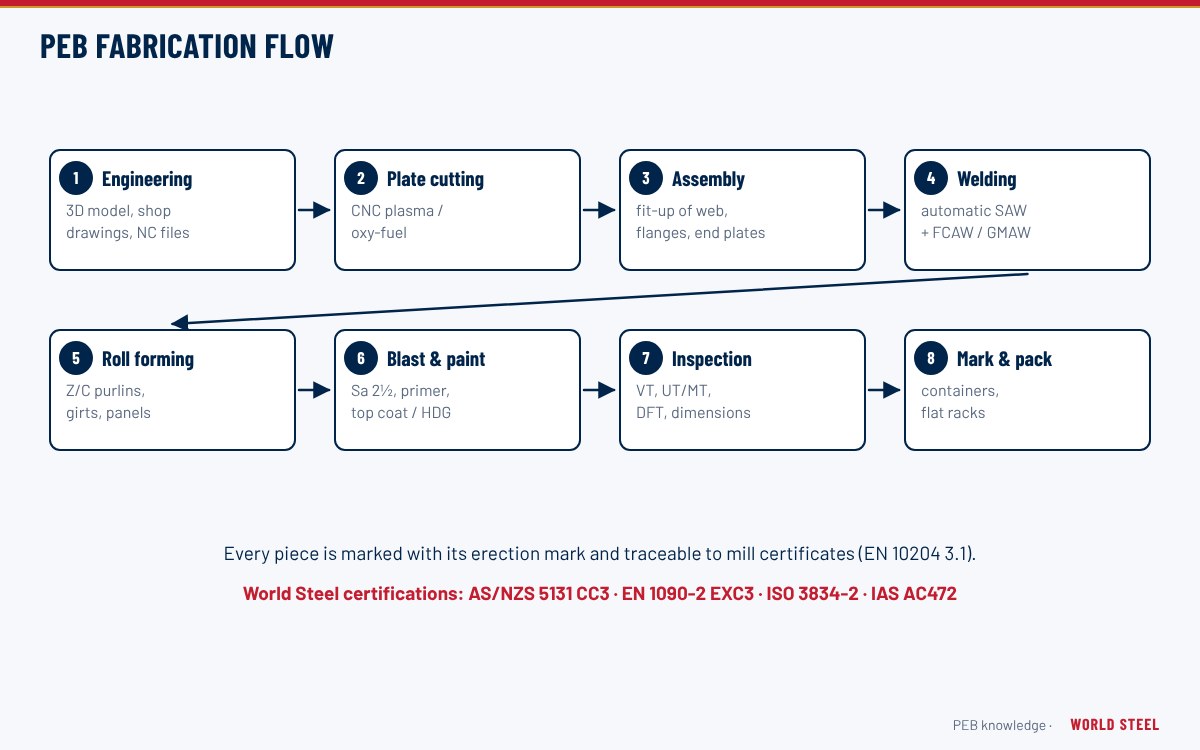
The production flow step by step
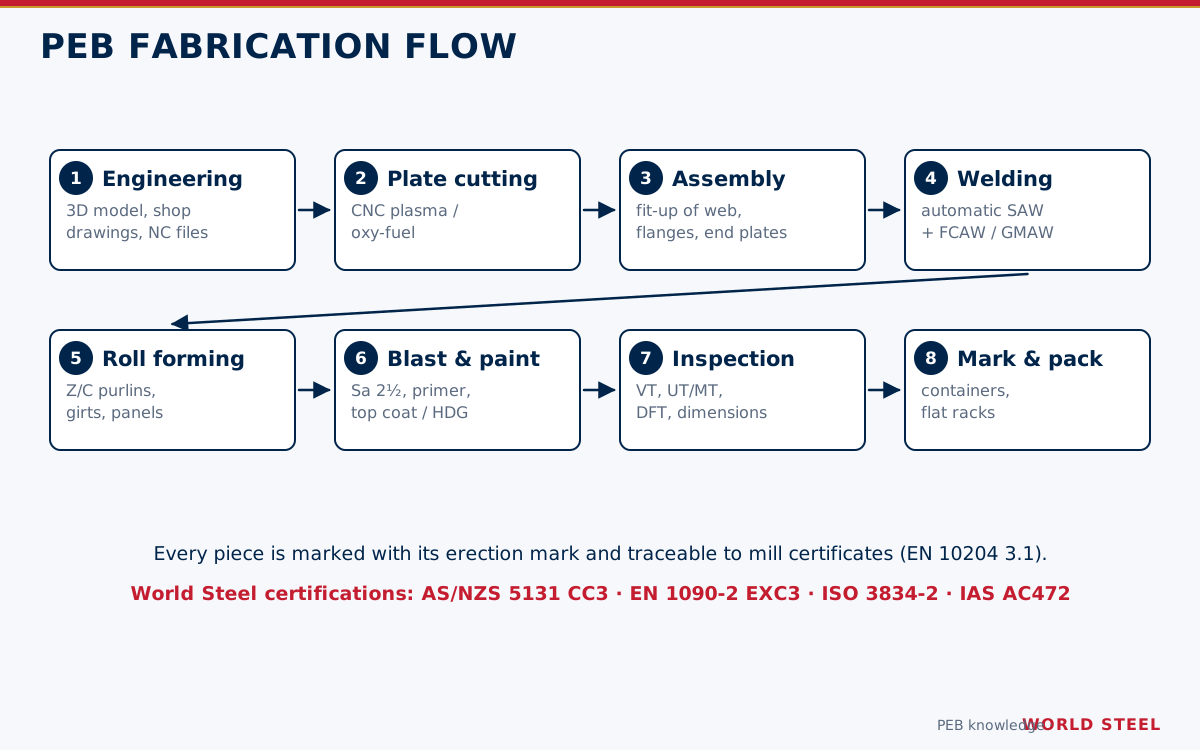
- Material receipt and traceability – plate and coil are checked against mill certificates (EN 10204 type 3.1) and heat numbers are recorded so that every primary member can be traced back to its mill heat.
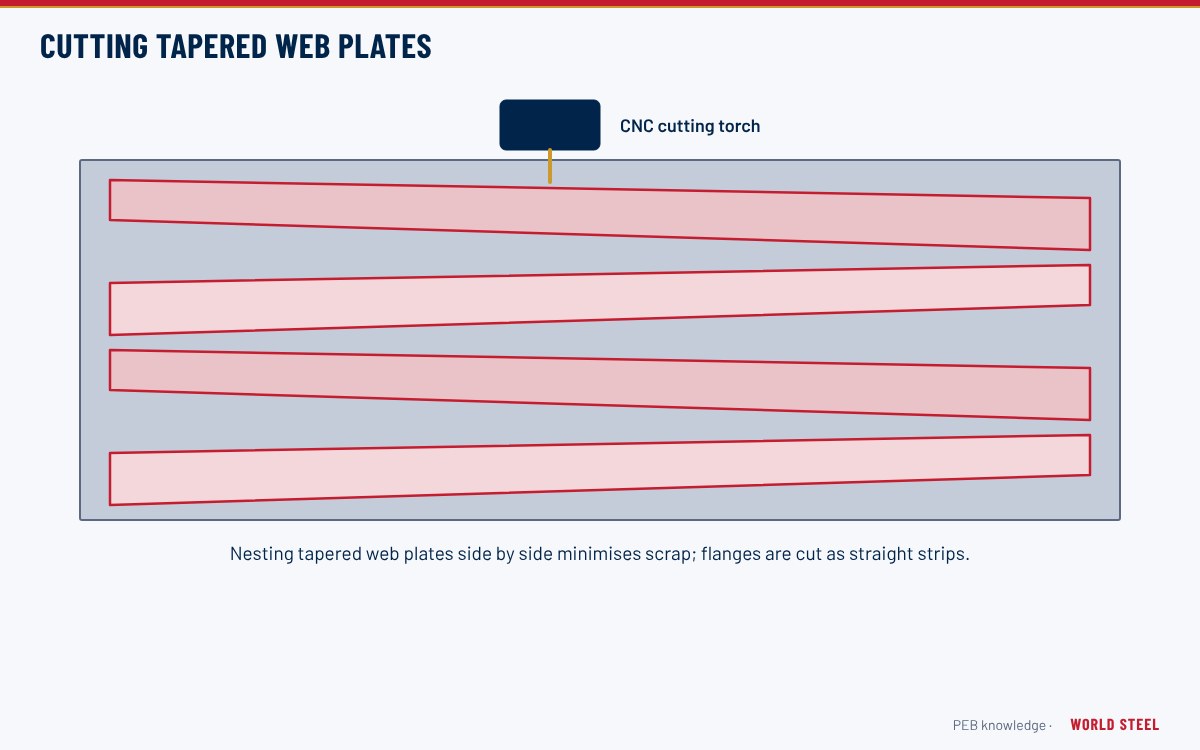
- Plate cutting and web tapering – flanges are stripped from plate and tapered webs are nested and cut by CNC plasma or oxy-fuel.
- Fit-up – web and flanges are assembled on a tack-welding or H-beam assembly machine.
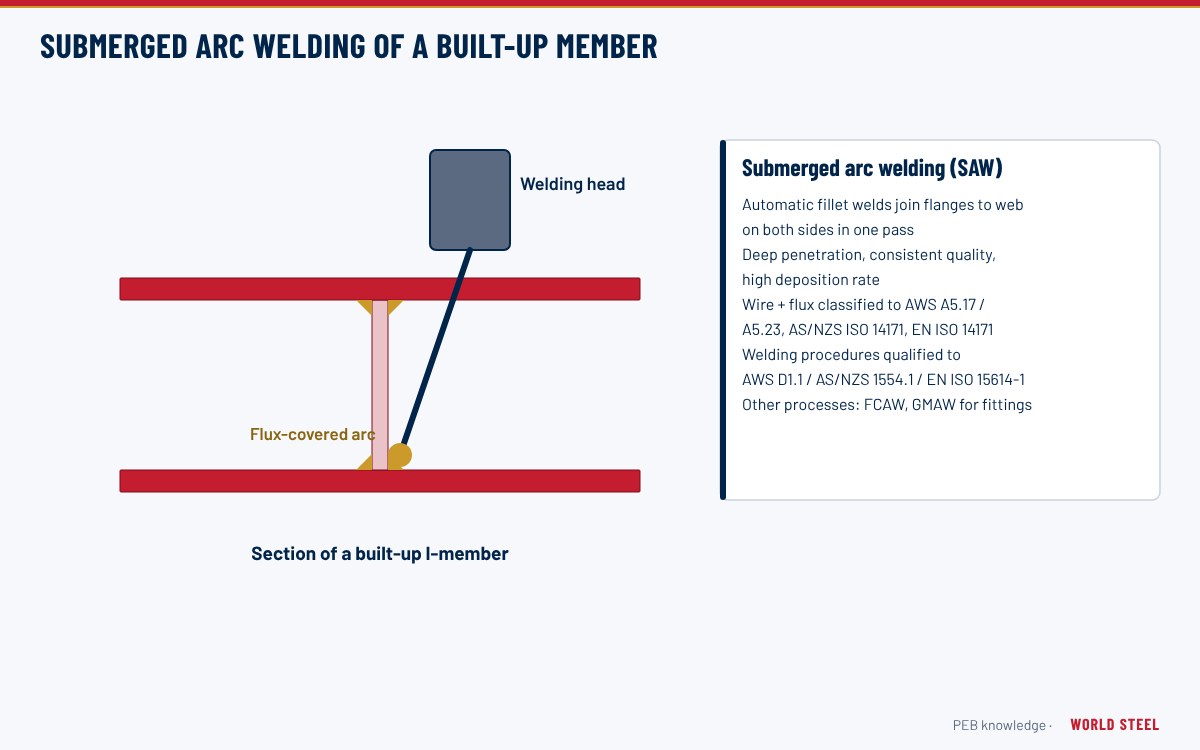
- Automatic welding – flange-to-web fillet welds are made by submerged arc welding, followed by straightening of flange distortion.
- Secondary fabrication – end plates, stiffeners, base plates, cleats and purlin clips are welded on; holes are drilled or punched.
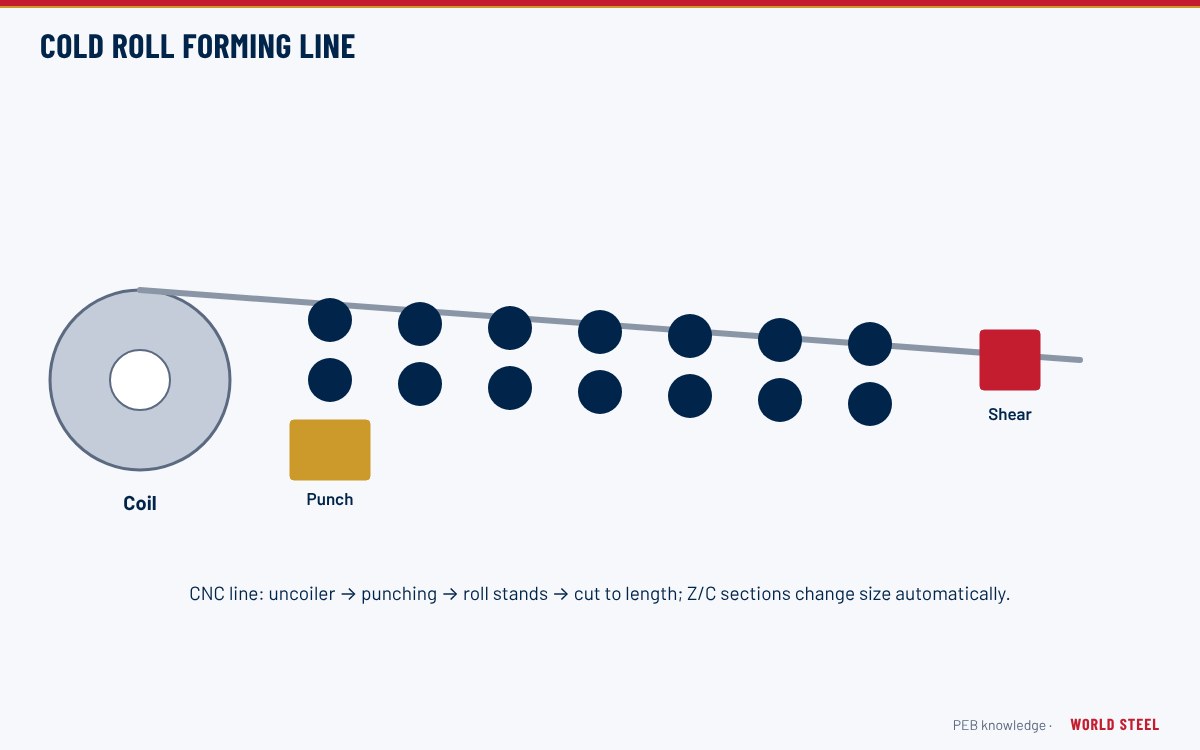
- Cold roll forming – Z and C purlins, girts, eave struts and roof and wall panels are formed from coil (cold roll forming).
- Surface preparation and coating – shot blasting to ISO 8501-1 Sa 2½ and painting, or hot-dip galvanizing where specified.
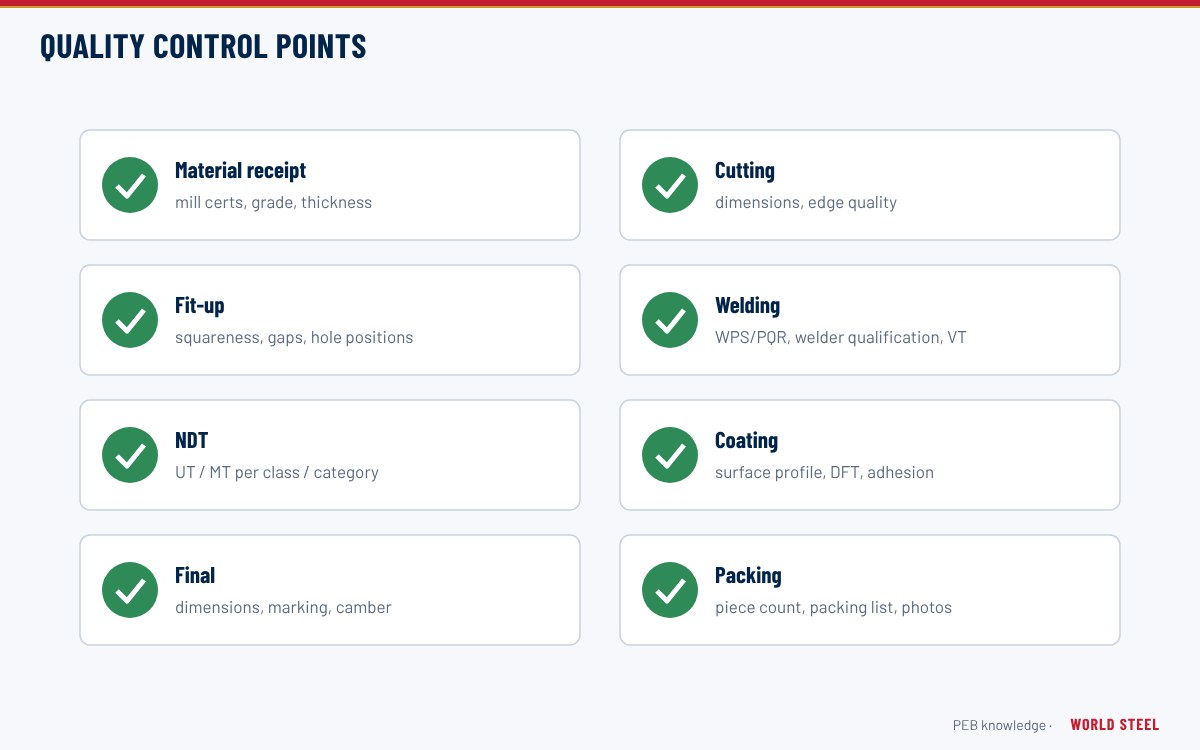
- Inspection – visual and NDT weld inspection, dimensional checks and coating DFT (quality control).
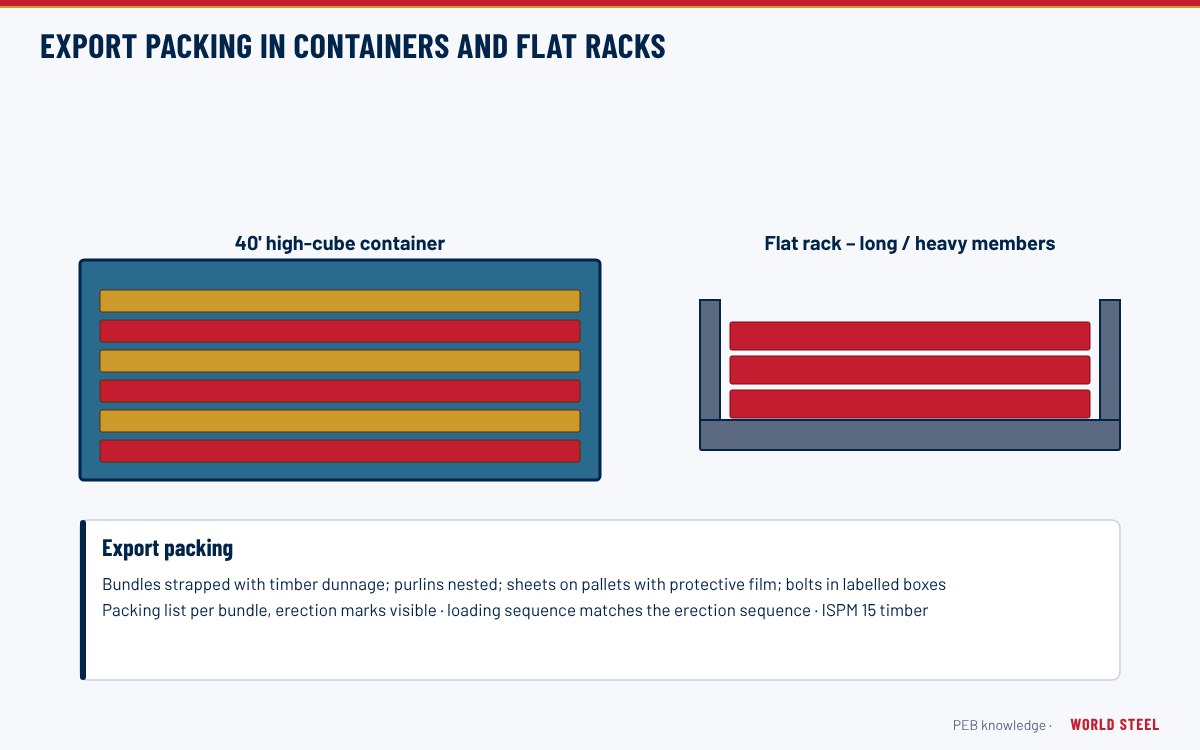
- Marking, bundling and packing for container, flat rack or break-bulk shipment (packing and shipping).
Primary and secondary production lines
A PEB plant is organised as two largely independent streams. The primary line produces welded, tapered I-sections – columns, rafters, crane runway beams and endwall members – that carry the main loads. It is plate-intensive and welding-intensive, and throughput is governed by the beam welding lines and the blasting and painting capacity. The secondary line produces light-gauge cold-formed members and cladding at high speed from coil; its constraint is changeover time between profiles and gauges rather than labour.
| Item | Primary members | Secondary members and cladding |
|---|---|---|
| Raw material | Hot-rolled plate, typically 5–40 mm | Galvanized or metallic-coated coil, typically 0.4–3.0 mm |
| Key process | CNC cutting, SAW welding, drilling | Cold roll forming with inline punching |
| Corrosion protection | Blast and paint, or hot-dip galvanizing | Pre-galvanized or pre-painted coil |
| Main inspections | VT, UT/MT, dimensions, DFT | Profile dimensions, hole positions, coating mass |
Bought-out items, sundries and special buyouts
Not everything in a building kit is made on the plant's own lines. A complete PEB order also contains manufactured items that the building supplier procures, checks and consolidates into the shipment, so that the buyer deals with one supplier and one packing list.
| Group | Examples | Points to control |
|---|---|---|
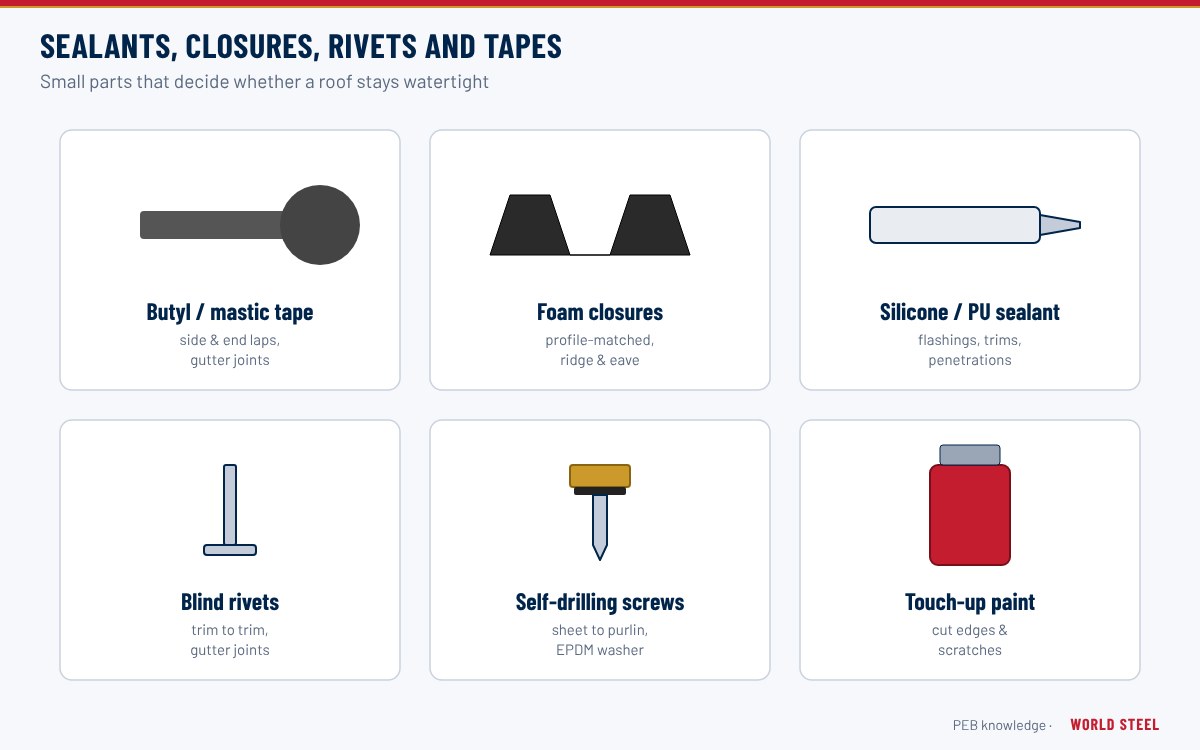
| Sundries | Self-drilling screws, rivets, butyl and silicone sealants, foam closures, tapes, pipe flashings | Durability class, colour match, shelf life, quantity with spares |
| Insulation | Glass or rock wool blankets with facings, reflective foil, spacer systems | Thickness, facing type, fire classification, dry packing |
| Daylight and ventilation | Translucent sheets, ridge ventilators, louvers, turbine vents | Profile match, UV protection, wind rating |
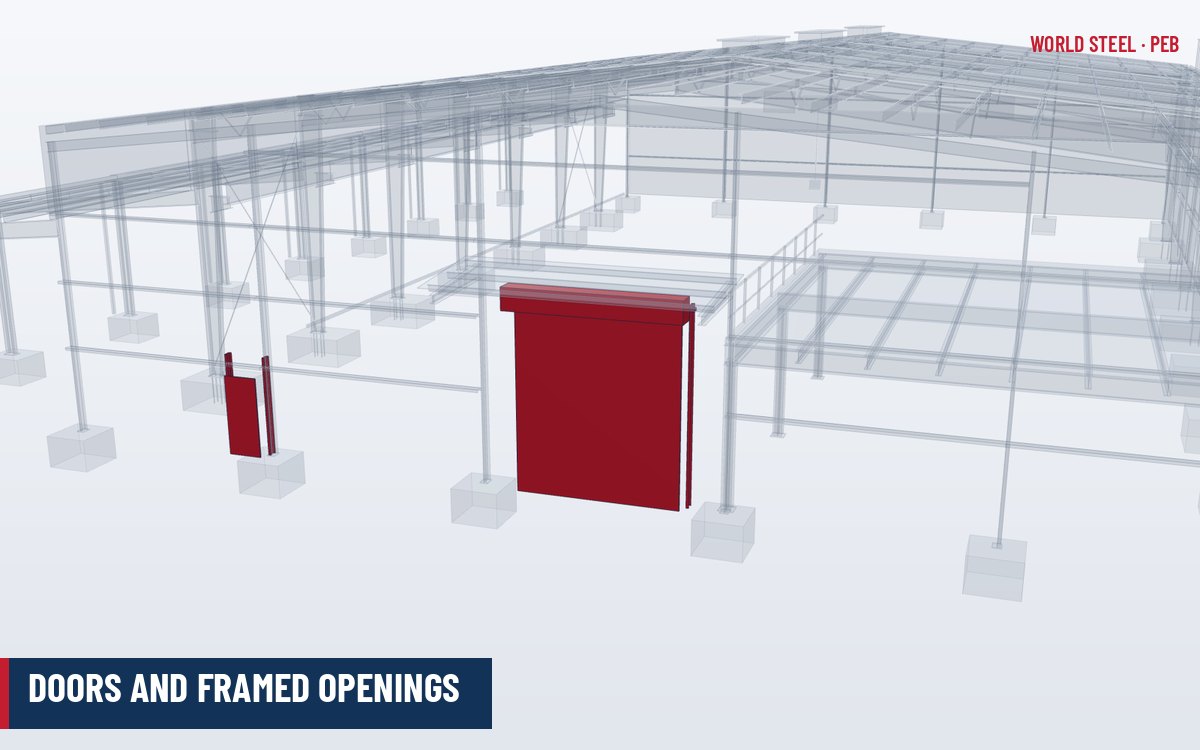
| Doors and windows | Roll-up and sectional doors, personnel doors, sliding windows | Wind rating, fire rating where required, opening sizes matched to framing |
| Special buyouts | Overhead cranes, dock levellers, fire-rated panels, sandwich panels, grating, specialised hangar or high-speed doors | Supplier data used in design, delivery timing, interface details and warranties |
| Fixings to concrete | Anchor rods, chemical or expansion anchors, embeds | Grade, length, galvanizing, early shipment ahead of steel |
Bought-out items need the same discipline as fabricated members: technical data approved before ordering, incoming inspection against the order, and inclusion in the packing list and quality dossier. Interfaces – for example crane wheel loads, door guide fixings or skylight profile – must be confirmed with the supplier before the steel drawings are released, because a late change in a bought-out item often forces a change in the fabricated steel.
Quality systems behind the process
Export markets increasingly ask not only for compliant members but for a certified fabrication system. World Steel's plant in Hai Son Industrial Park, Tay Ninh, operates a welding quality system certified to ISO 3834-2 and fabricates to EN 1090-2 Execution Class EXC3 and AS/NZS 5131 Construction Category CC3. WSC also holds IAS AC472 accreditation for metal building systems – WSC was the first company in Asia to be accredited – which covers the integration of design, fabrication and quality control that is specific to pre-engineered buildings.
Market-specific requirements such as CSA W47.1 certification for Canada, AISC Certification for some US owners or CE marking under EN 1090-1 are arranged and confirmed per project; see market compliance and certification.
Ask for the inspection and test plan (ITP) at contract stage: it defines hold and witness points, NDT extent and documentation that will accompany each shipment.
What the buyer receives
The output of the process is a complete building kit: piece-marked primary members, bundled secondary members, cladding, accessories, bolts and fasteners, together with erection drawings, packing lists and a quality dossier (mill certificates, welding procedure qualifications, NDT and coating reports). World Steel supplies these kits through its manufacturing and export supply services, from single buildings to multi-building industrial parks; see also PEB fabrication services.
תקנים לפי אזור
| אזור | תקן | היקף |
|---|---|---|
 United States |
AISC 360-22 / AWS D1.1 | Structural steel specification and structural welding code |
| United States |
IAS AC472 | Accreditation criteria for inspection programs of metal building system manufacturers |
 Canada |
CSA W59 / CSA W47.1 | Welded steel construction; certification of welding companies (market requirement) |
 Australia / NZ |
AS/NZS 5131:2016 | Structural steelwork – fabrication and erection |
 Europe |
EN 1090-2 | Execution of steel structures – technical requirements |
| International | ISO 3834-2 | Comprehensive quality requirements for fusion welding |
שאלות נפוצות
How long does it take to fabricate a PEB?
Fabrication time depends on tonnage, complexity and plant loading. Once drawings are approved and material is available, a medium-sized warehouse is typically fabricated within a few weeks; the material procurement and approval stages often take longer than the shop work itself.
Why are PEB primary members welded rather than hot-rolled?
Welding plate into I-sections allows the web depth and flange size to vary along the member so that steel is placed only where the bending moment requires it. Hot-rolled sections have a constant section and are usually heavier for the same frame.
What documents should come with a PEB shipment?
Packing lists with piece marks, erection drawings, mill certificates, welding procedure and welder qualifications, NDT and dimensional reports, coating inspection records and, where required, declarations for the target market.