ENEnglish
 VITiếng Việt
 ZH中文
 KO한국어
 JA日本語
 FRFrançais
 ITItaliano
 PTPortuguês
 ESEspañol
 HEעברית
 ARالعربية

Why cutting matters in a PEB
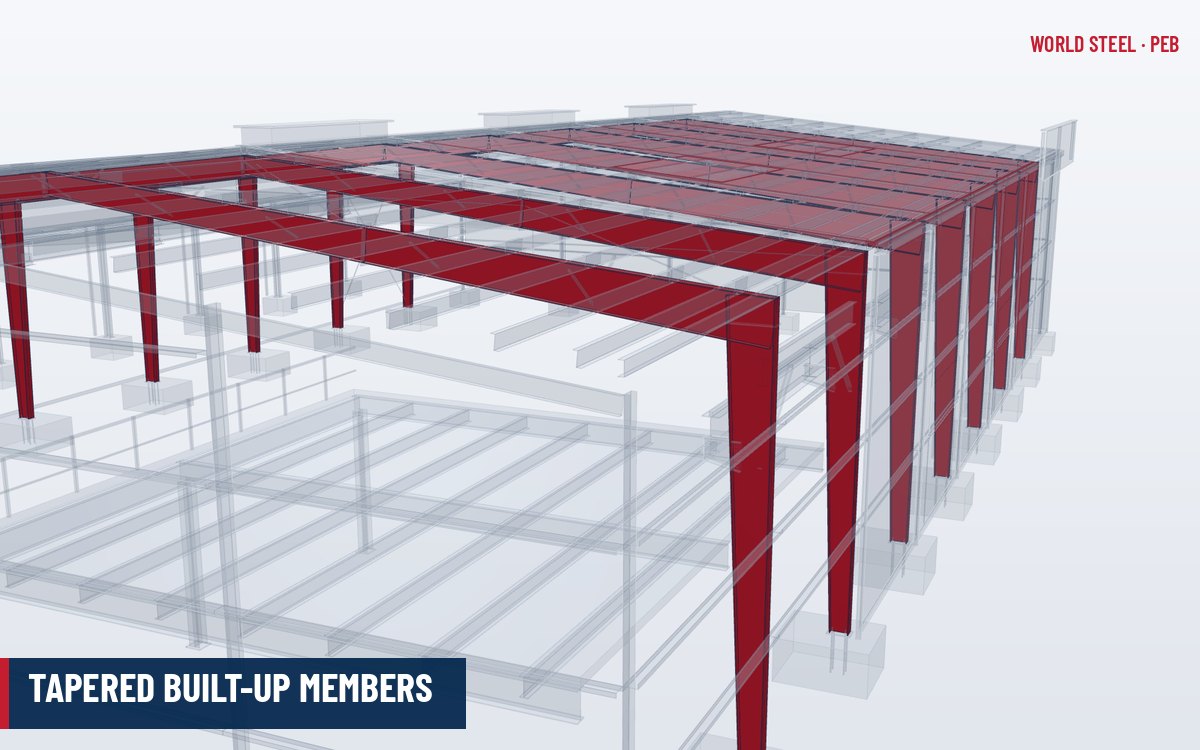
The economy of a pre-engineered building comes from tapered built-up members: the web depth follows the bending moment, so a rafter may be 400 mm deep at mid-span and 900 mm deep at the knee. Every one of these webs is a unique trapezoid or polygon, and every flange is a strip of a specified width and thickness. Plate cutting is therefore the first and one of the most important steps of the PEB fabrication process – dimensional errors made here propagate into fit-up, welding and finally into bolted end-plate connections on site.
Cutting processes
| Process | Typical thickness range | Use in PEB fabrication |
|---|---|---|
| CNC plasma (high-definition) | ~3–30 mm, most economical up to ~25 mm | Webs, stiffeners, end plates, gussets; fast with narrow kerf |
| CNC oxy-fuel (multi-torch) | ~6 mm to well over 100 mm | Flange stripping of thick plate, heavy base plates, crane girder flanges |
| Laser | Thin to medium plate | Small accurate parts, clips and brackets where available |
| Shearing | Thin plate | Straight cuts of small plates, stiffeners and fillers |
Multi-torch oxy-fuel strip cutting is widely used for flanges because several parallel torches cut both edges of several flanges at once, giving straight strips with low camber. Plasma is preferred for webs because its speed and narrow heat-affected zone reduce distortion of thin plates, which in PEB webs are commonly 5–10 mm.
Nesting and web tapering
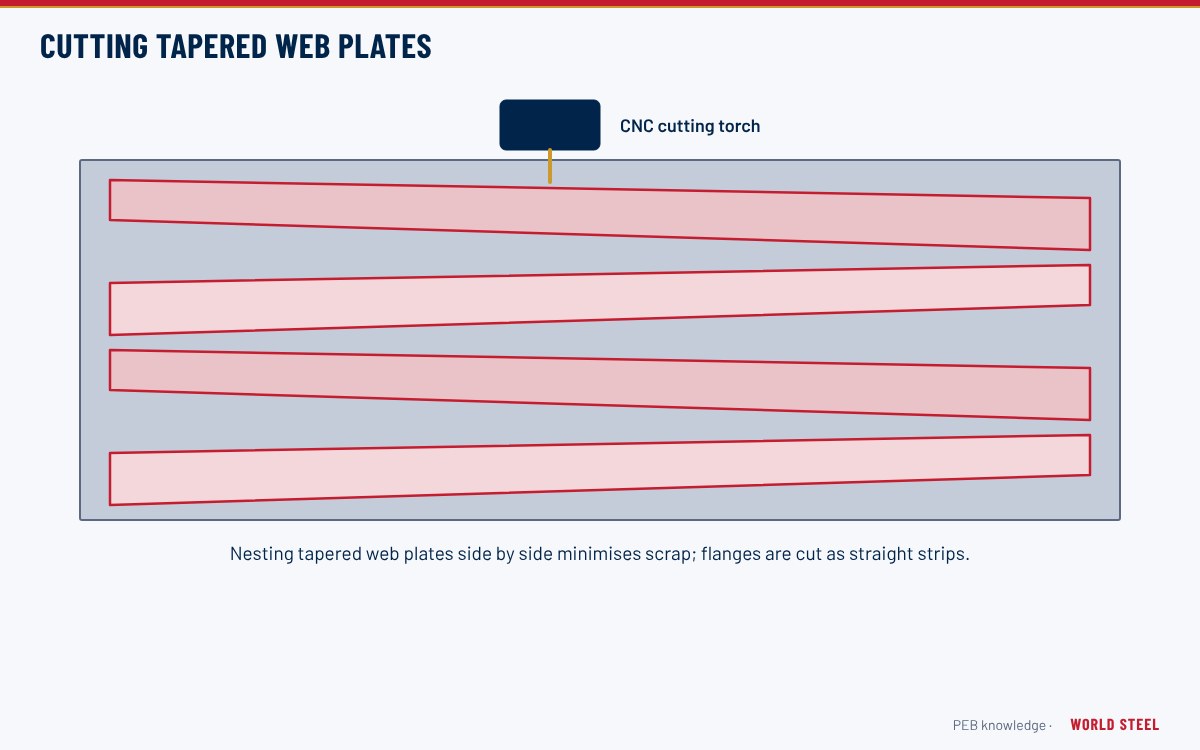
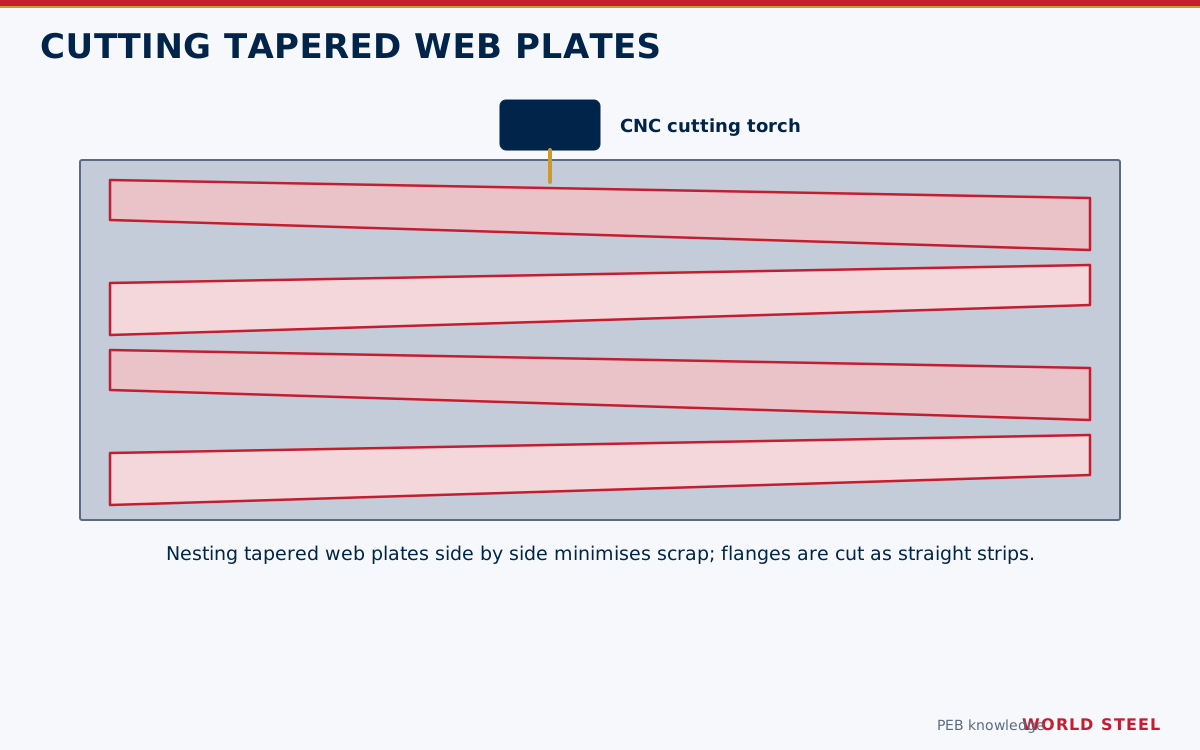
Webs are nested by software that reads the detailing model and arranges parts to minimise offcut. Tapered webs are nested head-to-tail so that adjacent parts share a diagonal cut. The nesting file also carries part marks, which are scribed or printed on each part, and heat number information so that traceability is not lost once the plate is cut.
- Web depth tolerance – controls the final depth of the member and the fit of end plates; it is set by the governing fabrication standard (AS/NZS 5131, EN 1090-2 or AISC 303).
- Straightness of cut edges – a wavy web edge creates gaps at the flange-to-web joint and weld quality problems.
- Squareness at ends – web ends must match the end-plate geometry so that the end plate sits flat.
- Edge quality – cut-surface quality is assessed against ISO 9013 (range of perpendicularity and mean roughness); EN 1090-2 links the required quality to the execution class.
Edge condition and hardness
Thermal cutting creates a hardened, oxidised zone on the cut edge. For most PEB members this is removed or rendered harmless by grinding and subsequent blasting. Where edges are free edges in fatigue-loaded members, such as crane runway girders, or where execution class rules apply, the fabricator may need to demonstrate that cut-edge hardness stays within limits – EN 1090-2 requires process qualification for thermal cutting for this reason. Corners and notches are rounded to avoid stress raisers, and sharp edges are ground to a radius before painting so that the coating builds proper thickness on the edge.
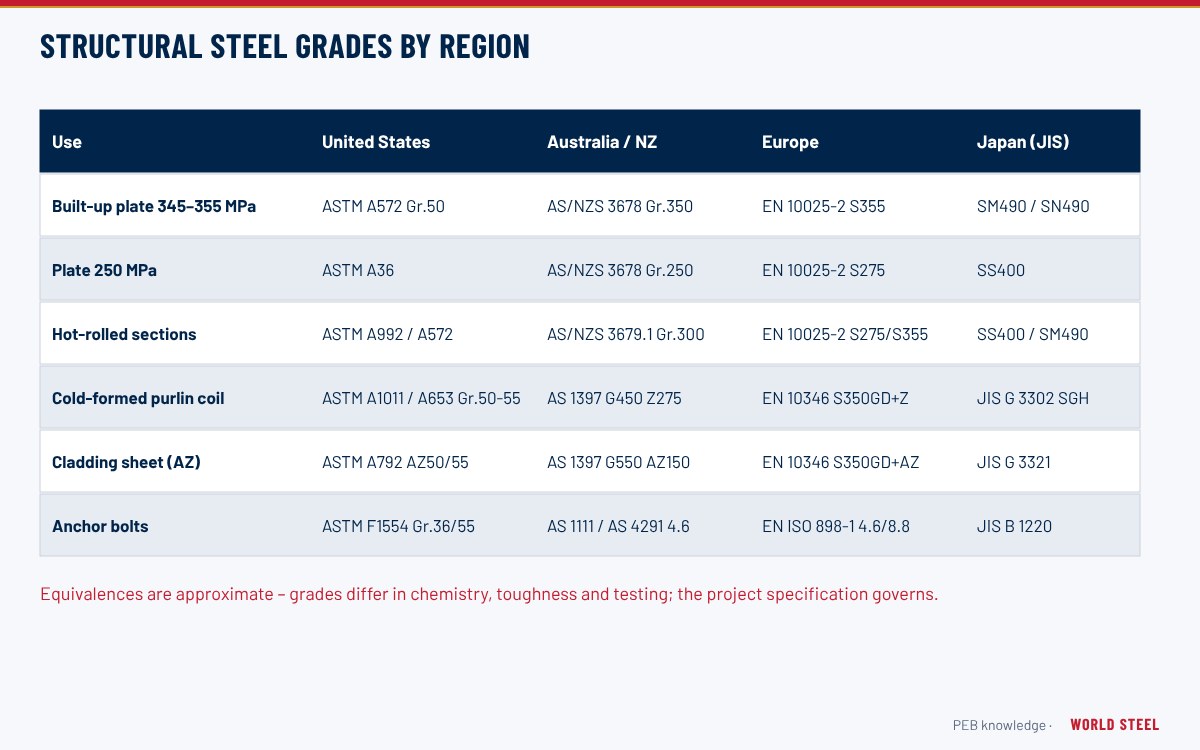
Plates must be cut with the rolling direction considered where the design calls for it, and the plate grade must be checked against the mill certificate before cutting – see structural steel plate grades.
Holes: drilling, punching and standard sizes
Bolt holes in end plates, base plates, splice plates and connection clips are made by CNC drilling, punching or, for some codes and thicknesses, thermal cutting. Hole quality and size directly affect fit-up on site and the behaviour of bolted connections.
- Drilling gives the best hole quality and is used for thick end plates, base plates and fatigue-loaded members. CNC drilling lines drill flanges and webs of finished members in one pass.
- Punching is fast and economical for thinner plates and clips. AISC 360-22 generally allows punching full size where material thickness does not exceed the bolt diameter plus about 3 mm (1/8 in); EN 1090-2 restricts punching without reaming in higher execution classes; AS/NZS 5131 has its own limits for punched holes. Fatigue-loaded details normally need drilled or sub-punched and reamed holes.
- Thermally cut holes are permitted by some codes under conditions (for example plasma holes meeting specified roughness), but should be agreed for structural connections.
| Code | Bolts up to about M24 | Bolts M27 and above |
|---|---|---|
| AISC 360-22 (metric bolts) | d + 2 mm | d + 3 mm |
| AS 4100 / AS/NZS 5131 | d + 2 mm | d + 3 mm |
| EN 1090-2 | d + 1 mm (M12–M14), d + 2 mm (M16–M24) | d + 3 mm |
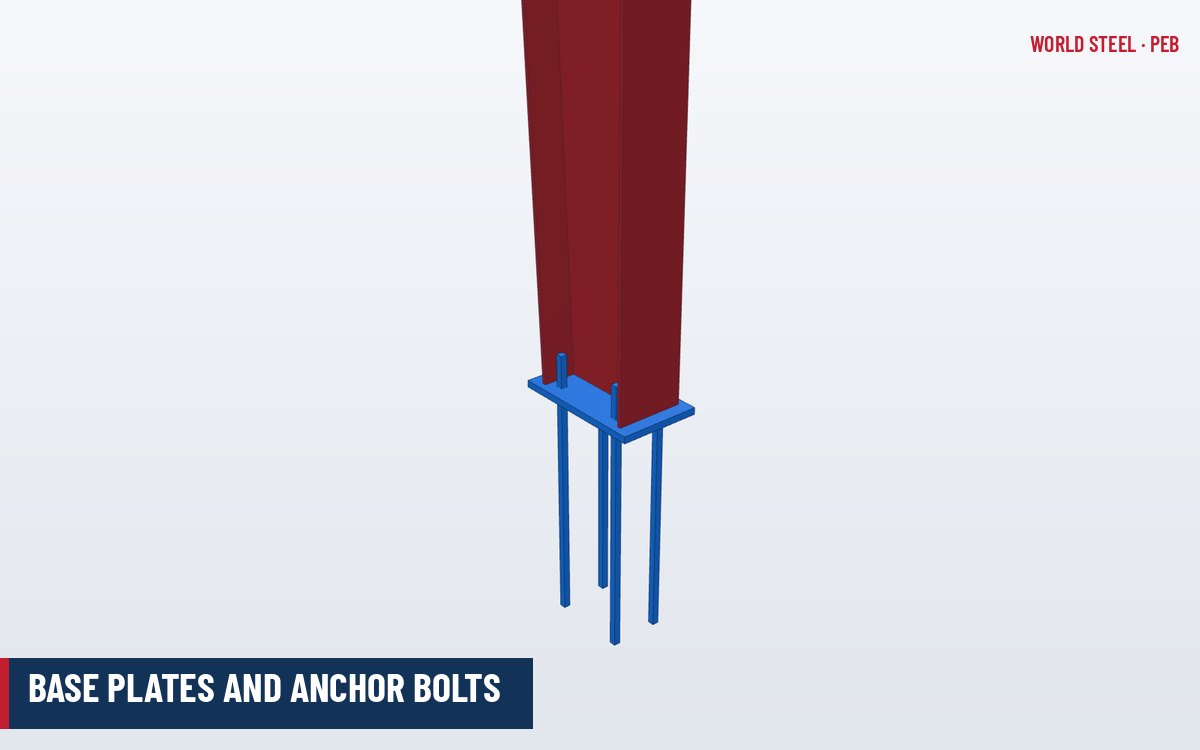
Oversized and slotted holes are used for erection adjustment – for example in purlin cleats, girt clips and crane runway seats – but their use in slip-critical or pretensioned joints must be accounted for in design. Anchor rod holes in base plates are deliberately oversized and are combined with heavy plate washers welded or fitted on site, following guidance such as AISC Design Guide 1.
WSC practice
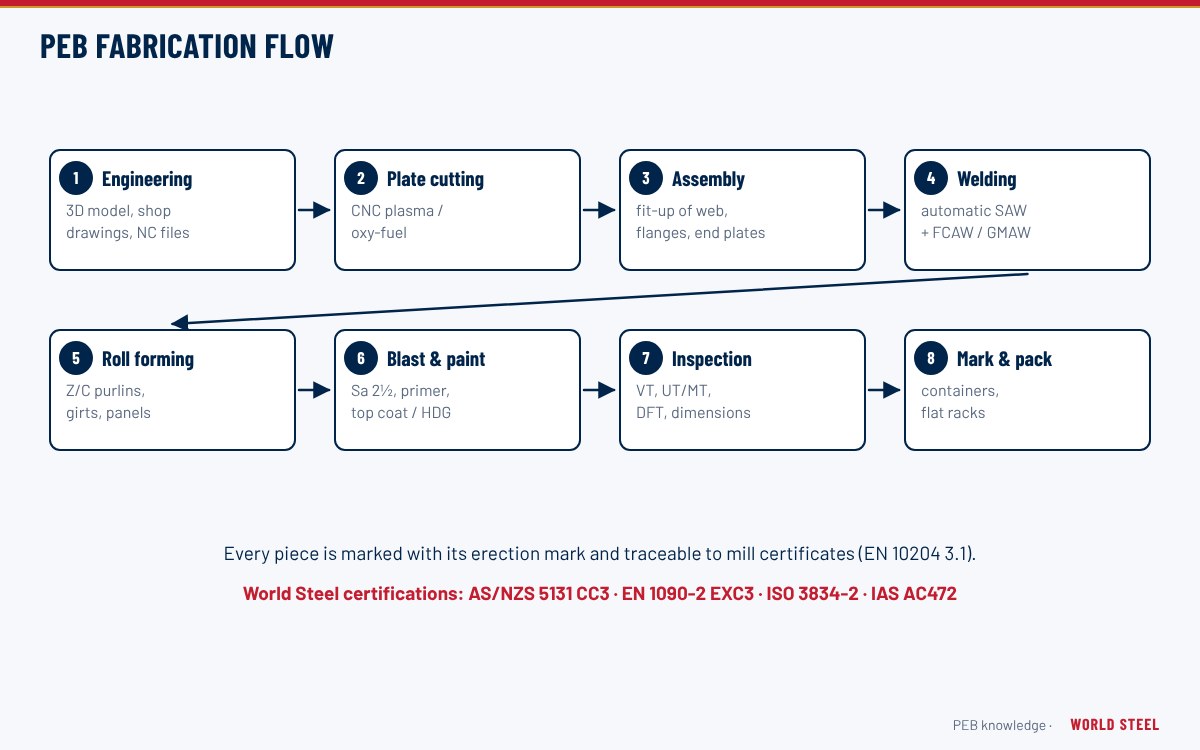
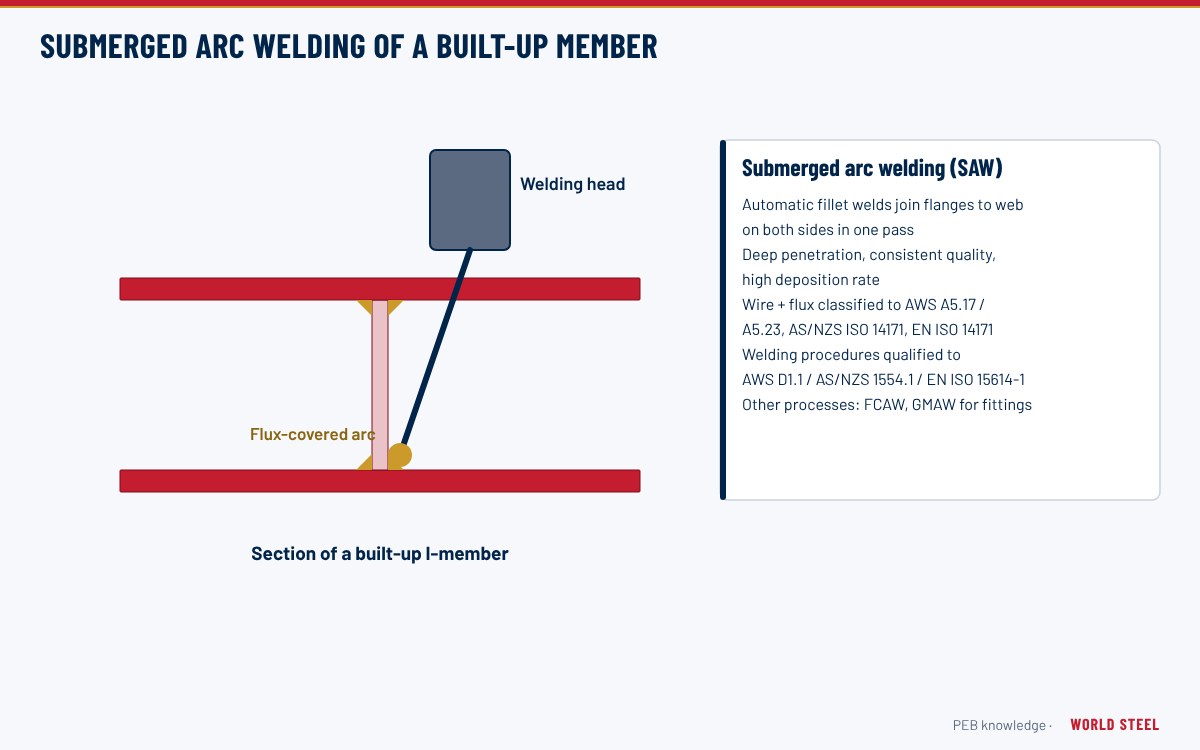
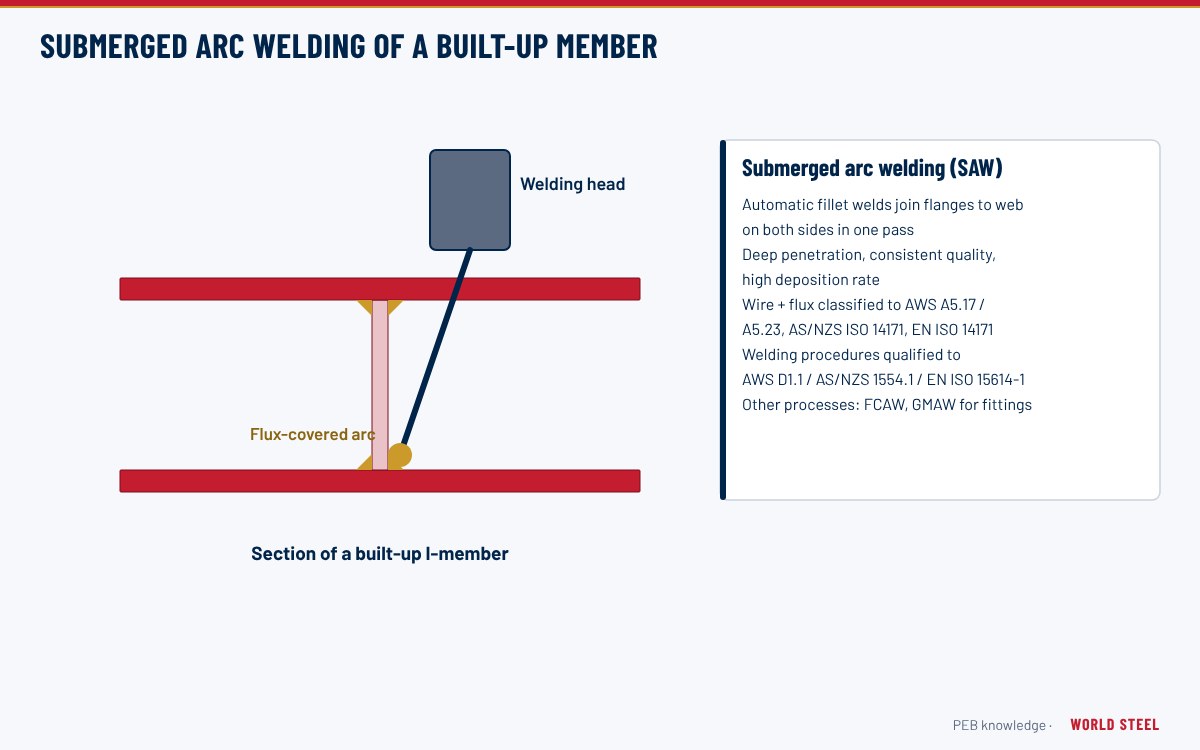
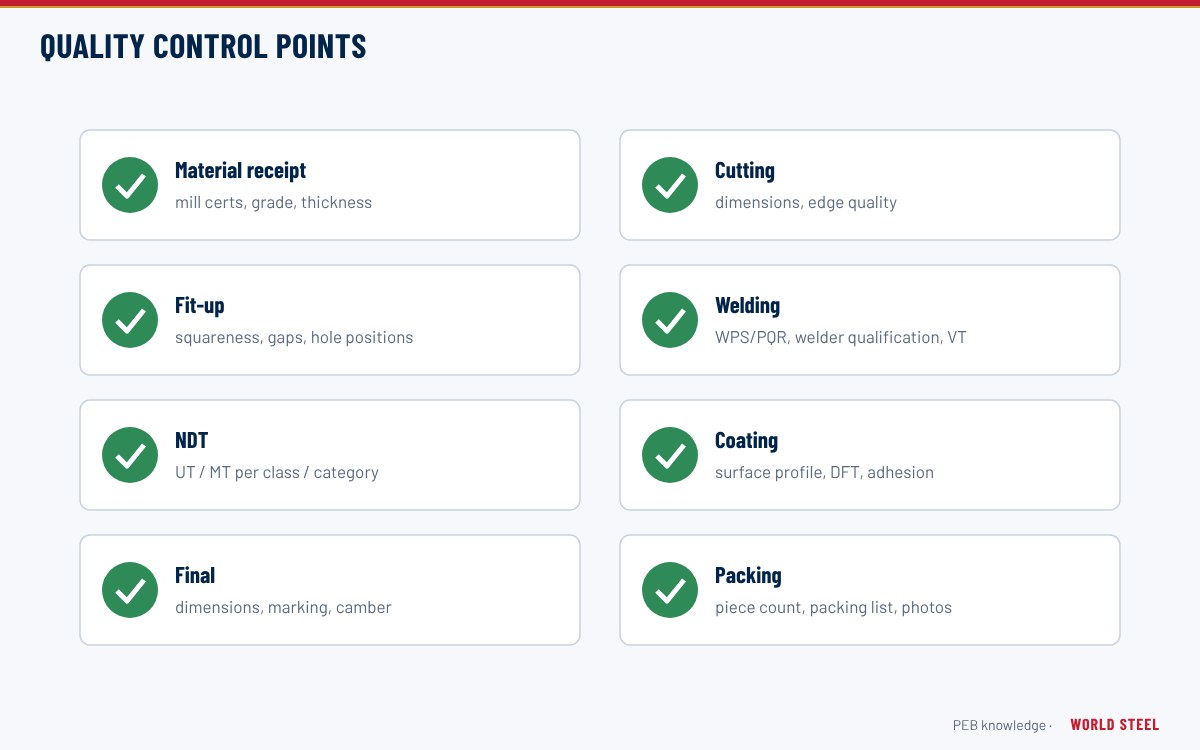
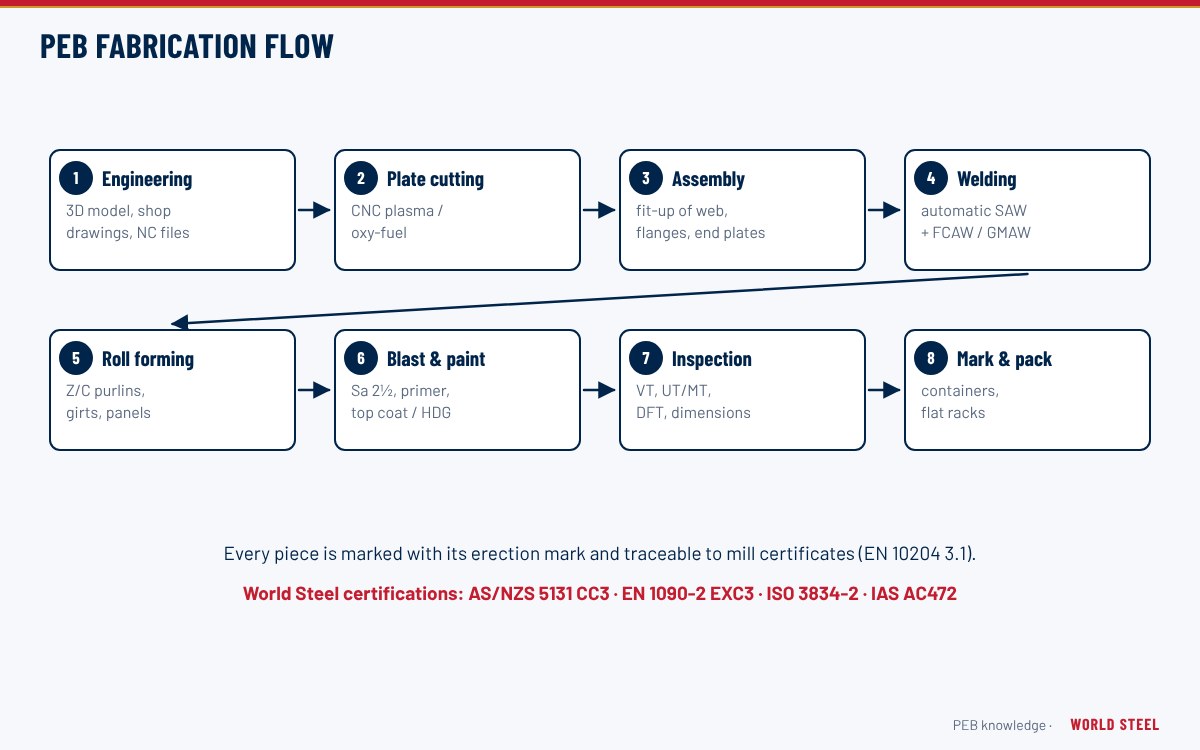
World Steel cuts webs and flanges on CNC plasma and multi-torch oxy-fuel lines driven directly from the detailing model, with part marks and heat numbers transferred to every part. Cut parts are inspected for dimensions and edge quality before release to fit-up, under a quality system aligned with EN 1090-2 EXC3, AS/NZS 5131 CC3 and ISO 3834-2. The parts then move to automatic welding. Learn more about WSC manufacturing.
Tiêu chuẩn theo khu vực
| Khu vực | Tiêu chuẩn | Phạm vi |
|---|---|---|
 United States |
AISC 303 / AWS D1.1 | Code of standard practice; thermal-cut edge requirements for welded joints |
 Canada |
CSA W59 | Welded steel construction – preparation of material |
 Australia / NZ |
AS/NZS 5131:2016 | Fabrication – cutting, holing and edge conditions |
 Europe |
EN 1090-2 | Cutting, hardness of free-edge surfaces, process qualification |
| International | ISO 9013 | Thermal cutting – classification and quality tolerances |
Câu hỏi thường gặp
Is plasma or oxy-fuel better for cutting PEB webs?
For the thin and medium plates typical of PEB webs, CNC plasma is faster and causes less distortion. Oxy-fuel remains the economical choice for thick plates and for multi-torch strip cutting of flanges.
Do thermally cut edges need grinding?
Edges that will be welded or painted are normally cleaned of dross and sharp corners are rounded. Additional requirements such as hardness limits apply for higher execution classes and fatigue-loaded members.
How is traceability kept after plate is cut?
The nesting file links each part to the plate and its heat number, and the part mark is transferred to every cut piece so that the mill certificate can be traced to the finished member.