ENEnglish
 VITiếng Việt
 ZH中文
 KO한국어
 JA日本語
 FRFrançais
 ITItaliano
 PTPortuguês
 ESEspañol
 HEעברית
 ARالعربية

What cold-formed steel is
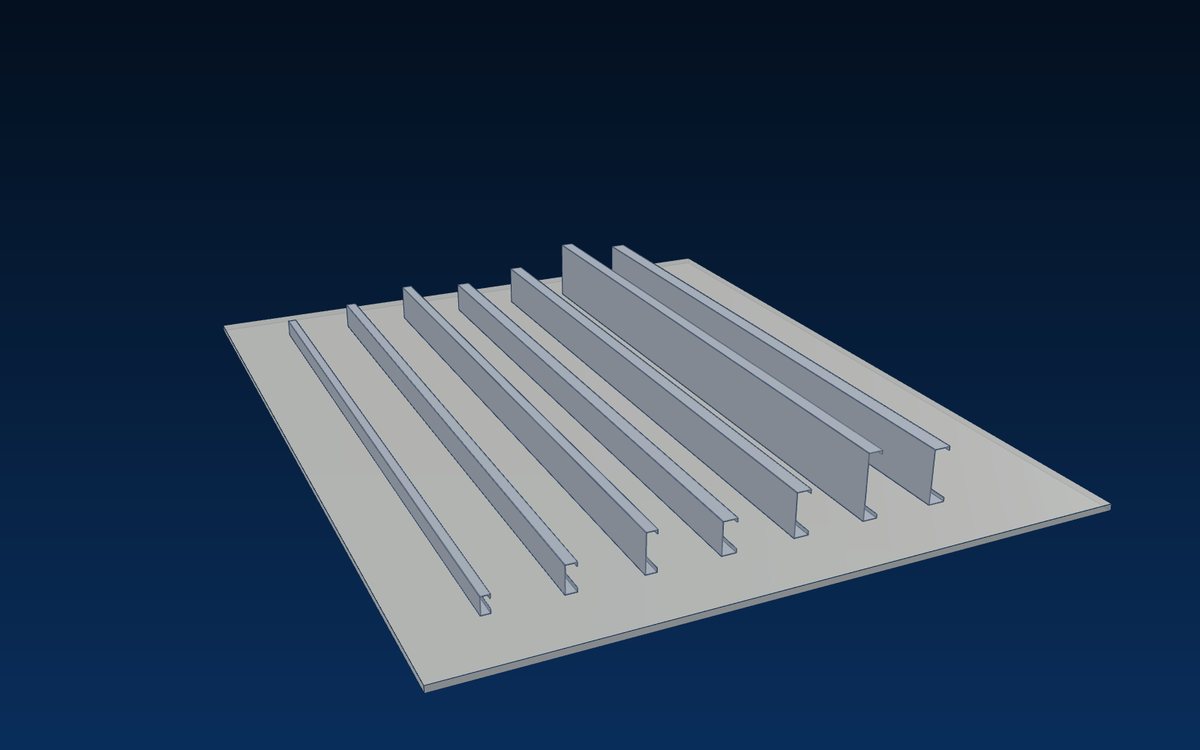
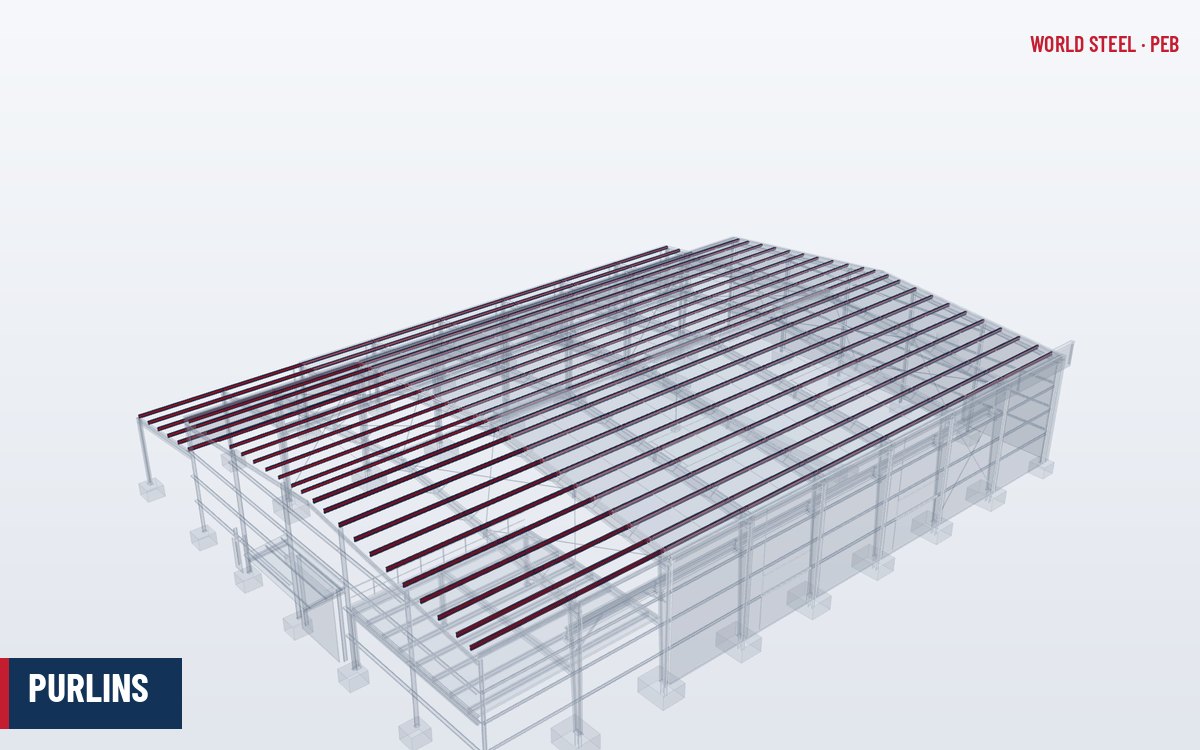
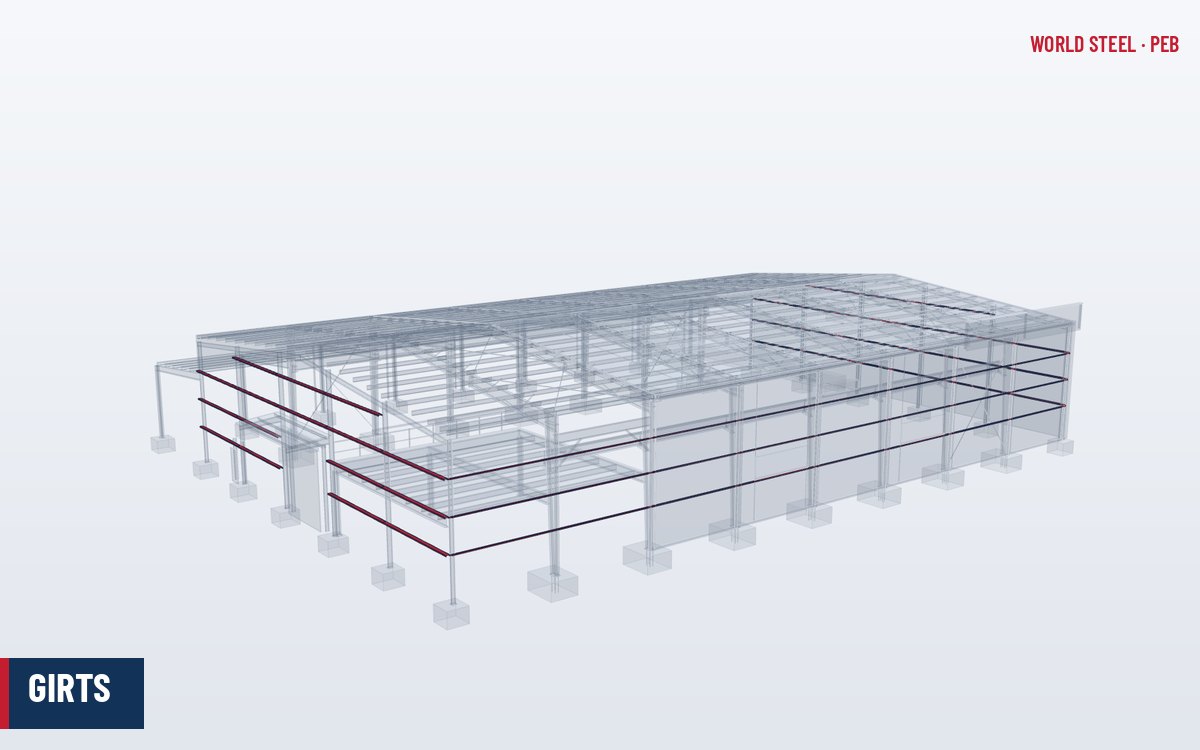
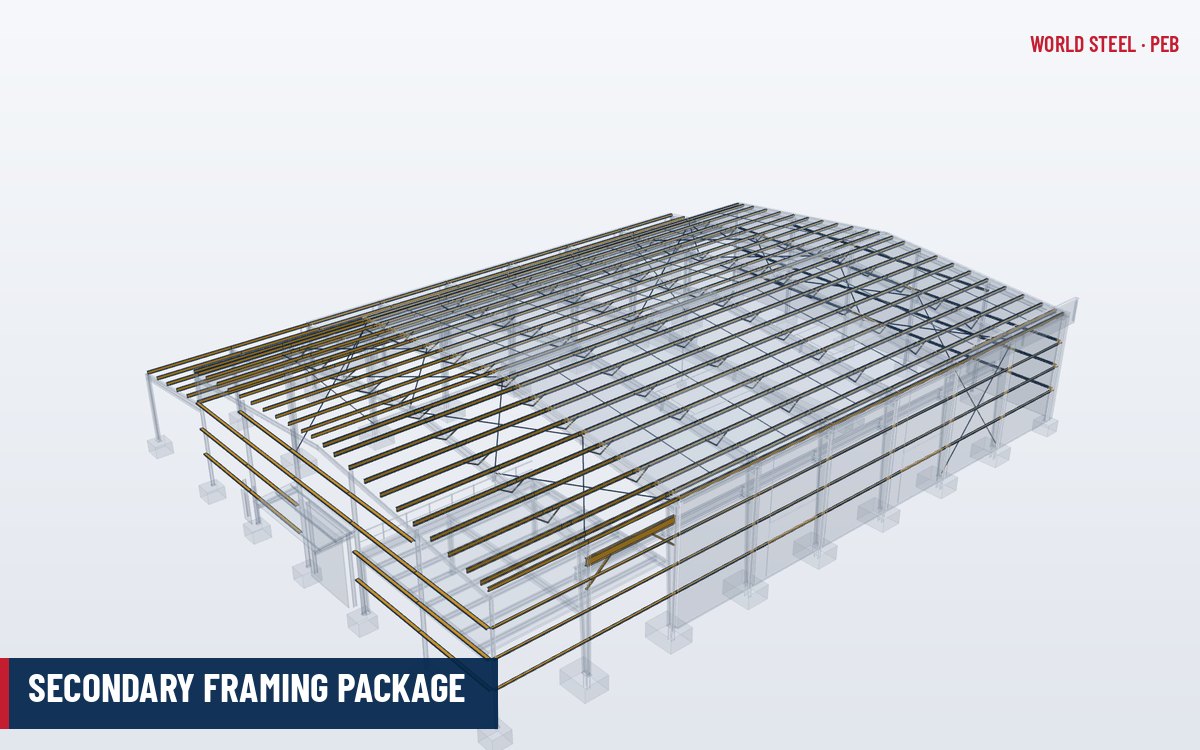
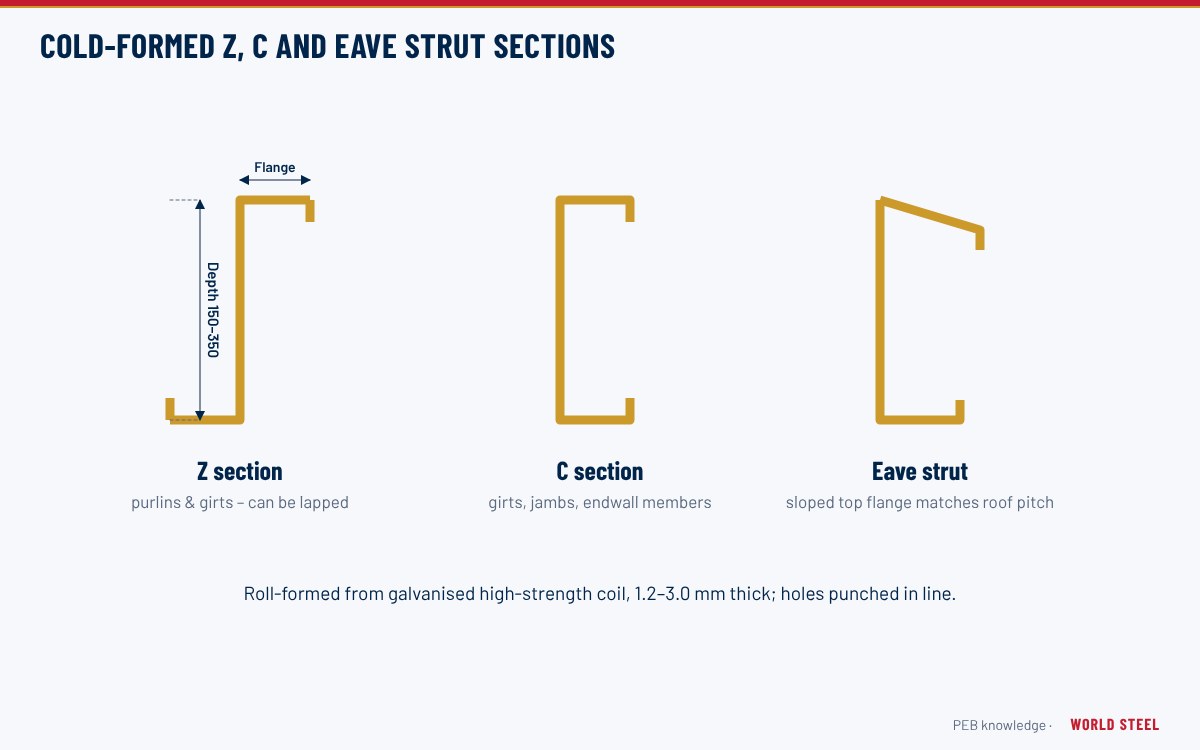
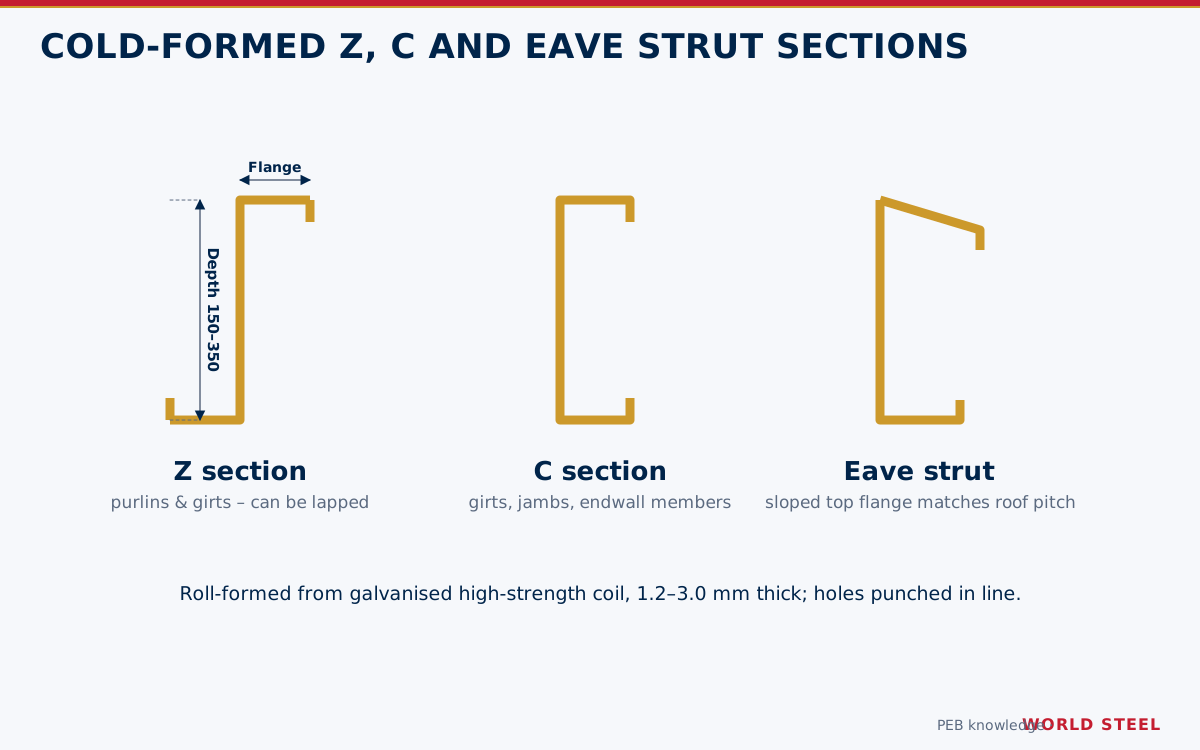
Cold-formed steel sections are shaped at room temperature from thin flat strip by roll forming or press braking. In pre-engineered buildings they form the secondary framing: Z and C purlins, girts, eave struts, door jambs and flange braces. Typical thicknesses are about 1.5–3.0 mm and depths 150–350 mm. Because the sections are thin, they are efficient but susceptible to local, distortional and lateral-torsional buckling, which is why they are designed to dedicated cold-formed codes rather than hot-rolled steel codes.
Coil types and grades
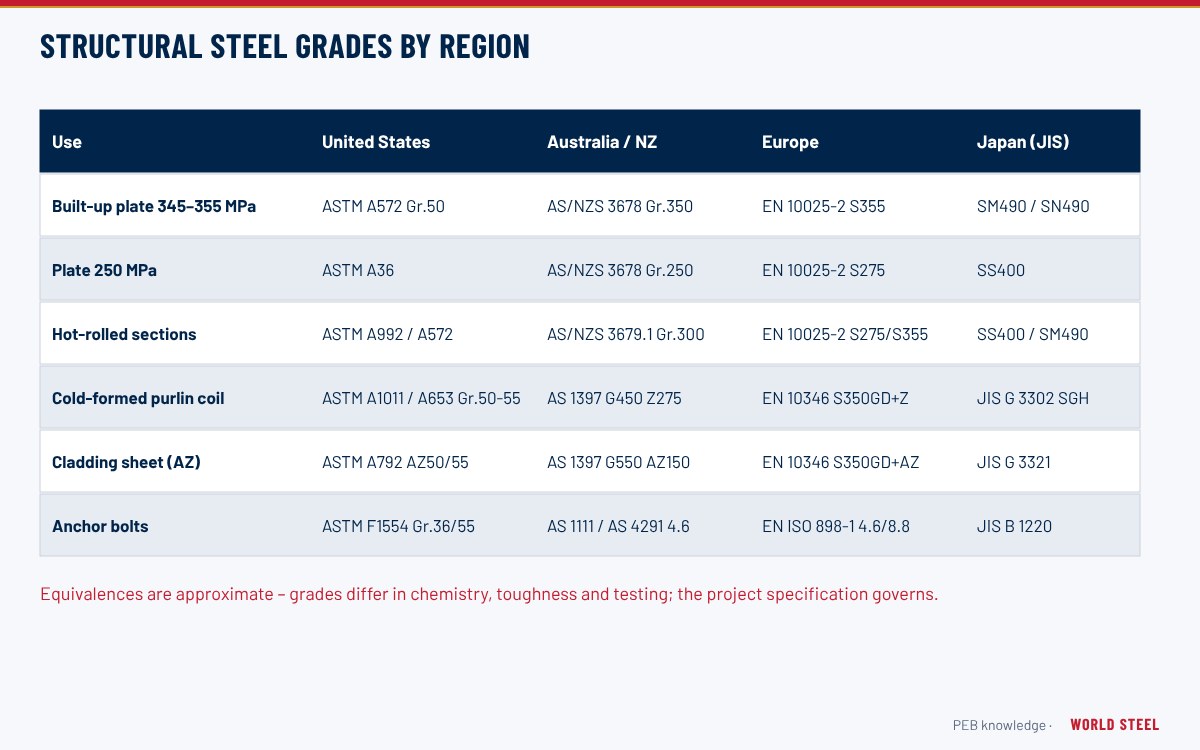
| Type | USA (ASTM) | Australia / NZ | Europe | Japan |
|---|---|---|---|---|
| Hot-rolled (black), ~340–380 MPa | A1011 SS Grade 50 / HSLAS Grade 50–55 | AS/NZS 1594 HA350 / HW350 | EN 10149-2 S355MC | – |
| Galvanized, ~340–350 MPa | A653 SS Grade 50 (340 MPa) | AS 1397 G350 | EN 10346 S350GD+Z | JIS G3302 SGC440 |
| Galvanized, ~450 MPa | A653 SS / HSLAS Grade 60–70 (approx.) | AS 1397 G450 | EN 10346 S450GD+Z | – |
| Galvanized, ~550 MPa | A653 SS Grade 80 (550 MPa) | AS 1397 G550 | EN 10346 S550GD+Z | JIS G3302 SGC570 |
Very high-strength grades (G550, Grade 80) usually have limited elongation; codes reduce the design strength or restrict their use in some applications (for example AS/NZS 4600 and AISI S100 provisions for low-ductility steels). Purlins in Australia are commonly G450 with Z350 coating, while US metal building purlins are often Grade 55 hot-rolled or galvanized material.
Galvanized or black steel?
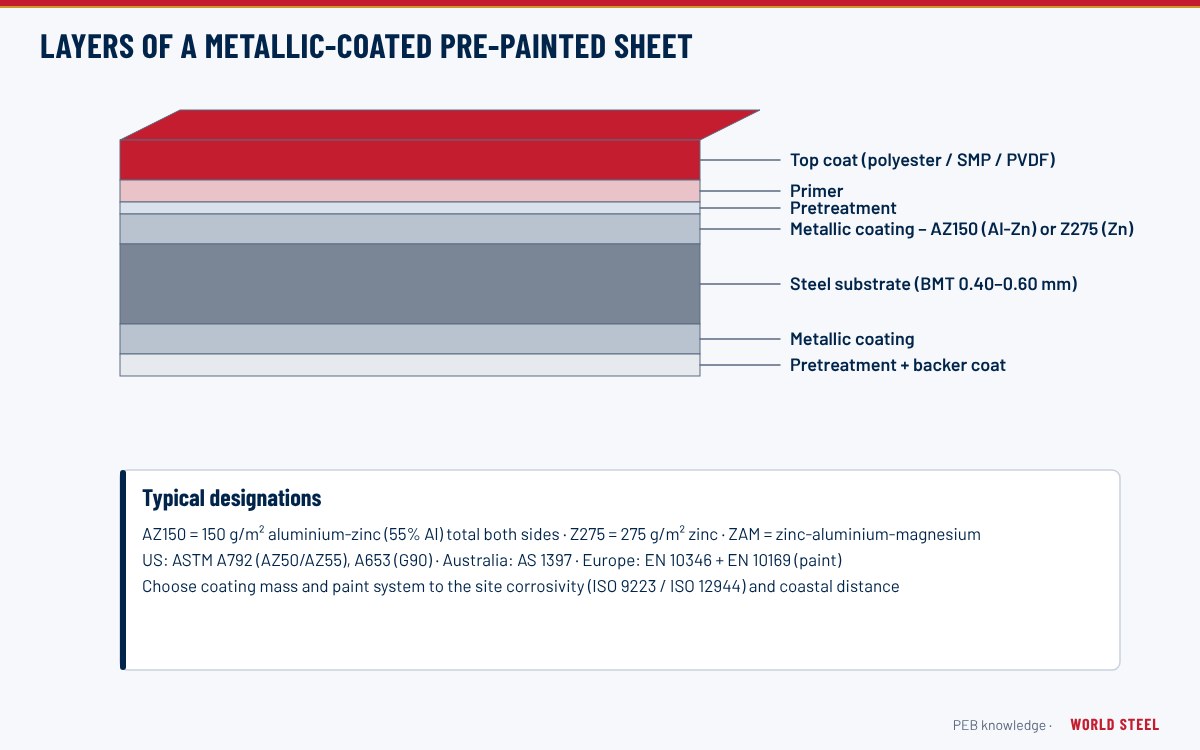
- Pre-galvanized (Z) coil: zinc coating applied at the mill (e.g. Z275 / G90 in US terms, Z350 in Australia); sections are punched after forming with cut edges protected by the zinc's sacrificial action. Good durability for enclosed buildings; no painting required.
- Hot-rolled black coil: lower material cost; shop primed or painted after forming. Common in North American metal buildings and for dry interior environments.
- Hot-dip galvanized after forming: heavy coating for agricultural or corrosive buildings.
- ZAM (Zn-Al-Mg) coil: increasingly used for improved cut-edge and coastal performance at lower coating mass – see metallic-coated sheet.
Choose the coating to the building's environment: open-sided, livestock, coastal and chemical environments need heavier protection than closed warehouses.
Design codes and fabrication
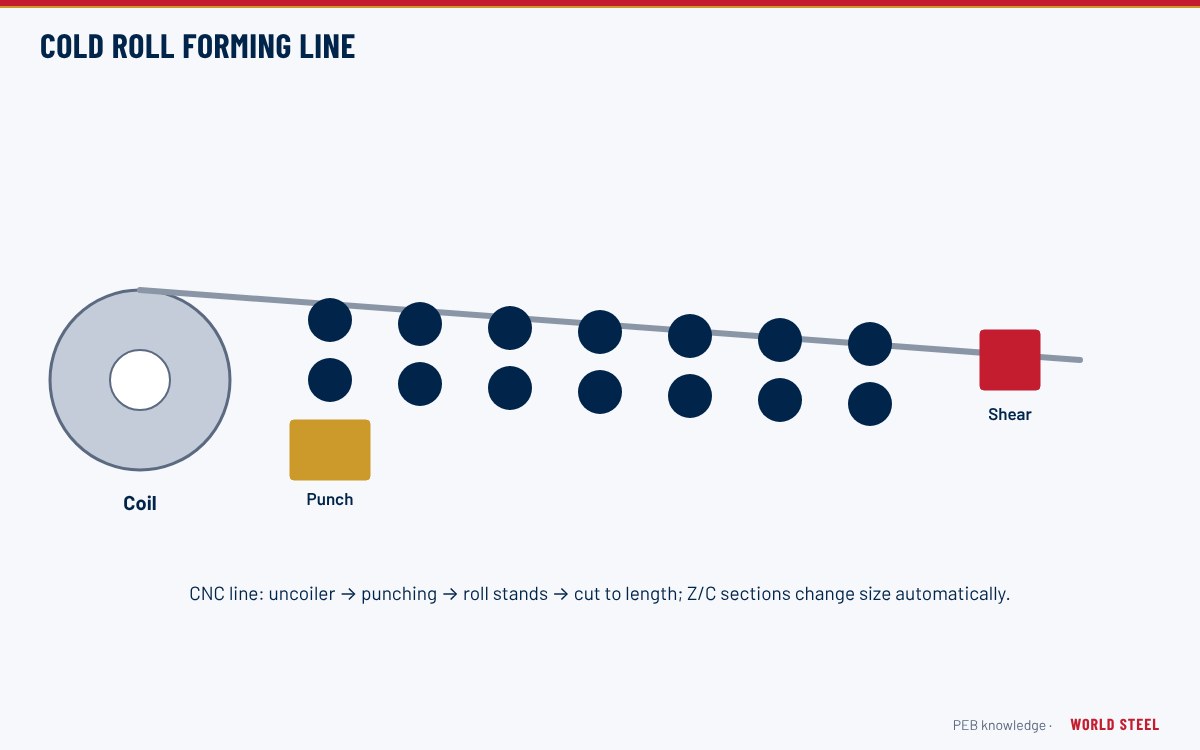
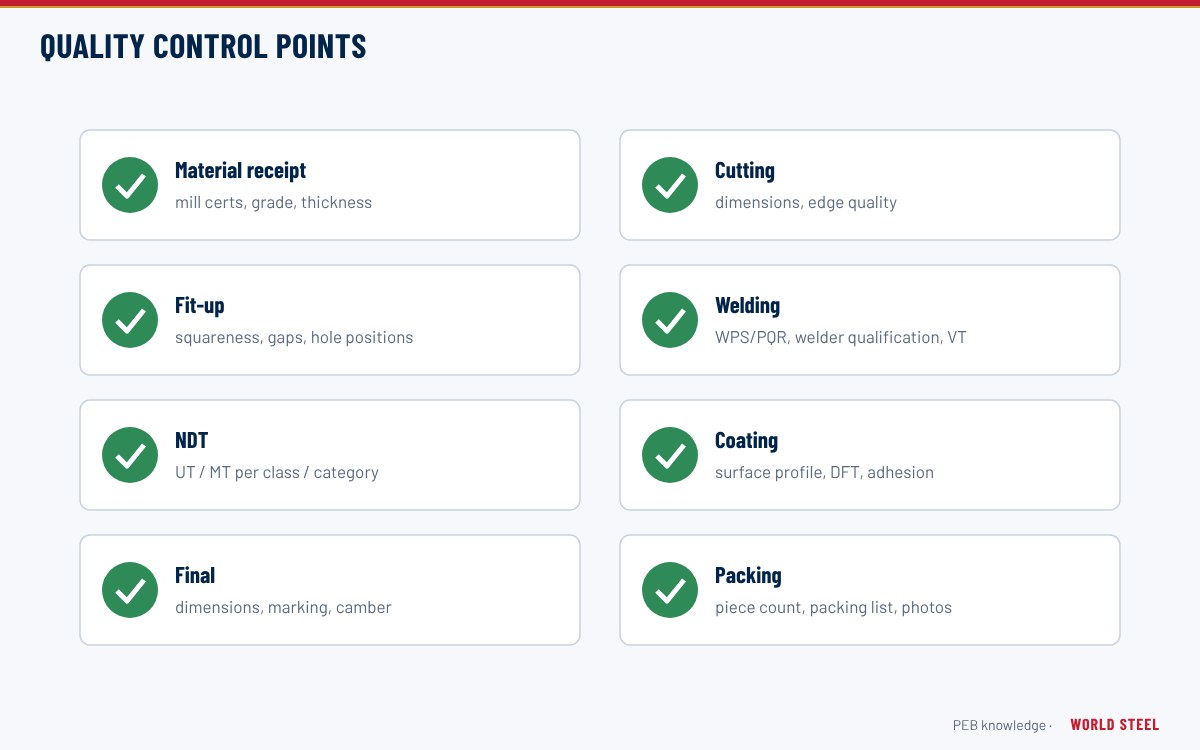
Cold-formed members are designed to AISI S100-16 (reaffirmed 2020) in the US, CSA S136-16 in Canada, AS/NZS 4600:2018 in Australia and New Zealand and EN 1993-1-3 in Europe. Section capacities depend on the effective width method or the direct strength method, and purlin systems benefit from lapping over supports (see purlins). Base metal thickness (BMT), not total coated thickness, is used in design and must be checked on delivery. Coil is ordered by grade, coating mass, width and BMT; incoming coils are checked against the mill certificate for yield strength, coating mass and thickness tolerance before roll forming. Punching of holes for bolts, sag rods and bracing is done inline, so hole positions must match the purlin and girt layout exactly. Because the section is thin, handling, bundling and storage on site matter: bundles should be kept dry and ventilated to avoid white rust on galvanized material. Roll-forming, punching and cutting are covered in cold roll forming.
Material requirements, testing and acceptance
Cold-formed design codes assume a minimum level of ductility and accurate thickness, so incoming coil is checked against more than just the grade name.
| Property | Typical requirement or method | Reference examples |
|---|---|---|
| Yield and tensile strength | Tensile test per heat or coil, compared with the grade minimum | ASTM A370, ISO 6892-1, AS 1391 |
| Ductility | Ratio of tensile to yield strength and elongation above code minimums (for example Fu/Fy of at least about 1.08 with about 10% elongation in AISI S100); low-ductility steels attract reduced design values | AISI S100-16, AS/NZS 4600:2018, EN 1993-1-3 |
| Base metal thickness | Measured after removing coating, or calculated from total thickness minus coating; tolerances per product standard | ASTM A924, AS 1397, EN 10143 |
| Coating mass | Triple-spot and single-spot tests or calibrated gauges | ASTM A90, AS 1397, EN 10346 |
| Surface condition | No white rust, laminations, edge cracks or excessive camber | Visual inspection on receipt |
For galvanized purlins, typical coating masses are Z275 (G90) for enclosed industrial buildings and Z350–Z450 or Zn-Al-Mg coatings for humid, open-sided or near-coastal buildings. Where a heavier coating is not available on coil, hot-dip galvanizing after fabrication to ISO 1461, ASTM A123 or AS/NZS 4680 is an option, but it adds cost and can cause distortion in thin sections.
Sources and WSC supply
Galvanized coil for purlins is produced in Vietnam by coated-steel mills and also imported; hot-rolled coil is produced by integrated mills such as Hoa Phat, Formosa Ha Tinh and China Steel Sumikin Vietnam. World Steel roll-forms Z and C sections in-house, selecting grade and coating to suit the destination code and environment, and supplies them as part of its secondary members package.
Tiêu chuẩn theo khu vực
| Khu vực | Tiêu chuẩn | Phạm vi |
|---|---|---|
 United States |
AISI S100-16 (2020) | North American specification for cold-formed steel structural members |
| United States |
ASTM A653 / A1011 | Galvanized sheet; hot-rolled sheet and strip |
 Canada |
CSA S136-16 | Canadian edition of the North American cold-formed specification |
 Australia / NZ |
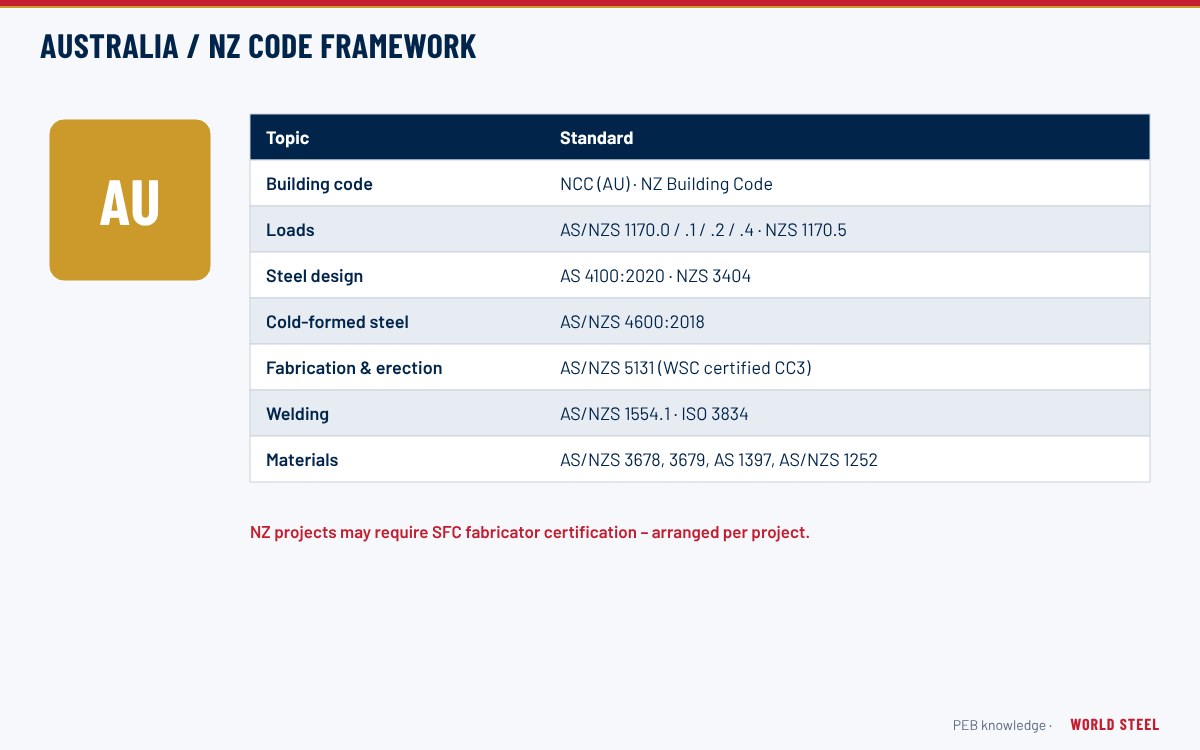
AS/NZS 4600:2018 | Cold-formed steel structures |
| Australia / NZ |
AS 1397 | Continuous hot-dip metallic coated steel sheet and strip |
 Europe |
EN 1993-1-3 | Cold-formed members and sheeting |
| Europe |
EN 10346 | Continuously hot-dip coated steel flat products |
Câu hỏi thường gặp
What steel grade is used for PEB purlins?
Typically high-strength coil of about 340–450 MPa yield, such as AS 1397 G450, EN 10346 S450GD or ASTM A653 / A1011 Grade 50–55, either pre-galvanized or hot-rolled and primed.
Are galvanized purlins better than painted black purlins?
Pre-galvanized purlins usually offer better long-term corrosion protection in enclosed buildings and need no painting. Primed black purlins are cheaper and suitable for dry interiors.
What is BMT?
Base metal thickness – the steel thickness excluding the metallic coating. Design and inspection of cold-formed sections use BMT.