ENEnglish
 VITiếng Việt
 ZH中文
 KO한국어
 JA日本語
 FRFrançais
 ITItaliano
 PTPortuguês
 ESEspañol
 HEעברית
 ARالعربية

Why serviceability matters
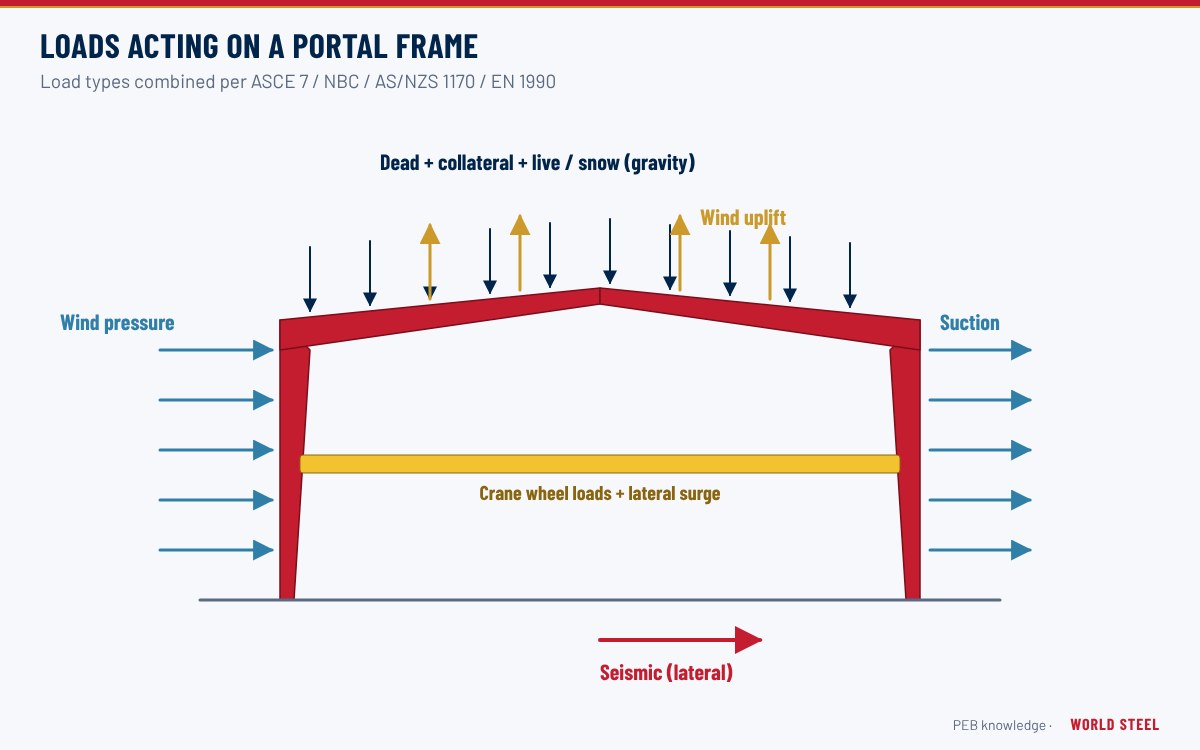
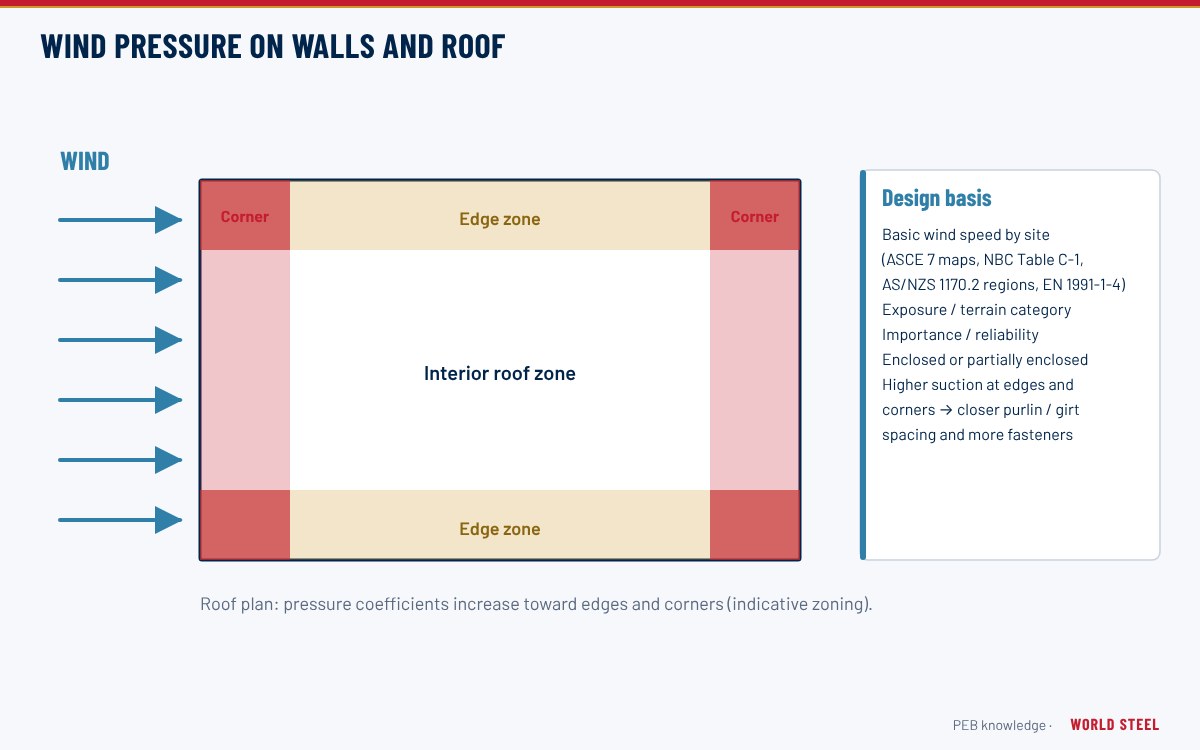
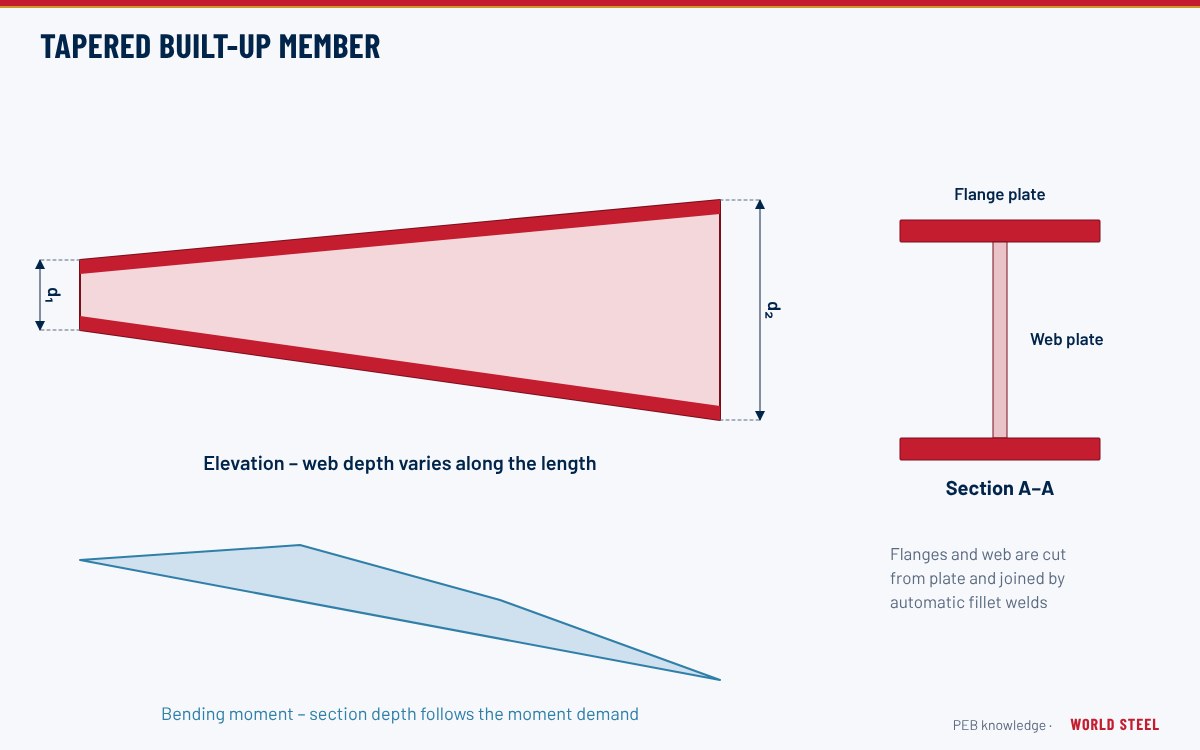
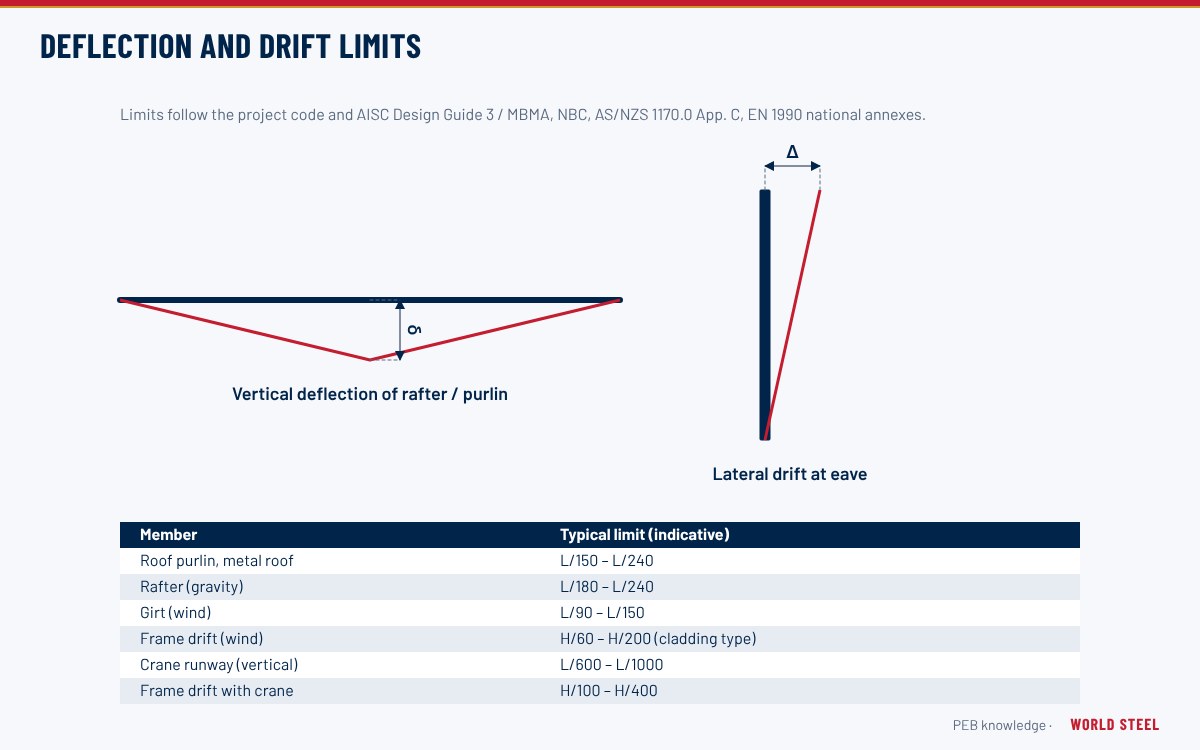
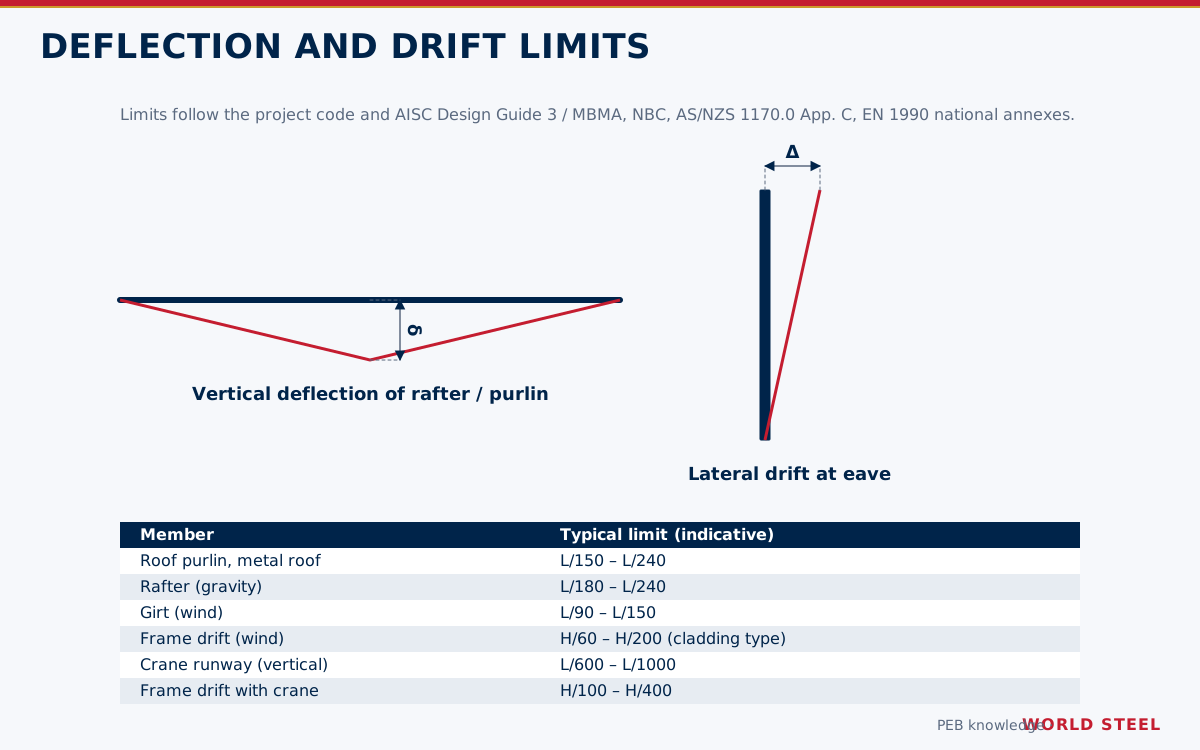
A steel frame can be strong enough yet still too flexible for its use. Excessive deflection can crack masonry walls and finishes, damage cladding and sealants, cause ponding on low-slope roofs, misalign crane runways, jam doors, or simply alarm occupants. Serviceability limits are not safety limits; most codes leave them to the designer and owner, giving recommendations rather than mandatory values. Because PEB members are optimised for strength, serviceability often controls the final member size – especially for rafters, girts and crane buildings – so limits should be agreed in the design criteria rather than left to default. The loads used are service-level: unfactored gravity loads and wind with a shorter return period (see design loads).
Typical limits – US practice
For metal buildings in the United States, guidance comes from the MBMA Metal Building Systems Manual (2018), AISC Design Guide 3 (Serviceability Design Considerations for Steel Buildings, 2nd ed.) and IBC Table 1604.3. The following are typical values; project specifications may differ.
| Element | Load | Typical limit |
|---|---|---|
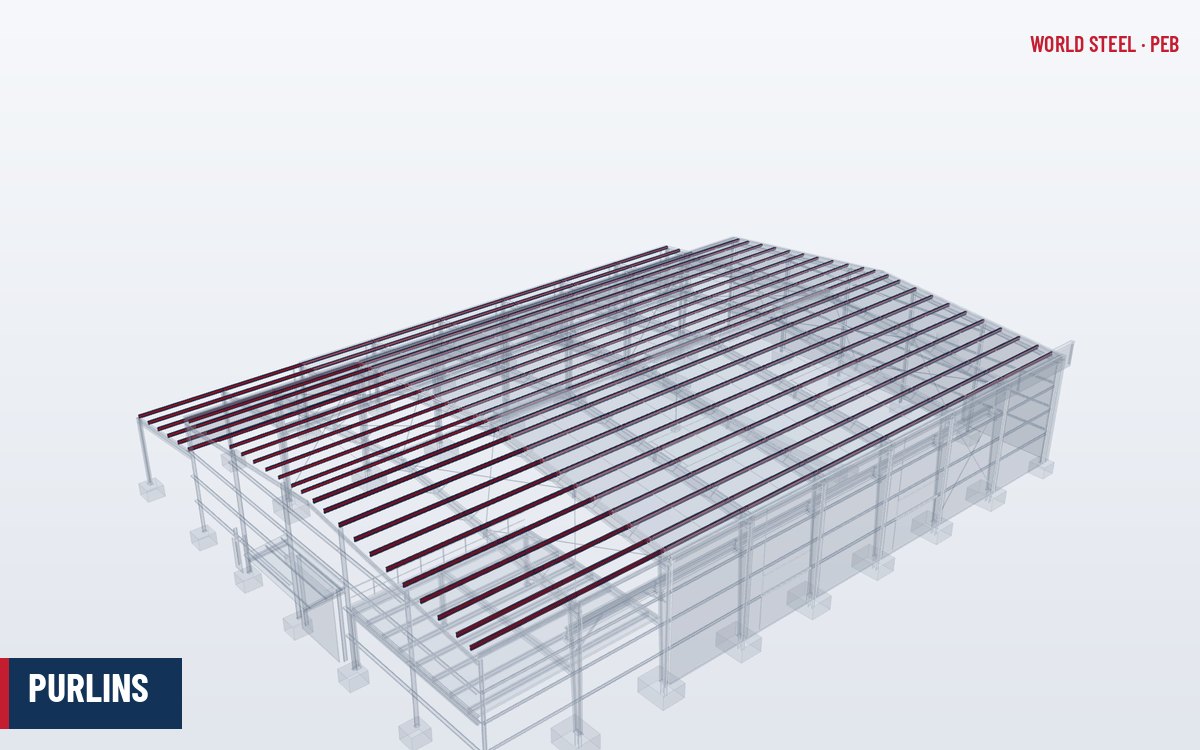
| Roof members, no ceiling | Live / snow | L/180 (IBC); L/150 often used for purlins under metal roofs (DG3) |
| Roof members supporting non-plaster ceiling | Live / snow | L/240 |
| Roof members supporting plaster ceiling | Live / snow | L/360 |
| Girts with metal wall panels | 10-year wind | L/90 to L/120 |
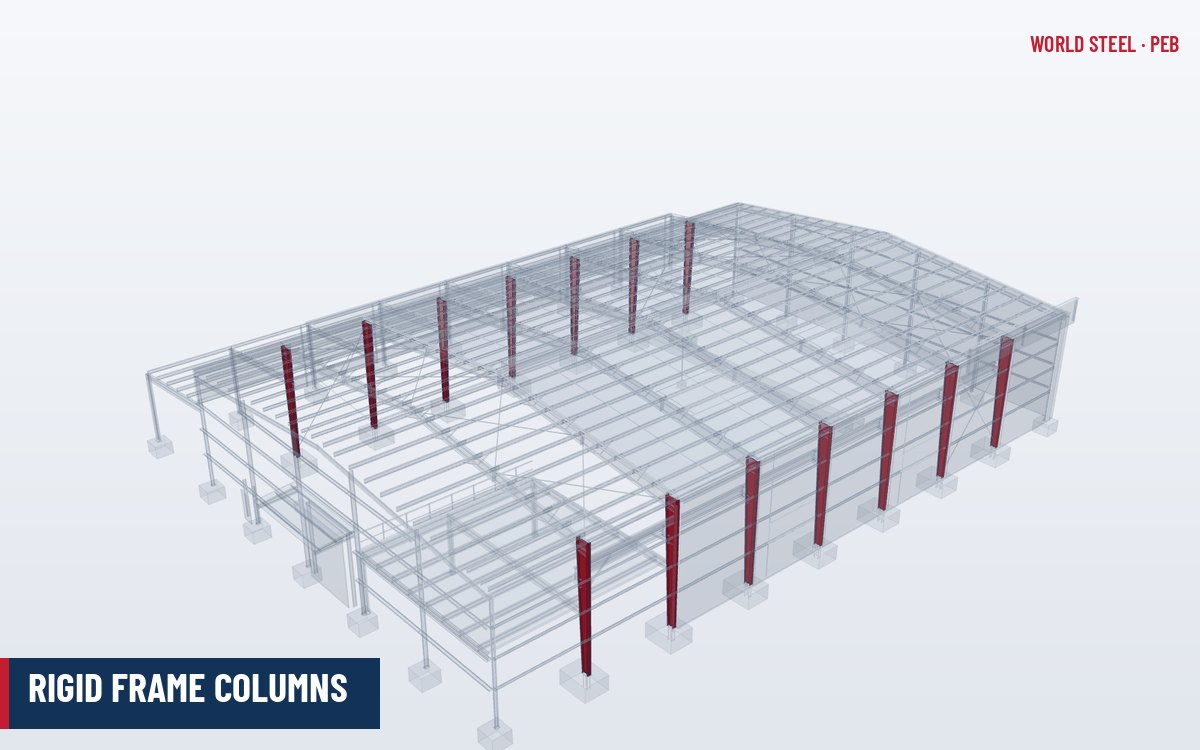
| Frame drift, metal wall panels | 10-year wind | H/60 to H/100 |
| Frame drift, masonry or brittle walls | 10-year wind | Much tighter – per DG3 recommendations for wall type |
| Frame drift at pendant crane runway | Crane lateral or 10-year wind | H/100 |
| Frame drift at cab-operated crane runway | Crane lateral or 10-year wind | H/240, max. about 50 mm |
| Floors | Live / total | L/360 / L/240 |
Seismic drift is a separate code requirement (allowable storey drift in ASCE 7-22 Table 12.12-1), checked with amplified deflections.
Canada, Australia / NZ and Europe
- Canada: CSA S16-19 Annex D gives recommended deflection limits; NBC 2020 requires serviceability checks with specified (unfactored) loads, and wind serviceability is commonly based on the 1-in-10-year pressure for drift-sensitive checks.
- Australia / NZ: AS/NZS 1170.0 Appendix C gives suggested serviceability criteria for elements, using serviceability wind Ws (commonly taken as a 1-in-20 to 1-in-25-year event in Australian practice). Portal frame eave deflections in the range of roughly H/150 to H/300 are commonly adopted depending on cladding and use, together with limits on purlin and girt deflection from the cladding manufacturer.
- Europe: EN 1990 Annex A1.4 defines serviceability criteria, with limits set by the National Annex or project. For example, the UK National Annex to EN 1993-1-1 suggests span/200 for roofs generally and height/300 for column tops in single-storey buildings, except portal frames, whose limits are agreed to suit the cladding.
Limits from one code should not be mixed with service loads from another: a US H/60 limit under a 10-year wind is not equivalent to an Australian limit under a 25-year wind.
Limits for special members and add-on structures
Beyond rafters, girts and frame drift, several members in a PEB need their own criteria. The values below are typical industry guidance used when the specification is silent; they should be stated on the design criteria sheet.
| Member | Load | Typical limit |
|---|---|---|
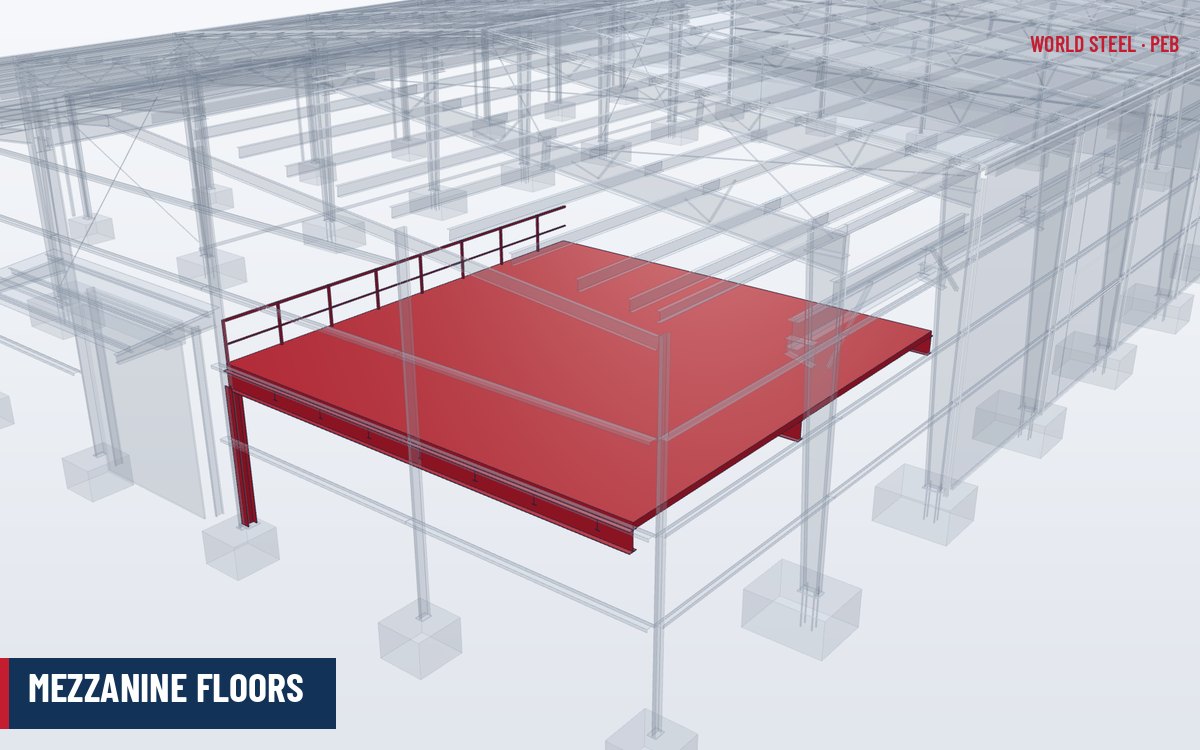
| Mezzanine beams and joists | Live / total | L/360 / L/240; tighter under brittle floor finishes |
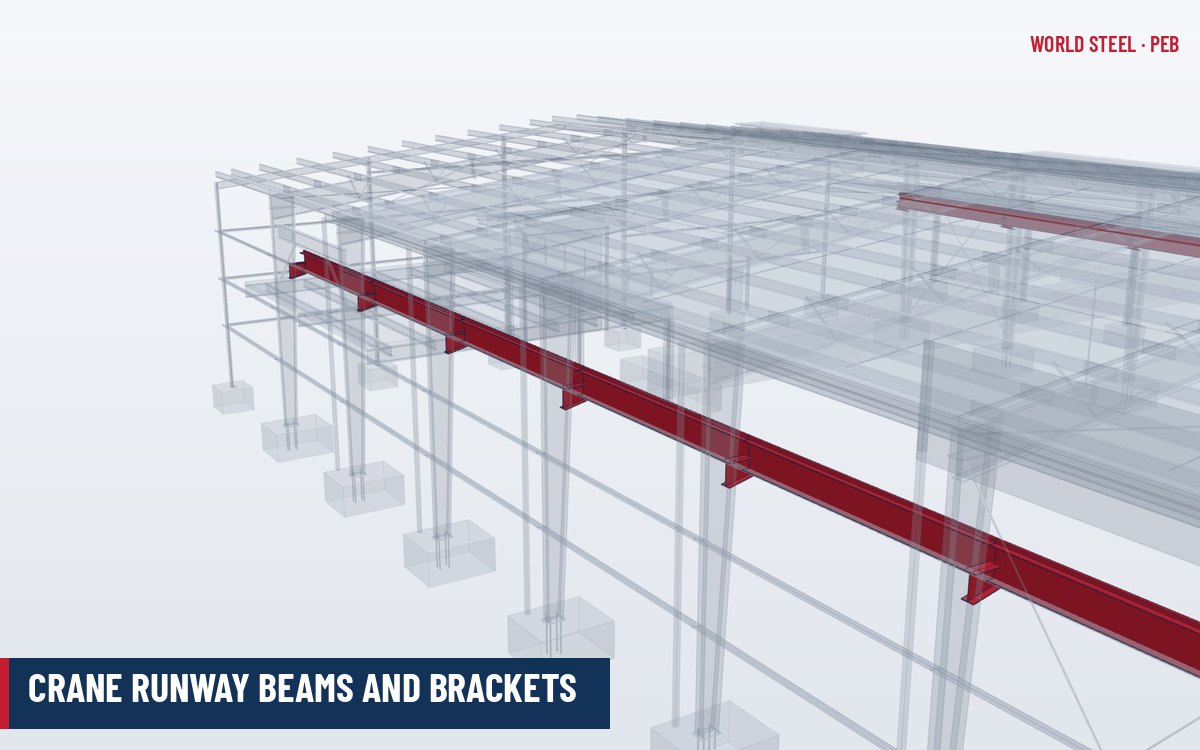
| Top-running crane runway beams | Crane wheel loads, no impact | L/600 (light to medium service) to L/1000 (heavy service) |
| Underhung crane and monorail beams | Crane wheel loads | About L/450 to L/500 |
| Crane runway, lateral | Crane lateral force | About L/400 |
| Frames supporting underhung cranes or monorails | Crane loads | Differential deflection between adjacent frames kept small so the runway stays level – limit set with the crane supplier |
| Door headers and jambs | Wind | Per door manufacturer; commonly L/180 or tighter for roll-up and sliding doors |
| Girts and wind columns supporting masonry or glazing | Wind | About L/240 to L/360, or a fixed millimetre limit |
| Purlins supporting standing seam roofs | Live / snow | Often L/180 to L/240 to protect clip movement and seams |
Mezzanine floors and cranes also bring dynamic criteria – floor vibration and crane runway alignment – which are covered in buildings with mezzanine floors and crane buildings.
Ponding, vibration and other checks
- Ponding: low-slope roofs (below about 1:48 / 1/4 in per ft) need ponding stability checks, especially where parapets or blocked drains can hold water.
- Vibration: mezzanine and office floors – see mezzanine floors and AISC Design Guide 11.
- Crane runways: vertical and lateral deflection limits by crane class – see crane runway beams.
- Thermal movement: long buildings may need expansion joints in roof sheeting and structure.
Agreeing criteria with WSC
World Steel lists all serviceability criteria on the design criteria sheet submitted for client approval before detailed design, and reports deflections in the calculation package. Clients with brittle wall finishes, sensitive equipment or cranes should state their requirements at enquiry so that the optimised frames described in structural optimisation meet them from the start; see also PEB design services.
各地区标准
| 地区 | 规范 | 范围 |
|---|---|---|
 United States |
AISC Design Guide 3 | Serviceability design considerations for steel buildings |
| United States |
MBMA 2018 | Metal Building Systems Manual |
| United States |
IBC 2021 Table 1604.3 | Deflection limits |
 Canada |
CSA S16-19 Annex D | Recommended maximum values for deflections |
 Australia / NZ |
AS/NZS 1170.0 App. C | Guidelines for serviceability limit states |
 Europe |
EN 1990 A1.4 | Serviceability limit states |
| Europe |
EN 1993-1-1 + NA | Deflection limits per National Annex |
常见问题
Are deflection limits mandatory?
Mostly not. Many codes give recommended values and leave the choice to the designer and owner, though some limits, such as seismic drift and certain IBC values, are mandatory.
Why is frame drift often limited to H/60–H/100 for metal buildings in the US?
Metal wall panels tolerate large movements without damage, so MBMA and AISC Design Guide 3 accept relatively flexible frames under a 10-year wind. Brittle walls need much tighter limits.
What happens if serviceability limits are tightened?
Members become deeper or heavier. Stating realistic limits at enquiry avoids redesign and keeps the building economical.
Are deflection limits mandatory in building codes?
Only partly. Seismic drift limits and some floor and roof limits (for example IBC Table 1604.3) are code requirements, but most frame drift, girt and crane criteria are recommendations from design guides, cladding or crane suppliers. They should therefore be agreed and written into the design criteria.