ENEnglish
 VITiếng Việt
 ZH中文
 KO한국어
 JA日本語
 FRFrançais
 ITItaliano
 PTPortuguês
 ESEspañol
 HEעברית
 ARالعربية

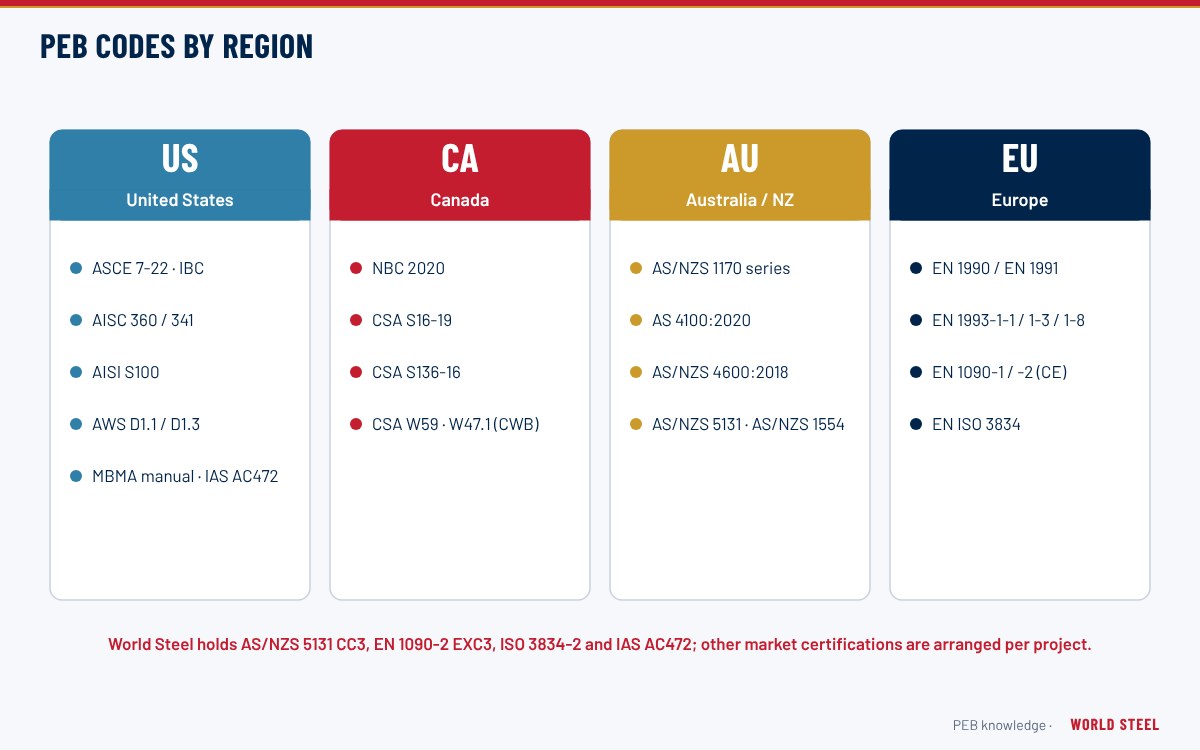
One building, many code systems
A pre-engineered building uses the same physical components everywhere, but the rules for designing, fabricating and approving it differ by country. An exporter must work within a complete code framework: a building code that gives legal force, load standards that define wind, snow, seismic and live loads, material design standards for hot-rolled and cold-formed steel, execution standards for fabrication and welding, product standards for materials, and – increasingly – mandatory fabricator certification.
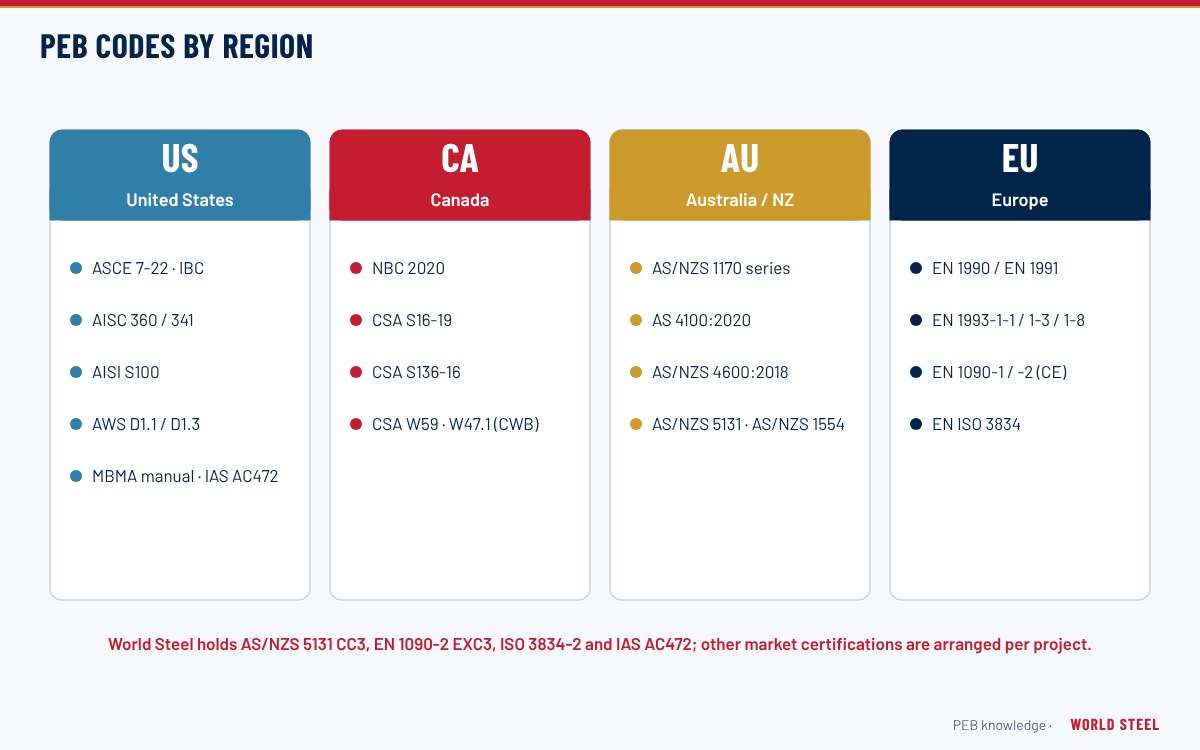
The four frameworks most relevant to PEB export are the United States, Canada, Australia/New Zealand and Europe. Many other markets adopt one of these: the Middle East and the Caribbean often use US codes or Eurocodes, Singapore applies Eurocodes with Singapore National Annexes, and Pacific markets such as Papua New Guinea frequently reference Australian standards.
Code mapping by topic
| Topic | United States | Canada | Australia / NZ | Europe |
|---|---|---|---|---|
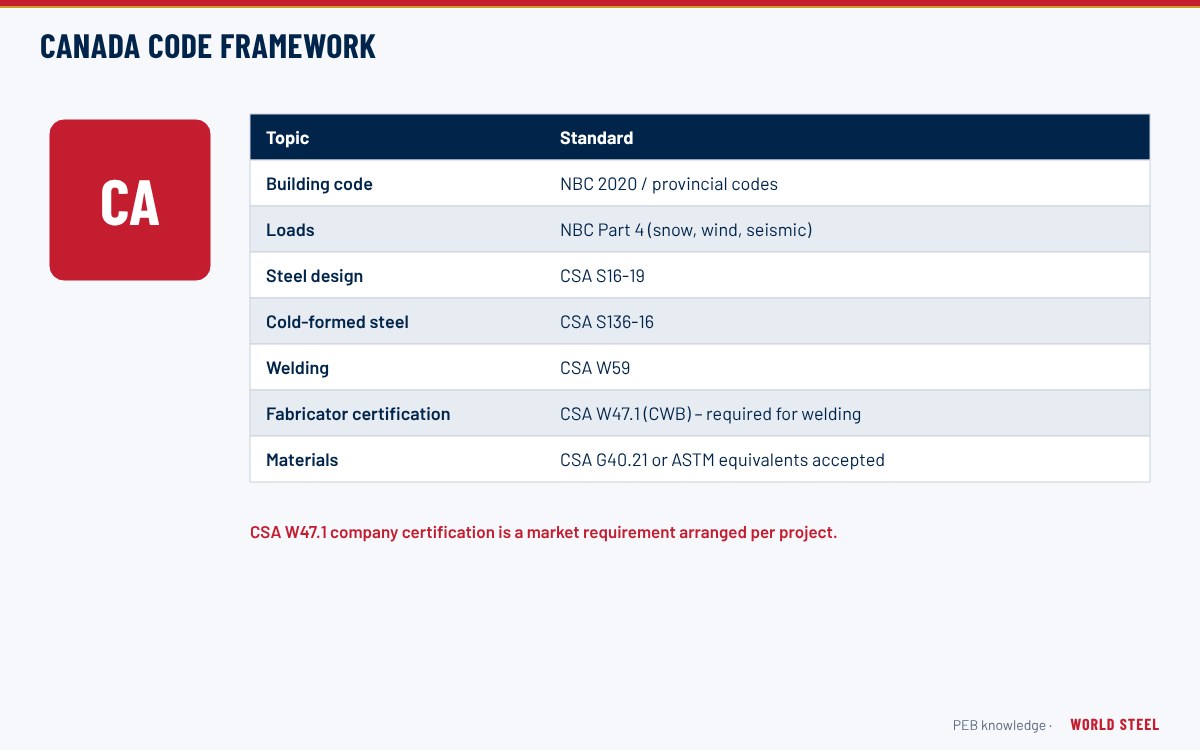
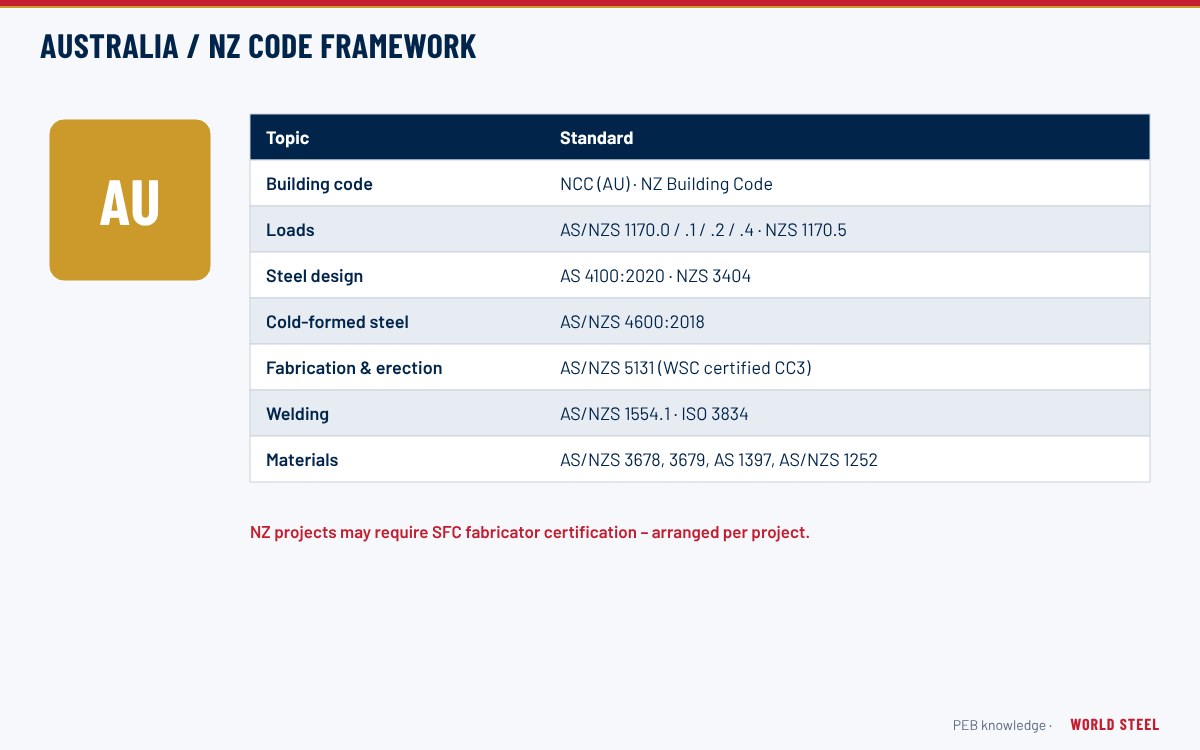
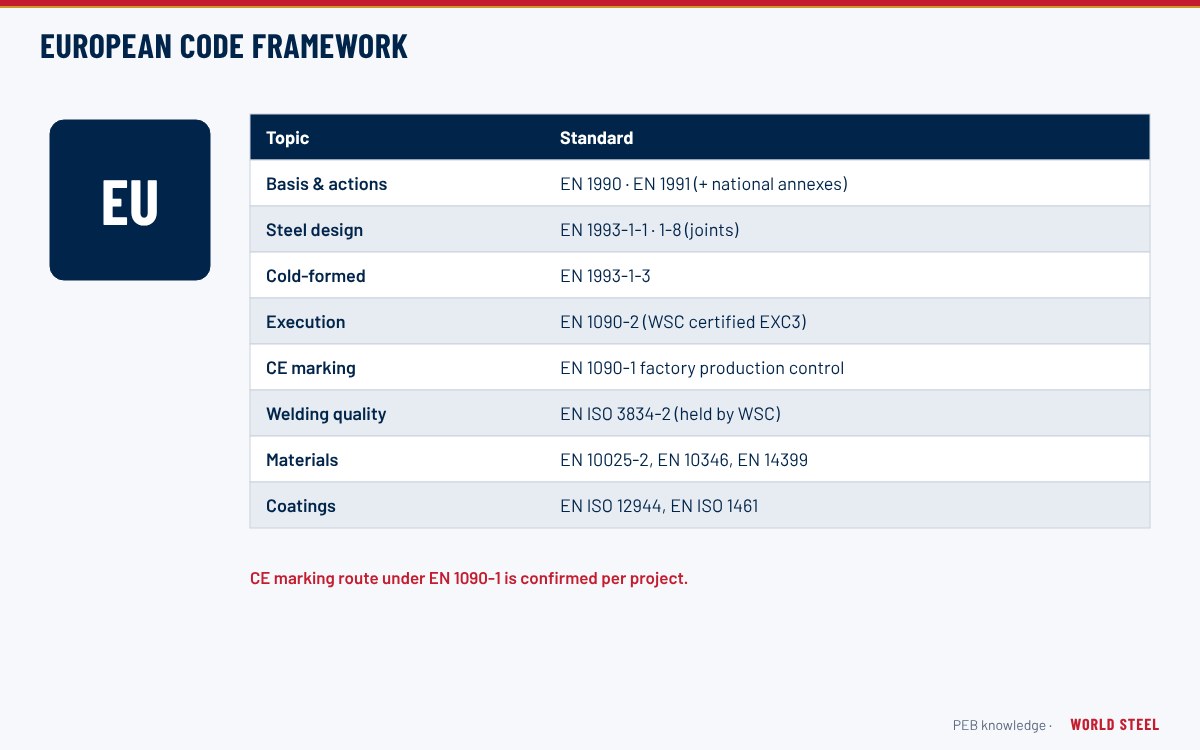
| Building approval | IBC 2021/2024 as adopted by states | NBC 2020 and provincial codes | NCC (AU); NZ Building Code B1 | National building regulations + CPR |
| Loads | ASCE 7-22 | NBC 2020 Part 4 | AS/NZS 1170 series, AS 1170.4, NZS 1170.5 | EN 1990, EN 1991, EN 1998 + National Annexes |
| Steel design | AISC 360-22, AISC 341-22 | CSA S16-19 | AS 4100:2020; NZS 3404 | EN 1993-1-1, -1-5, -1-8 |
| Cold-formed design | AISI S100-16 (2020) | CSA S136-16 | AS/NZS 4600:2018 | EN 1993-1-3 |
| Welding | AWS D1.1, D1.3 | CSA W59; CSA W47.1 | AS/NZS 1554.1 | EN ISO 3834, EN 1090-2 |
| Fabrication / execution | AISC 303-22, MBMA Manual 2018 | CSA S16, CSA A660 | AS/NZS 5131:2016 | EN 1090-2, EN 1090-4 |
| Materials | ASTM A572, A36, A1011, A653, A792, F3125, F1554 | CSA G40.21; ASTM equivalents | AS/NZS 3678, 3679.1, AS 1397 | EN 10025-2, EN 10346, EN 14399 |
| Serviceability guidance | AISC Design Guide 3, MBMA Manual, IBC Table 1604.3 | CSA S16-19 Annex D | AS/NZS 1170.0 Appendix C | EN 1990 Annex A1.4 + National Annexes |
| Crane runways | AISC Design Guide 7; CMAA 70/74 crane classes | CSA S16-19 (crane-supporting structures) | AS 1418.18; AS 4100 | EN 1991-3, EN 1993-6 |
| Corrosion protection | AMPP (SSPC) standards; ISO 12944 often specified | AMPP / ISO 12944 | AS 2312.1, AS/NZS 2312.2 (galvanizing) | EN ISO 12944, EN ISO 1461 |
| Fabricator certification | IAS AC472 or AISC Certification (IBC approved fabricator) | CSA W47.1 (CWB); CSA A660 | AS/NZS 5131 certification; SFC (NZ) | CE marking via EN 1090-1 FPC |
Design philosophy: LRFD, ASD and limit states
Every framework checks the same physical limits – yielding, buckling, fracture, excessive deflection – but expresses safety differently. Knowing the method matters when comparing calculations or reaction tables from suppliers working in different markets.
| Framework | Strength method | Serviceability |
|---|---|---|
| United States | LRFD (factored loads vs. φ × nominal strength) or ASD (service loads vs. nominal strength / Ω); both permitted by AISC 360-22 and AISI S100 | Service loads; wind drift commonly at a 10-year return period |
| Canada | Limit states design with factored loads and resistance factors (NBC 2020, CSA S16-19, CSA S136-16) | Specified (unfactored) loads |
| Australia / NZ | Limit states design with AS/NZS 1170.0 combinations and capacity factors (AS 4100, AS/NZS 4600) | Serviceability loads such as Ws chosen for the element |
| Europe | Limit states with partial factors on actions and materials (EN 1990, EN 1993) | Characteristic, frequent or quasi-permanent combinations |
Column reactions given to foundation designers are therefore best supplied unfactored and by load type, so that the local combination rules can be applied; see design loads for PEB.
International standards used in every market
- ISO 3834 – quality requirements for fusion welding; part 2 (comprehensive) is the level expected for structural steel.
- ISO 12944 – corrosion protection of steel structures by paint systems, with corrosivity categories C1–CX; see paint and coating systems.
- ISO 8501-1 – visual grades of surface cleanliness (e.g. Sa 2½) before painting.
- ISO 9001, ISO 14001, ISO 45001 – quality, environmental and occupational health and safety management systems.
- ISO 9606-1 / ISO 15614-1 – welder and welding procedure qualification, accepted directly in Europe and often alongside AWS or AS/NZS qualifications elsewhere.
Design to code, certify to market
Two separate questions must be answered for every export project. First, design: can the supplier's engineers design to the local load and steel codes and, where required, have drawings sealed by a locally registered engineer? Second, fabrication compliance: does the plant hold the certification that the local building authority recognises? A building designed perfectly to AS 4100 may still be rejected if the fabricator cannot demonstrate AS/NZS 5131 compliance, and a European project requires CE-marked components.
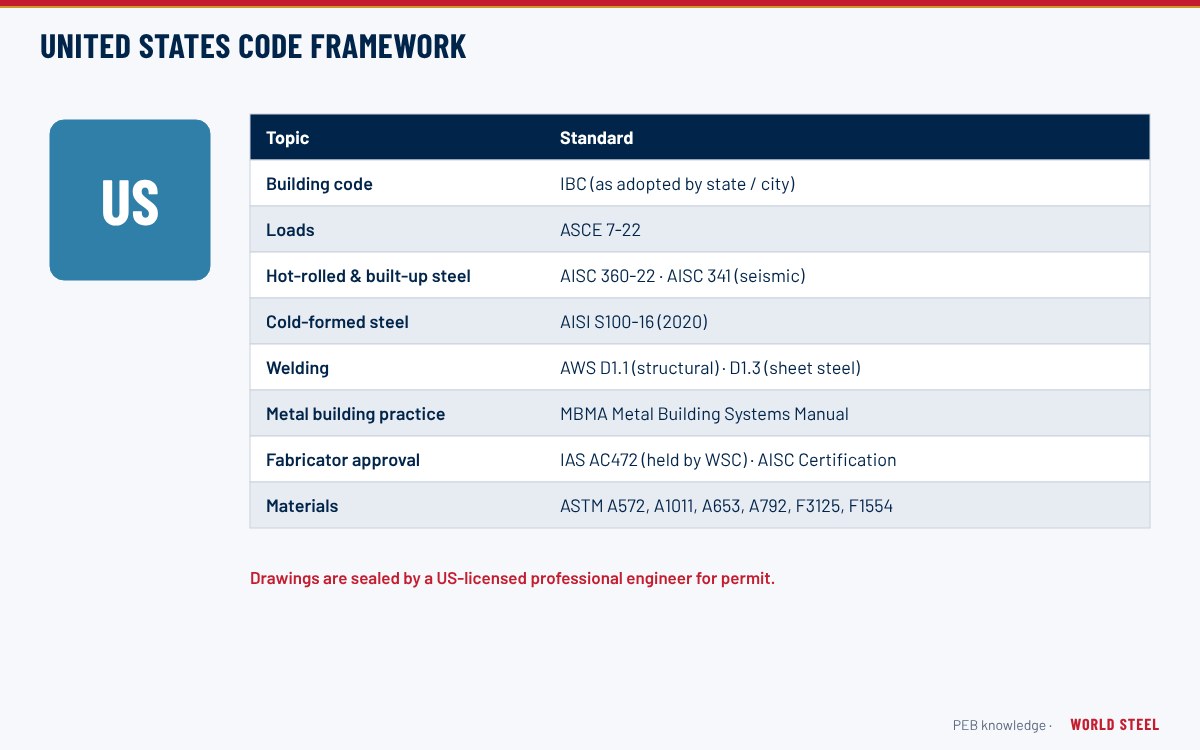
The regional articles explain each route: United States, Canada, Australia and New Zealand and Europe.
World Steel's certification position
| Requirement | WSC status |
|---|---|
| IAS AC472 (metal building systems) | Held – first company in Asia accredited |
| AS/NZS 5131 Construction Category CC3 | Held |
| EN 1090-2 Execution Class EXC3, ISO 3834-2 | Held |
| BC1 (Singapore) | Held |
| CSA W47.1, AISC Certification, CE marking under EN 1090-1, SFC (NZ) | Not held – arranged or confirmed per project where the market requires it |
WSC's design team works to US, Canadian, Australian/New Zealand and European codes. See market compliance and certification for how compliance is planned on each project.
各地区标准
| 地区 | 规范 | 范围 |
|---|---|---|
 United States |
ASCE 7-22 / AISC 360-22 / AISI S100-16 | Loads, steel and cold-formed design |
 Canada |
NBC 2020 / CSA S16-19 / CSA S136-16 | Loads, steel and cold-formed design |
 Australia / NZ |
AS/NZS 1170 / AS 4100:2020 / AS/NZS 4600:2018 | Actions, steel and cold-formed design |
 Europe |
EN 1991 / EN 1993 / EN 1090 | Actions, steel design and execution |
| International | ISO 3834-2 / ISO 12944 | Welding quality and corrosion protection |
常见问题
Which code is used to design a PEB for export?
The code of the country where the building is erected. Loads, steel design, fabrication and certification follow that country's framework, not the fabricator's home code.
Is ISO 3834-2 enough for all markets?
No. It is a widely recognised welding quality standard, but markets add their own requirements, such as CSA W47.1 in Canada, AS/NZS 5131 in Australia and New Zealand, or CE marking under EN 1090-1 in Europe.
Can one building be designed to both US and European codes?
A building is designed to one governing code framework. Materials can often be specified to meet both, for example by dual-certified plate, but the design checks follow one set of codes.
 New Zealand
 Germany
 Singapore