 ENEnglish
 VITiếng Việt
 ZH中文
 KO한국어
 JA日本語
 FRFrançais
 ITItaliano
 PTPortuguês
 ESEspañol
 HEעברית
 ARالعربية

Why AS/NZS 5131 matters when you buy structural steel
AS/NZS 5131 is the joint Australian and New Zealand standard for the fabrication and erection of structural steelwork. It turns the design intent of AS 4100, NZS 3404 and AS 5100.6 into execution requirements: what must be specified, which materials may be used, how members are cut, holed, welded, bolted, protected, measured, inspected and erected, and what records prove it. Most Australian construction specifications now call it up directly, and builders, engineers and building certifiers use it as the yardstick for any fabricator – local or overseas.
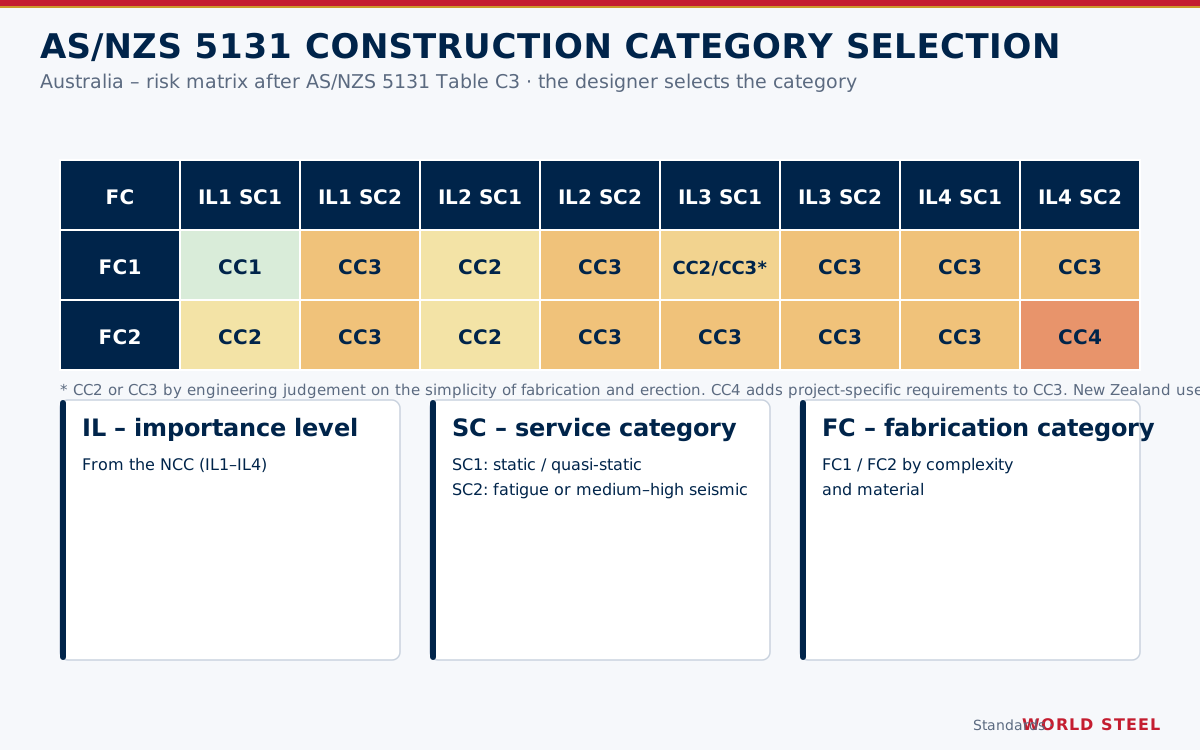
The standard does not apply one fixed level of control to every job. It scales the requirements with a Construction Category (CC1 to CC4) that the designer selects for each structure or part of a structure from its importance level, its service category (static or fatigue loading) and its fabrication category. The higher the category, the more welding inspection, traceability, qualified supervision and documentation the fabricator must deliver. Chapter 1 explains how the category is chosen.
What CC3 means
CC3 covers the structures most often specified for commercial, industrial and public buildings with higher importance levels, crane-supporting and other fatigue-sensitive steelwork, and many infrastructure elements. At CC3 a fabricator is expected to work to a documented quality plan and project inspection and test plan, use qualified welding procedures and welders under a competent welding supervisor, carry out non-destructive examination to the extents the standard sets for the category, keep traceability of materials to the finished members, control corrosion protection and geometry, and hand over a complete set of records with a declaration of compliance.
Because a fabricator certified at CC3 must satisfy those requirements across its whole system, it can also deliver CC1 and CC2 work. CC4 – the most demanding category, normally reserved for exceptional structures – needs project-specific arrangements agreed with the designer.
| Category | Typical application | Level of control |
|---|---|---|
| CC1 | Low-consequence structures with static loading | Basic documentation, visual inspection |
| CC2 | Most ordinary buildings with static loading | Quality plan, qualified welding, sampled NDE |
| CC3 | Higher-importance buildings, fatigue or high-demand fabrication | Full ITP, welding supervision, higher NDE extents, full traceability |
| CC4 | Exceptional structures with severe consequences of failure | CC3 plus project-specific requirements |
How to use this guide
The chapters follow the order of the standard – from the construction specification and quality management through materials, fabrication, welding, bolting, corrosion protection, architecturally exposed steel, erection, tolerances and inspection – and close with a complete fabricator assessment checklist. Each chapter explains the requirement in plain language, cites the clause numbers so you can check the standard itself, lists what an assessor should verify at a CC3 fabricator, and shows how World Steel applies it in its factory in Vietnam.
This guide is World Steel's explanation of AS/NZS 5131:2016 incorporating Amendment 1 (2020). It does not reproduce the standard and does not replace it – always refer to the current edition, the project's construction specification and the designer's requirements.
World Steel and AS/NZS 5131
World Steel's factory at Hai Son Industrial Park, Tay Ninh, is certified by BSI Group Australia and New Zealand under its JAS-ANZ accredited Benchmark product certification scheme for fabrication to AS/NZS 5131 at Construction Category CC3 – certificate BMP 827566, valid to 31 July 2030. The same quality system is certified to ISO 3834-2 for welding and to EN 1090-2 EXC3 for Europe, so every Australian job is fabricated under independently audited controls.
For Australian builders this means steel from Vietnam arrives with the documents an Australian certifier expects – and with a fabricator that has already been assessed against the questions in this guide. See how this fits our supply to Australia, the Australian and New Zealand standards we work to and our steel-framed modular homes for Australia.