ENEnglish
 VITiếng Việt
 ZH中文
 KO한국어
 JA日本語
 FRFrançais
 ITItaliano
 PTPortuguês
 ESEspañol
 HEעברית
 ARالعربية

Designing for transport
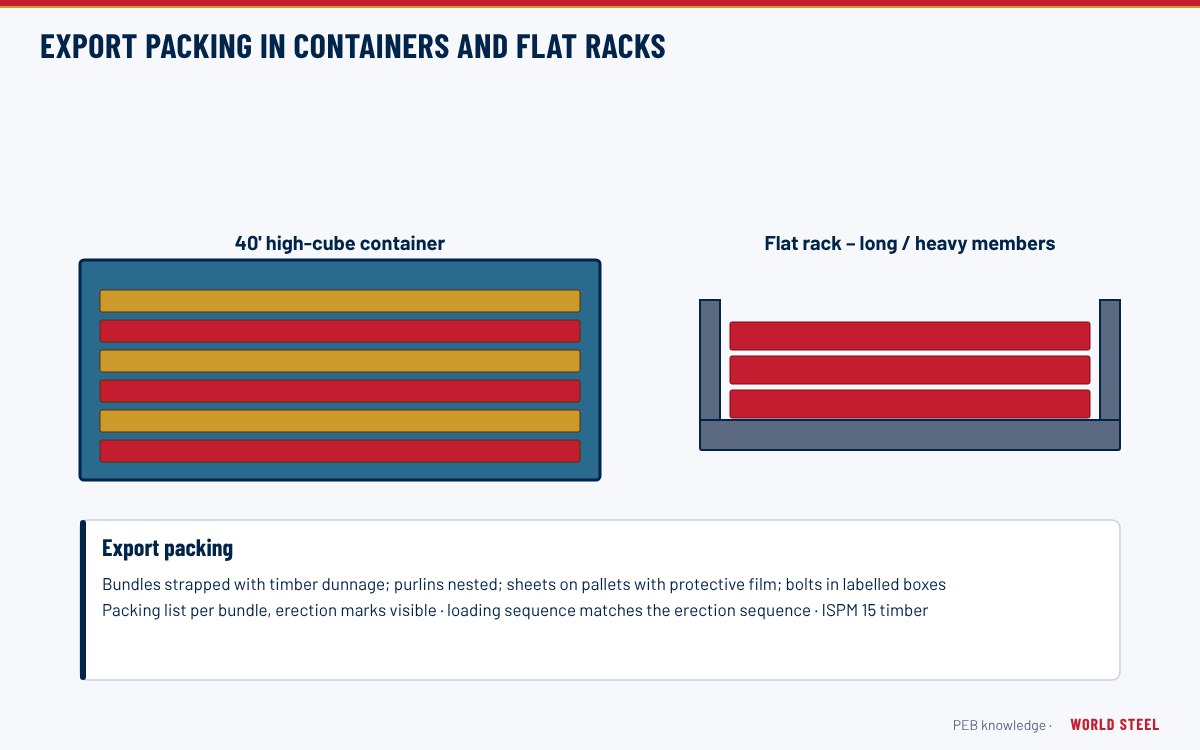
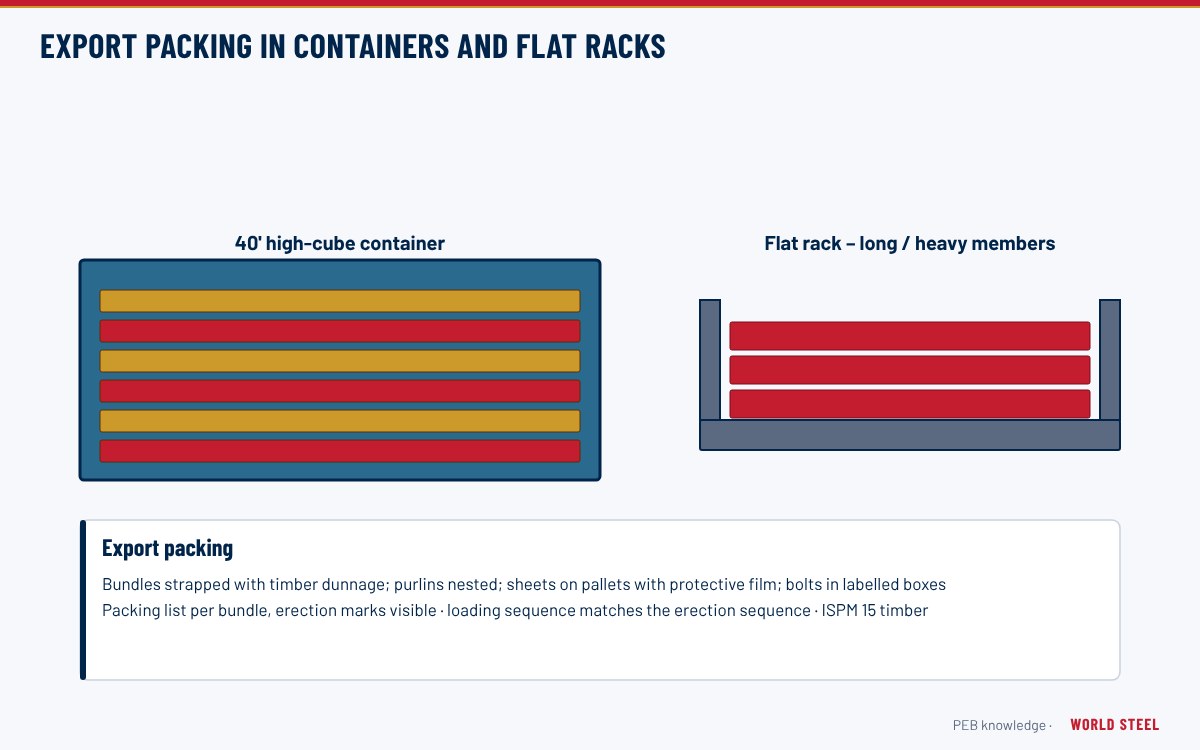
For an exported building, logistics begins at the design stage. Frame segments are split at bolted end-plate connections so that each piece fits the chosen transport mode; purlin and sheeting lengths are planned against container length; and the number of packages is balanced against crane capacity and laydown space at site. A rafter split into pieces of up to about 11.8 m fits in a standard 40-foot container, while longer pieces need flat racks, open-top containers or break-bulk shipment.
Transport options
| Mode | Indicative usable length | Best for | Considerations |
|---|---|---|---|
| 40 ft high-cube container | ~12.0 m | Most PEB kits: frames, purlins, sheeting, accessories | Weight limit often governs before volume for heavy frames |
| 20 ft container | ~5.9 m | Bolts, fasteners, accessories, short items | Dense, heavy cargo |
| 40 ft flat rack / open top | ~12 m, overwidth or overheight possible | Wide or heavy members, crane girders, crane-loaded cargo | Lashing and weather protection required; higher freight rate |
| Break-bulk | Not limited by box | Very long members, large projects to ports with general cargo service | Port handling risk, more packaging, longer port time |
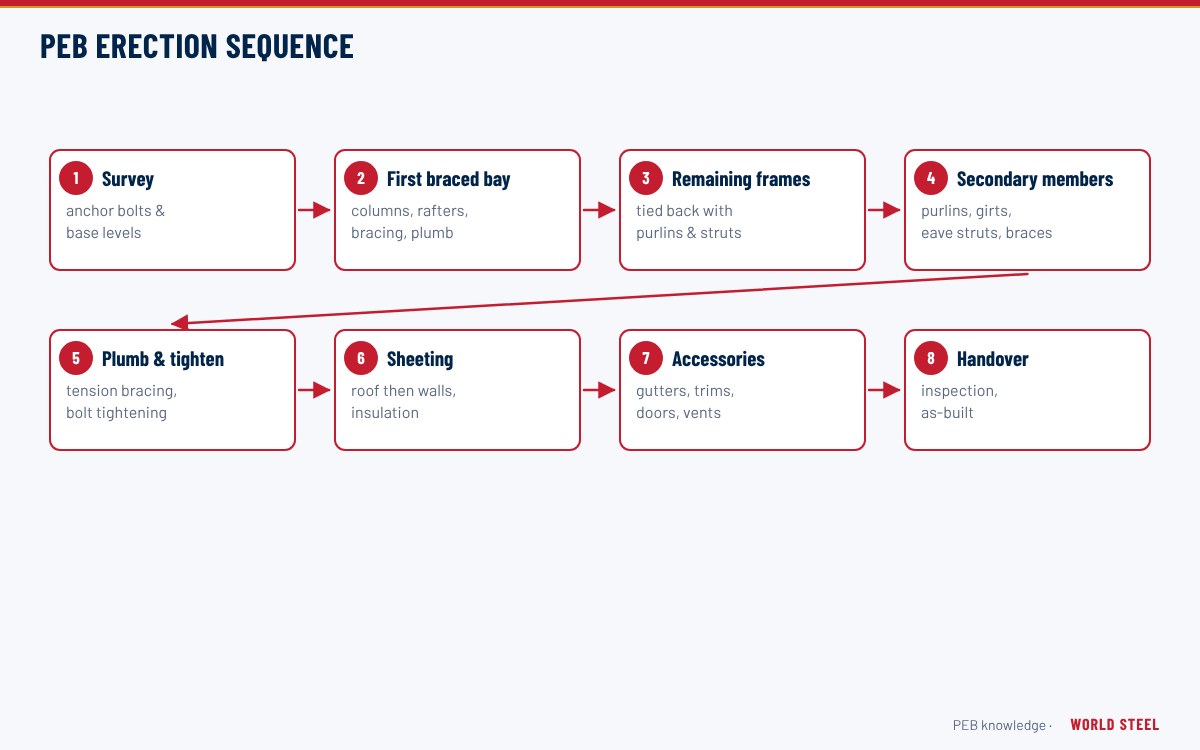
Container loading plans are prepared before stuffing to check weight distribution, maximum payload and the order of unloading at site. Ideally containers are packed by erection sequence so that the first bay can be erected from the first containers to arrive.
Marking and bundling
- Piece marks stencilled or tagged on every primary member, matching the erection drawings.
- Bundles of purlins, girts and sheets strapped by mark and length, with timber dunnage between layers and bundle tags listing contents.
- Sheeting stacked on timber skids, protected against water ingress; strippable film where specified. Moisture trapped between coated sheets causes white rust or wet-storage staining, so bundles are kept dry and sloped.
- Bolts and fasteners packed in labelled boxes or crates by type, grade and connection, with spare allowance.
- Accessories – doors, skylights, ventilators, trims and sealants – crated to prevent damage.
- Packing list cross-referenced to bundle, package and container numbers.
Timber dunnage, skids and crates for international shipment must comply with ISPM 15 (heat-treated and stamped) to avoid quarantine delays.
Protecting cladding, panels and sundries in transit
Coated sheet, insulated panels and sundries are more easily damaged in transit than heavy steel members. Most claims arise from moisture, abrasion and crushing rather than from handling accidents.
| Item | Main risk | Typical measure |
|---|---|---|
| Pre-painted and Zn-Al sheet | Wet-storage staining from condensation inside the container; scratching | Dry bundles wrapped in waterproof paper or film, desiccant in containers, timber skids, no steel strapping directly on the paint |
| Galvanized purlins | White rust in tightly nested wet bundles | Pack dry, spacers where long storage is expected, ventilated storage on arrival |
| Sandwich panels | Dents, edge damage, film degradation | Factory packs with foam spacers and edge protectors, limited stack heights, protective film removed soon after installation |
| Insulation rolls | Wetting and compression | Sealed plastic wrap; loaded last or in dedicated containers |
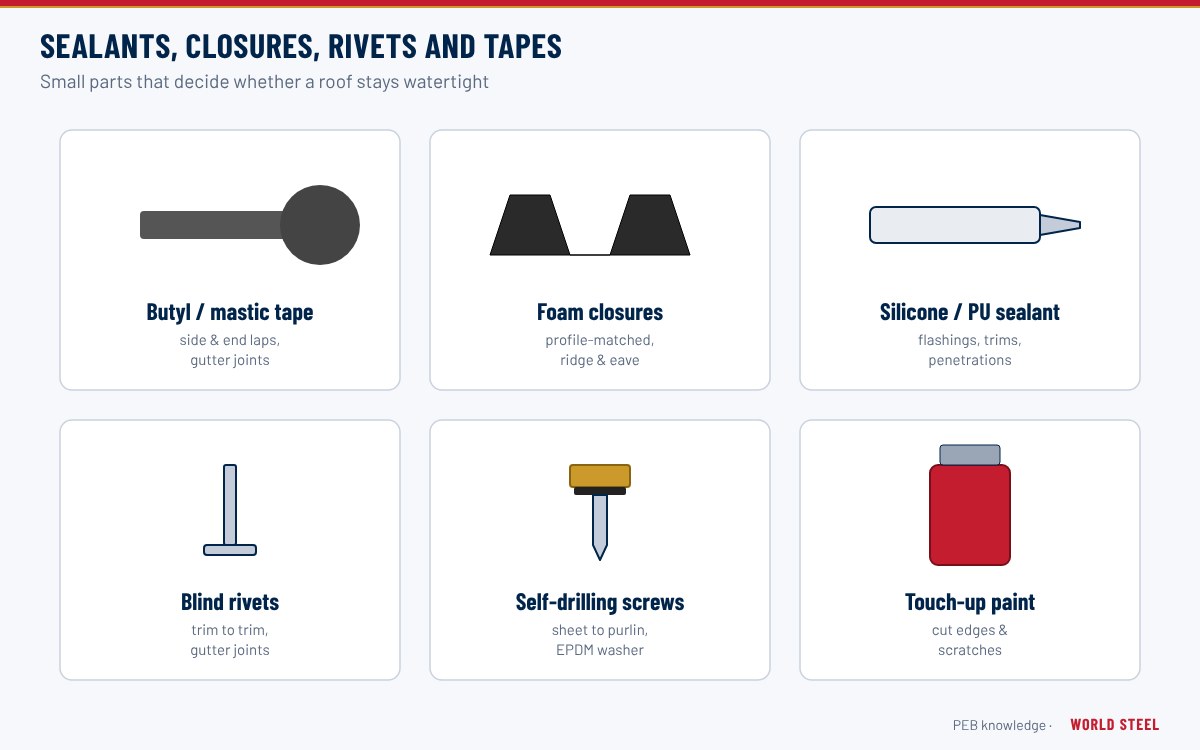
| Sealants, tapes and foam closures | Heat ageing, limited shelf life | Cartons away from container walls; stored in shade on site and used within shelf life |
| Doors, skylights, ventilators | Impact, UV damage of translucent sheet | Crates, opaque wrapping for translucent sheet, clear labelling |
Long sea voyages through tropical regions produce large temperature swings and condensation ("container rain"). Desiccant bags or strips and moisture-absorbing liners are inexpensive compared with the cost of replacing stained roof sheets.
Documents and trade compliance
A typical export shipment is accompanied by a commercial invoice, packing list, bill of lading, certificate of origin (preferential where a free trade agreement applies), mill certificates and the quality dossier. Structural steel buildings and parts are generally classified under HS heading 7308 (structures and parts of structures) or, for complete prefabricated buildings, 9406 – the correct code depends on the scope and the destination's tariff rules and must be confirmed per shipment. Destination-specific measures such as US Section 232 duties or anti-dumping rules affect landed cost and are reviewed during tendering; see export packing and logistics.
On arrival at site
Containers should be unloaded with suitable equipment, and members stored on timber off the ground, with cladding bundles inclined so that water drains. The site team checks package counts against the packing list and reports shortages or transit damage promptly. Correct storage protects the coating and makes the erection sequence run smoothly. World Steel ships from Vietnam to more than 30 countries under its export supply service, with loading plans and packing lists provided for every container.
المعايير حسب المنطقة
| المنطقة | الرمز | النطاق |
|---|---|---|
 United States |
MBMA Metal Building Systems Manual | Common industry practices – shipping, receiving and storage of materials |
 Australia / NZ |
AS/NZS 5131:2016 | Transport, storage and handling of fabricated steelwork |
 Europe |
EN 1090-2 | Handling, storage and transportation of components |
| International | ISPM 15 / Incoterms 2020 | Wood packaging for international trade; delivery terms |
الأسئلة المتكررة
How many containers does a PEB need?
It depends on tonnage, cladding area and member lengths. Heavy frames reach the payload limit first, while cladding and insulation fill volume first; the fabricator prepares a loading plan for each project.
Can very long rafters be shipped in containers?
Rafters are normally split at bolted splices so that each piece fits a 40-foot container. Where splitting is not desirable, flat racks or break-bulk shipment are used.
How should cladding be stored on site?
Off the ground, under cover or tarpaulins with ventilation, and with bundles sloped so water runs off. Wet bundles should be opened and dried to prevent staining of the coating.
 Trinidad and Tobago