 ENEnglish
 VITiếng Việt
 ZH中文
 KO한국어
 JA日本語
 FRFrançais
 ITItaliano
 PTPortuguês
 ESEspañol
 HEעברית
 ARالعربية

R stands for load-bearing capacity
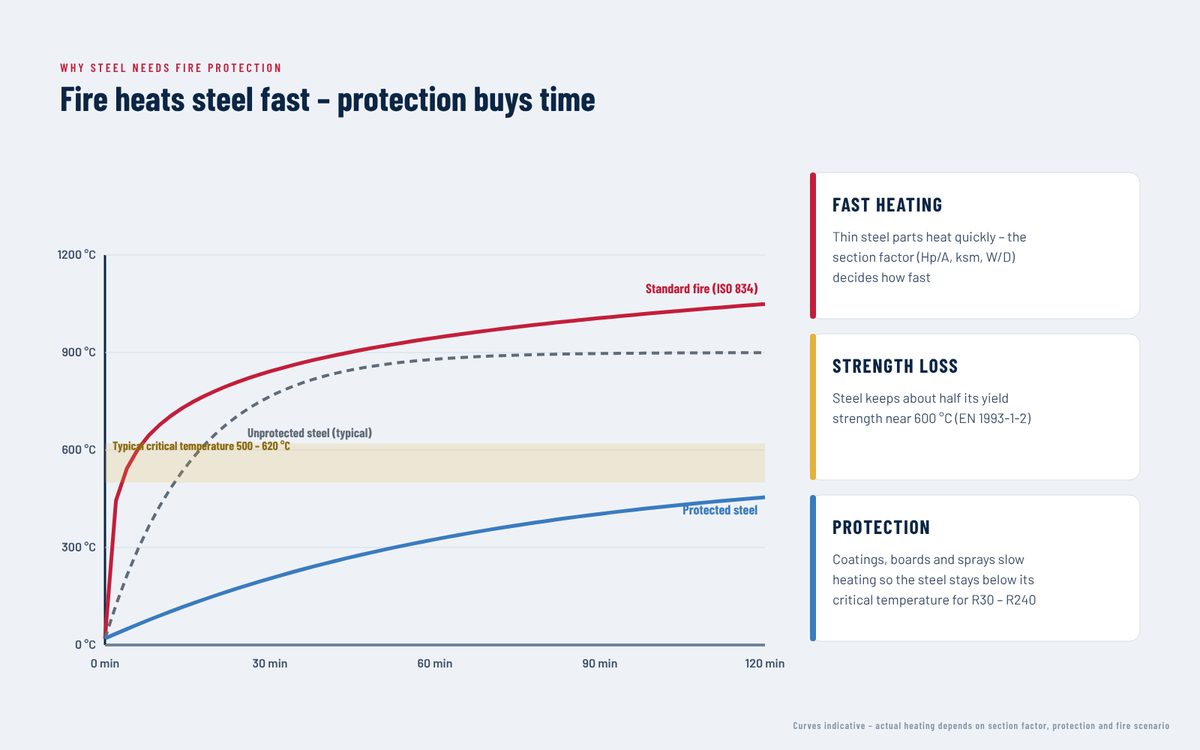
Under EN 13501-2, R is the time in minutes during which a load-bearing element keeps its function in the standard fire test. E (integrity) and I (insulation) apply to separating elements such as walls and floors. Structural steel beams and columns usually only need an R rating.
Equivalent expressions in other markets
| Europe / UK | Australia / NZ | United States |
|---|---|---|
| R 30 | FRL 30/–/– | — |
| R 60 | FRL 60/–/– | 1 h |
| R 90 | FRL 90/–/– | 1½ h |
| R 120 | FRL 120/–/– | 2 h |
| R 180 | FRL 180/–/– | 3 h |
Ratings are equivalent in duration, but test methods and approval data differ. A product needs data accepted in the project's country.
Who decides the rating
The building code, through the fire engineer or the authority having jurisdiction, sets the rating for each element from the building use, height, compartment size, sprinklers and evacuation strategy. The coating supplier designs the protection to meet it.
Why R120 can cost much more than twice R60
The relationship between thickness and time is not linear. On a light, high section-factor beam, R120 may need several times the R60 thickness – and some products are not assessed for every rating on every section. That is why long ratings often compare intumescents with boards or sprays.
FAQ
Is R60 the same as 1 hour?
Both mean 60 minutes of fire resistance, but they are tested and approved under different standards.
Do all steel members need the same rating?
No – the fire strategy can give different ratings to different elements, and some members may need no protection.
Preliminary calculations are provided for estimation purposes only. Final coating thickness and fire protection system selection must be verified against the approved product documentation, applicable project requirements and relevant engineering assessments.