 ENEnglish
 VITiếng Việt
 ZH中文
 KO한국어
 JA日本語
 FRFrançais
 ITItaliano
 PTPortuguês
 ESEspañol
 HEעברית
 ARالعربية

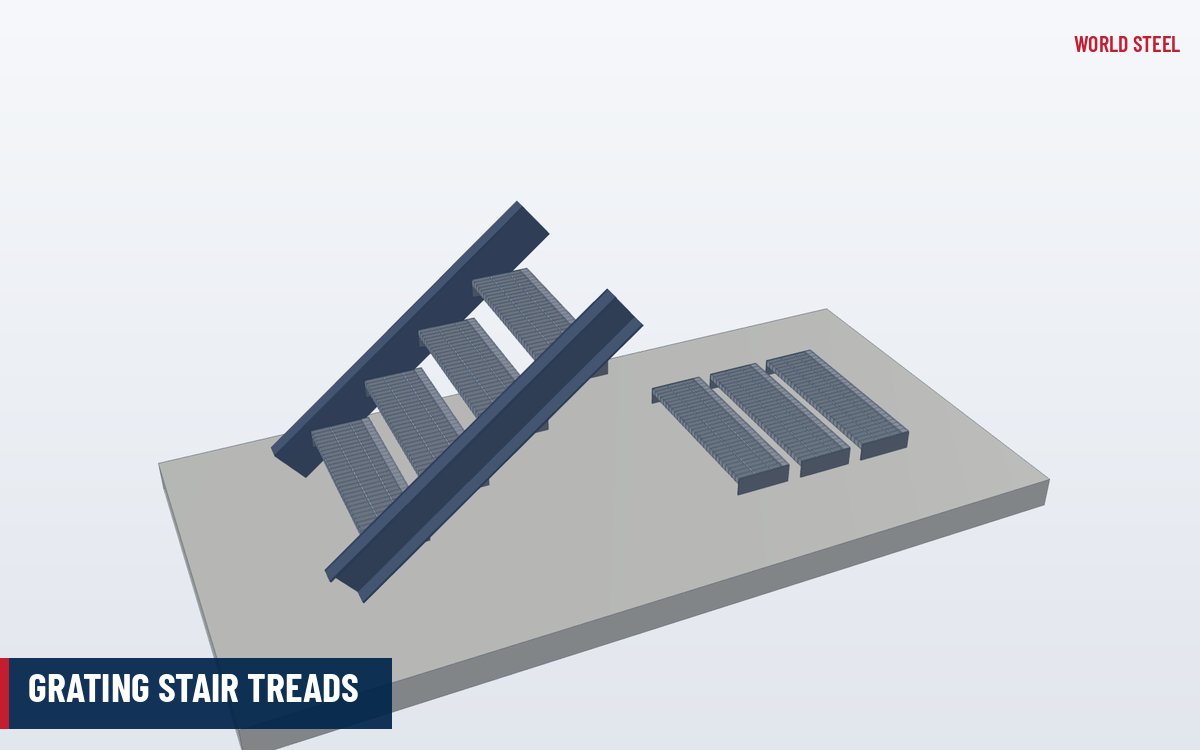
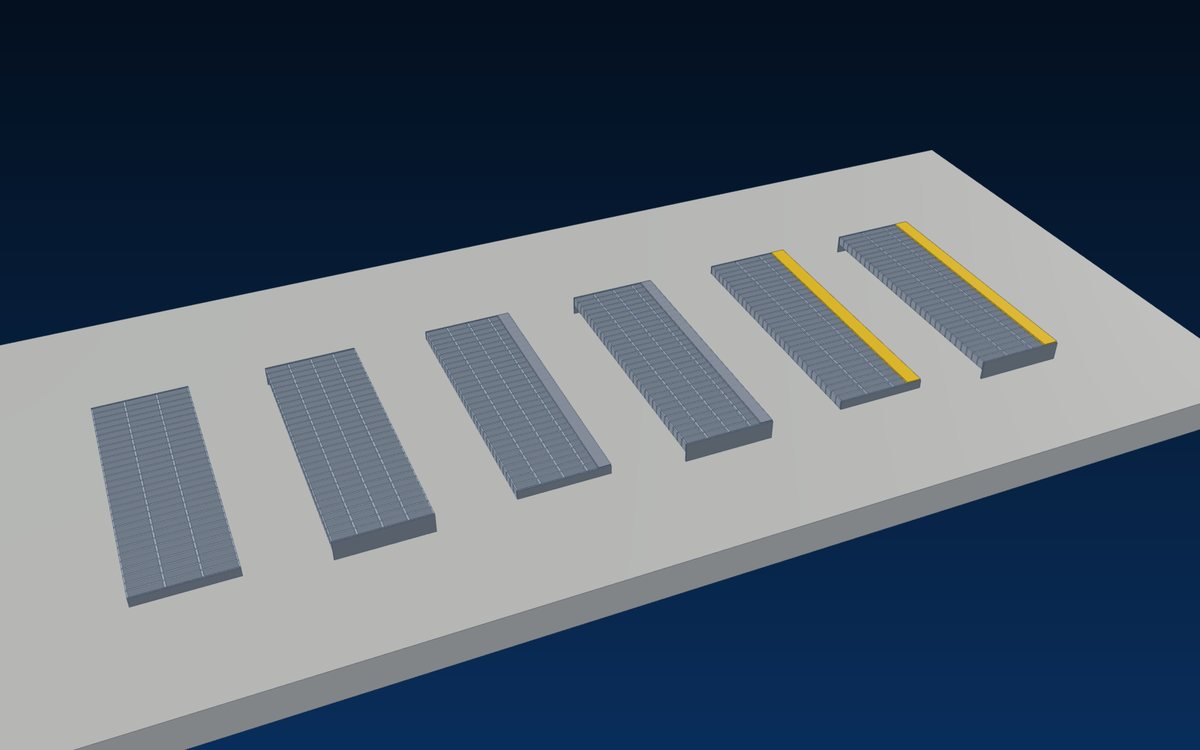
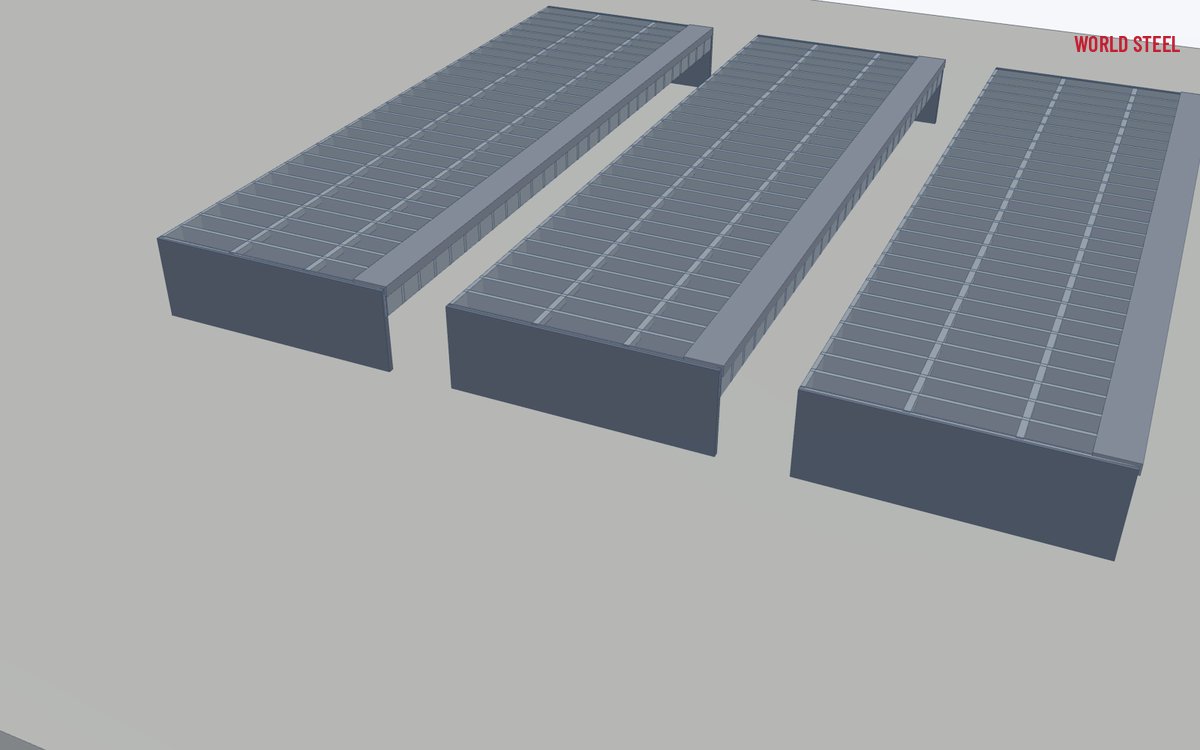
- Six standard types T1–T6
- Welded (banded ends) or bolted (holed end plates)
- Checker-plate or abrasive anti-slip nosing
- Recommended widths 115–325 mm
- Lengths up to 1600 mm
Six tread types
| Type | Fixing | Ends | Nosing |
|---|---|---|---|
| T1 | Welded | Banded ends | No nosing |
| T2 | Bolted | Holed end plates | No nosing |
| T3 | Welded | Banded ends | Checker-plate nosing |
| T4 | Bolted | Holed end plates | Checker-plate nosing |
| T5 | Welded | Banded ends | Abrasive anti-slip nosing |
| T6 | Bolted | Holed end plates | Abrasive anti-slip nosing |
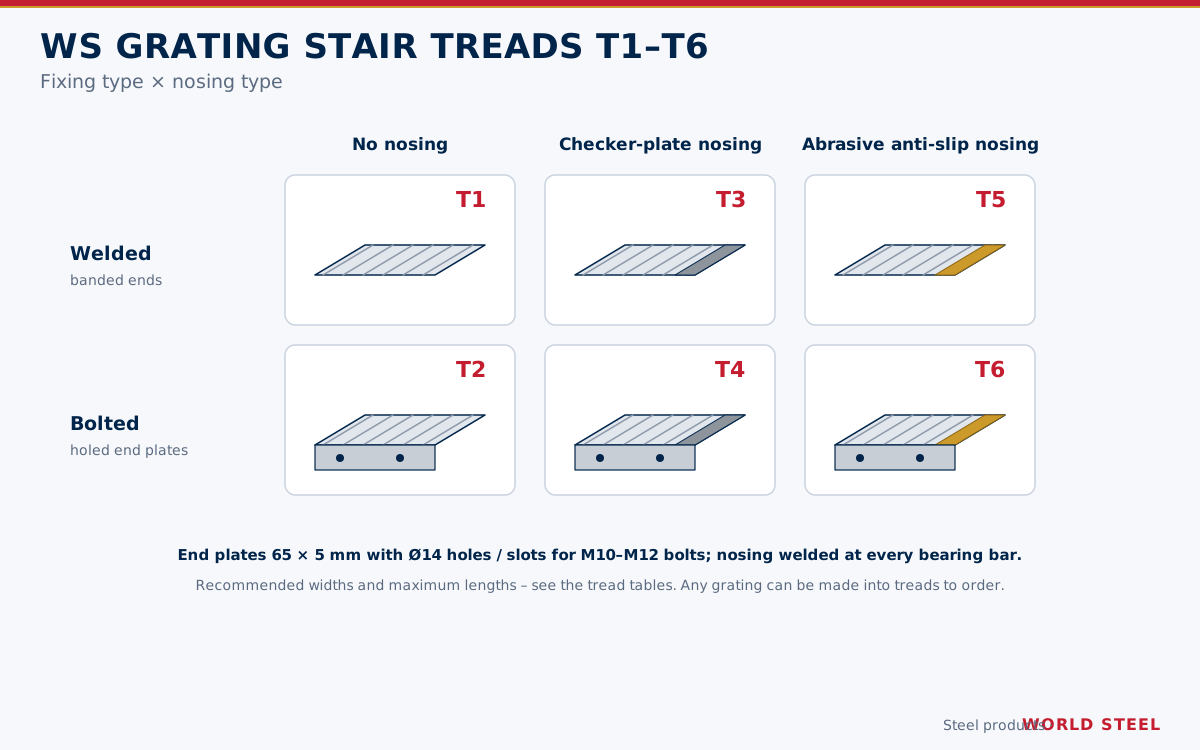
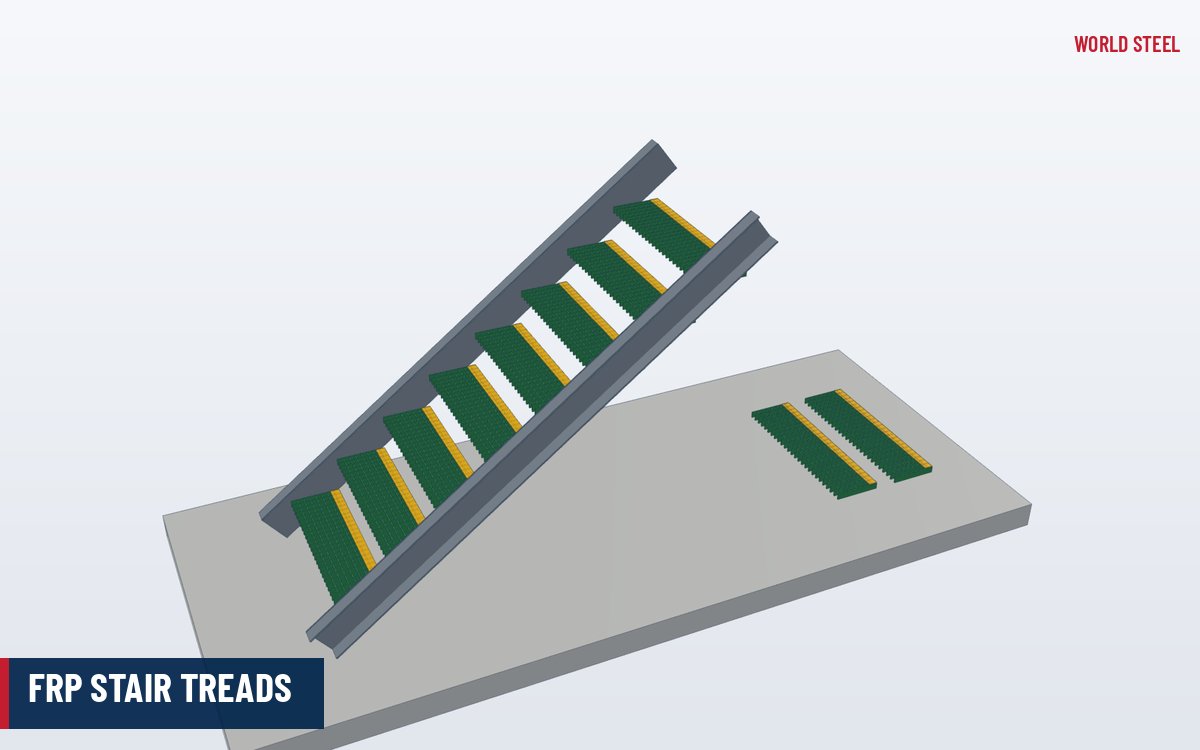
The choice of nosing depends on use: checker plate for robust industrial stairs, abrasive yellow nosing where a visible, high-grip edge is needed – public, outdoor and wet stairs. If you are unsure which to use, our engineers will recommend one.
Recommended widths
| Bar pitch | Types | Widths (mm) |
|---|---|---|
| 30 mm pitch | T1–T6 | 125 · 155 · 185 · 215 · 245 · 275 · 305 |
| 40 mm pitch | T1, T2, T5, T6 | 125 · 165 · 205 · 245 · 285 · 325 |
| 40 mm pitch | T3, T4 | 115 · 155 · 195 · 235 · 275 · 315 |
| 60 mm pitch | T1, T2, T5, T6 | 185 · 245 · 305 |
| 60 mm pitch | T3, T4 | 155 · 215 · 275 |
Tread length is the distance between the outside faces of the end plates, tolerance 0 / −3 mm; width ± 3 mm. End plates and nosing are welded with seams of 3 mm or more at every bearing bar.
Maximum length
| Bar pitch | 25 × 3 | 25 × 5 | 32 × 5 | 40 × 5 |
|---|---|---|---|---|
| 30 mm | 550 | 900 | 1300 | 1600 |
| 40 mm | 450 | 750 | 1200 | 1500 |
| 60 mm | – | 550 | 850 | 1350 |
Side plates use 65 × 5 mm flat bar with a Ø14 hole and a slotted hole for M10 or M12 bolts; the bearing bars can be mitred to the stair angle on request.
Installation
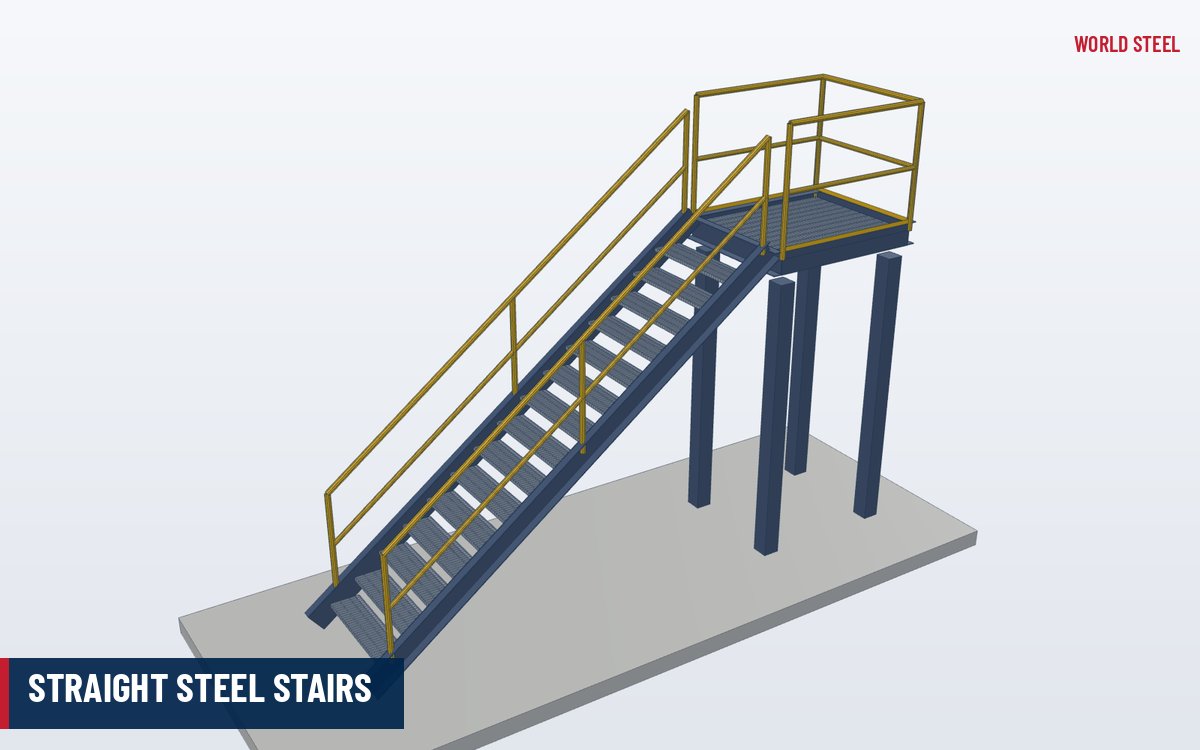
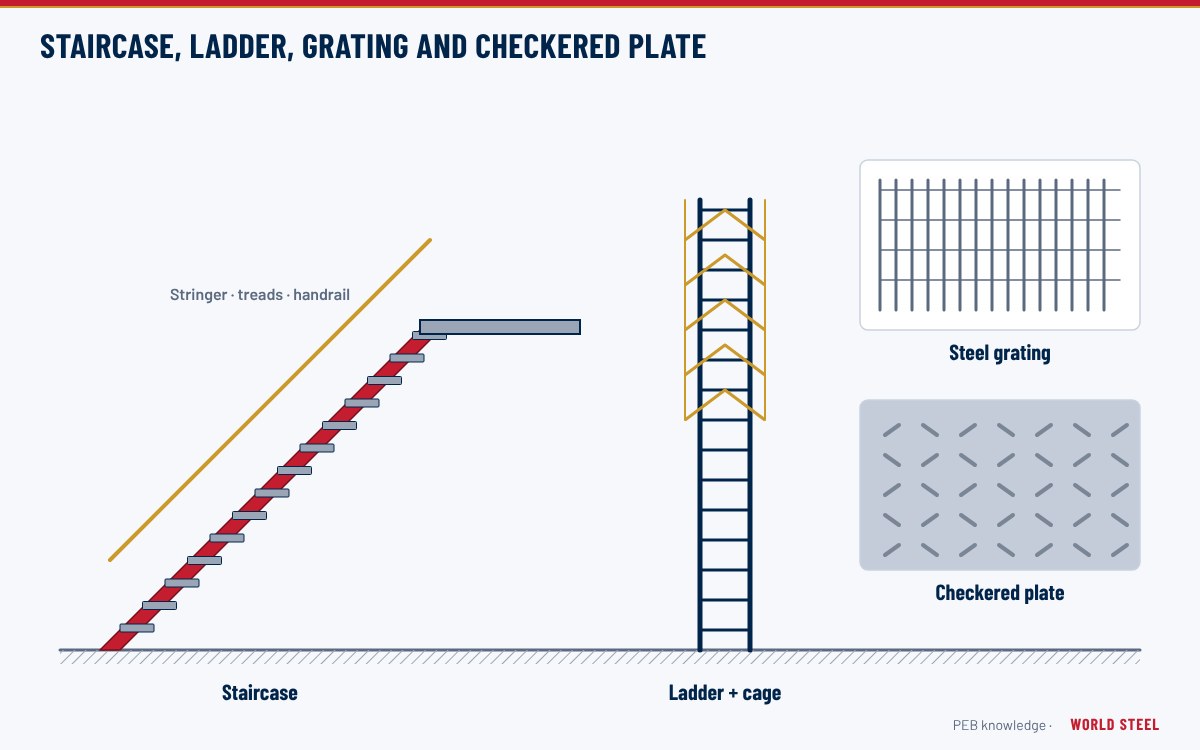
Bolted treads (T2, T4, T6) are fixed to the stringer with two bolts at each end through the holed end plates; welded treads (T1, T3, T5) are welded to stringer brackets. Stairs from 30° to 90° can be made with matching stringers, landings and handrails.
المعايير والمتطلبات حسب السوق
المعايير التي تصمم World Steel هذا المنتج وتصنّعه وتوثّقه وفقها – والمتطلبات الهندسية الرئيسية ومتطلبات الأحمال في كل سوق.
 الولايات المتحدة
- OSHA 1910.25Stairways
- IBC 2021 §1011Stairways
- ANSI/NAAMM MBG 531Metal Bar Grating Manual
- NAAMM AMP 510Metal Stairs Manual
- Riser / tread (OSHA)
- Riser ≤ 9.5 in, tread depth ≥ 9.5 in
 أستراليا / نيوزيلندا
- AS 1657-2018Fixed platforms, walkways, stairways and ladders
- AS 4586Slip resistance of pedestrian surfaces
- Going / riser (AS 1657)
- Going 215–355 mm, riser 130–225 mm
 أوروبا
- DIN 24531-1Gratings as stair treads – steel
- EN ISO 14122-3Stairs, stepladders and guard-rails
- Step formula
- 600 mm ≤ g + 2h ≤ 660 mm (EN ISO 14122-3)
ملخص للاسترشاد فقط – تسري مواصفات المشروع وإصدار المعيار المعتمد والجهة المختصة.
التشطيبات
| التشطيب | المعايير / ملاحظات |
|---|---|
| Hot-dip galvanised (G) | ASTM A123 · AS/NZS 4680 · EN ISO 1461 |
| Paint coated (PP) | Blast or pickle + paint system to ISO 12944 / AS/NZS 2312.1 / SSPC |
| Duplex with coloured nosing | Galvanised + paint; contrasting nosing per project |
الأسئلة المتكررة
Which tread type should I choose?
Bolted types T2, T4 and T6 are easiest to install and replace. Choose checker nosing (T3/T4) for industrial use and abrasive nosing (T5/T6) where a visible high-grip edge is needed.
Can you make non-standard treads?
Yes – treads can be made from any WS grating and to any width or length within the bar capacity.
 AS/NZS 5131 CC3
 EN 1090 EXC3 · CE