 ENEnglish
 VITiếng Việt
 ZH中文
 KO한국어
 JA日本語
 FRFrançais
 ITItaliano
 PTPortuguês
 ESEspañol
 HEעברית
 ARالعربية

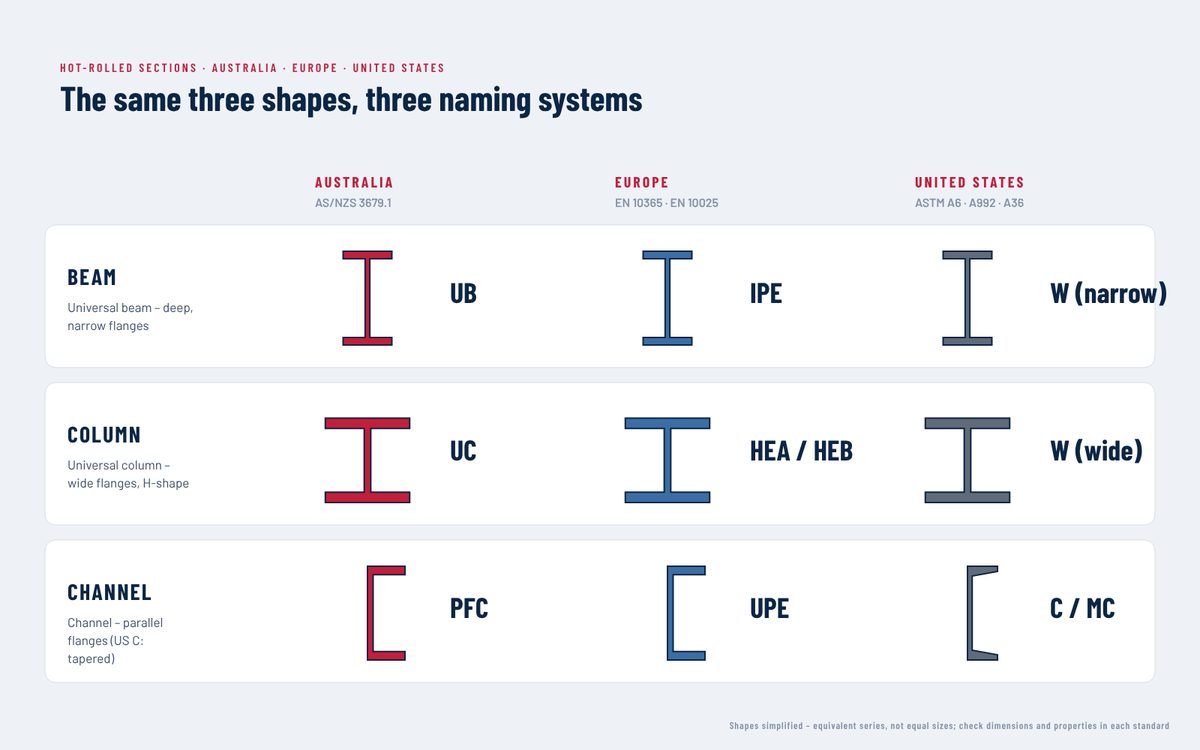
Definition
The section factor is the heated perimeter Hp divided by the cross-section area A, expressed in m⁻¹ (EN 1993-1-2 uses Am/V – the same ratio per unit length). A high section factor means a thin, light member that heats quickly; a low one means a heavy member that heats slowly.
- Europe: Hp/A or Am/V, m⁻¹
- Australia (AS 4100): exposed surface area to mass ratio ksm, m²/t
- United States: W/D – weight per foot (lb/ft) divided by heated perimeter (in)
Heated perimeter
| Section and exposure | Profile (coatings) | Boxed (boards) |
|---|---|---|
| I / H, 4 sides | 2d + 4b − 2tw | 2(d + b) |
| I / H, 3 sides (slab on top) | 2d + 3b − 2tw | 2d + b |
| RHS / SHS, 4 sides | 2(d + b) | 2(d + b) |
| CHS | πD | πD |
Worked example – beam, 3 sides
Universal beam 310UB40.4: d = 304 mm, b = 165 mm, tw = 6.1 mm, mass 40.4 kg/m.
- Hp = 2 × 304 + 3 × 165 − 2 × 6.1 = 1,091 mm
- A = 40.4 ÷ 0.00785 = 5,146 mm² (from mass, ρ = 7,850 kg/m³)
- Hp/A = 1,091 ÷ 5,146 × 1,000 ≈ 212 m⁻¹
Using the tabulated gross area instead of the mass-derived area changes the result slightly; use the method your product's assessment specifies.
Worked example – CHS column
CHS 168.3 × 6.4: Hp = π × 168.3 = 529 mm; A = π × 6.4 × (168.3 − 6.4) = 3,255 mm²; Hp/A ≈ 162 m⁻¹. Mass = 25.6 kg/m, so ksm ≈ 0.529 ÷ 0.0256 ≈ 20.7 m²/t and W/D ≈ 17.2 lb/ft ÷ 20.8 in ≈ 0.83.
Why it matters
Loading tables give the required coating thickness against section factor. Halving the section factor – by using a heavier section – can sharply reduce the coating needed, which is one of the main levers of value engineering.
FAQ
Is Hp/A the same as Am/V?
Yes – both are the exposed surface area per unit volume (or perimeter per area) of the member, in m⁻¹.
Do hollow sections need more coating?
Hollow sections are tested separately and many products need a higher thickness on them at the same section factor; check the product's closed-section data.
Preliminary calculations are provided for estimation purposes only. Final coating thickness and fire protection system selection must be verified against the approved product documentation, applicable project requirements and relevant engineering assessments.