ENEnglish
 VITiếng Việt
 ZH中文
 KO한국어
 JA日本語
 FRFrançais
 ITItaliano
 PTPortuguês
 ESEspañol
 HEעברית
 ARالعربية

Scope of supply
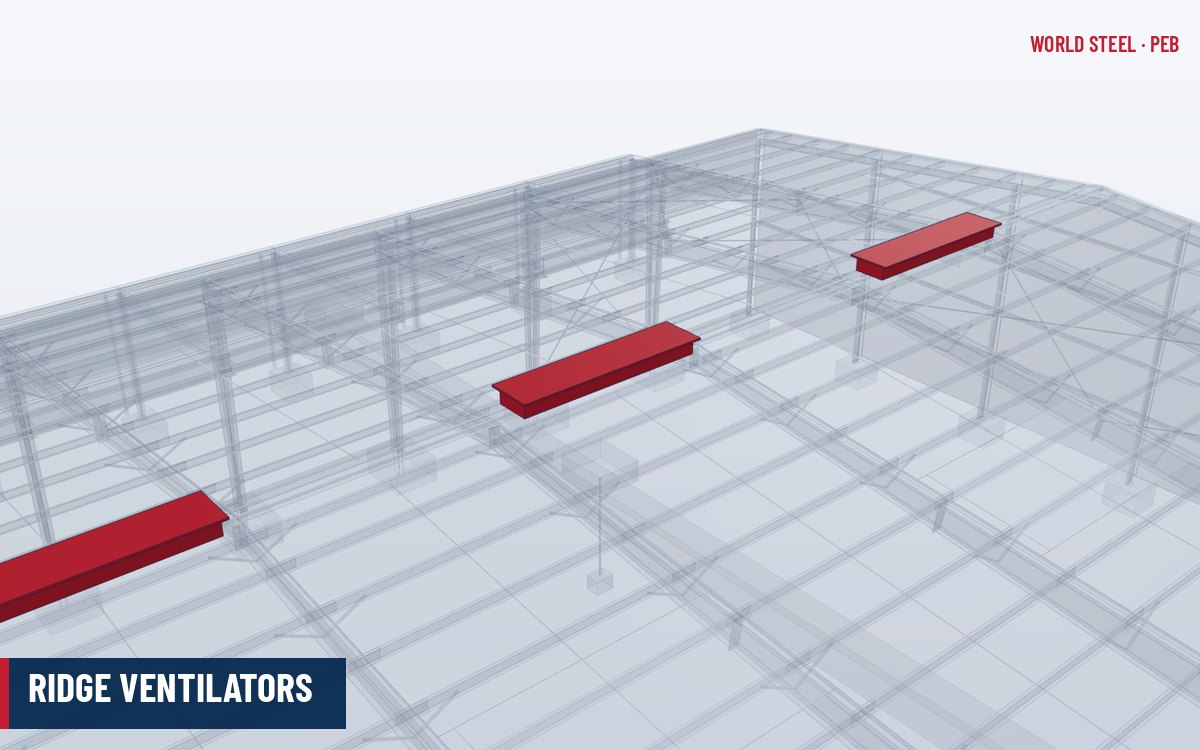
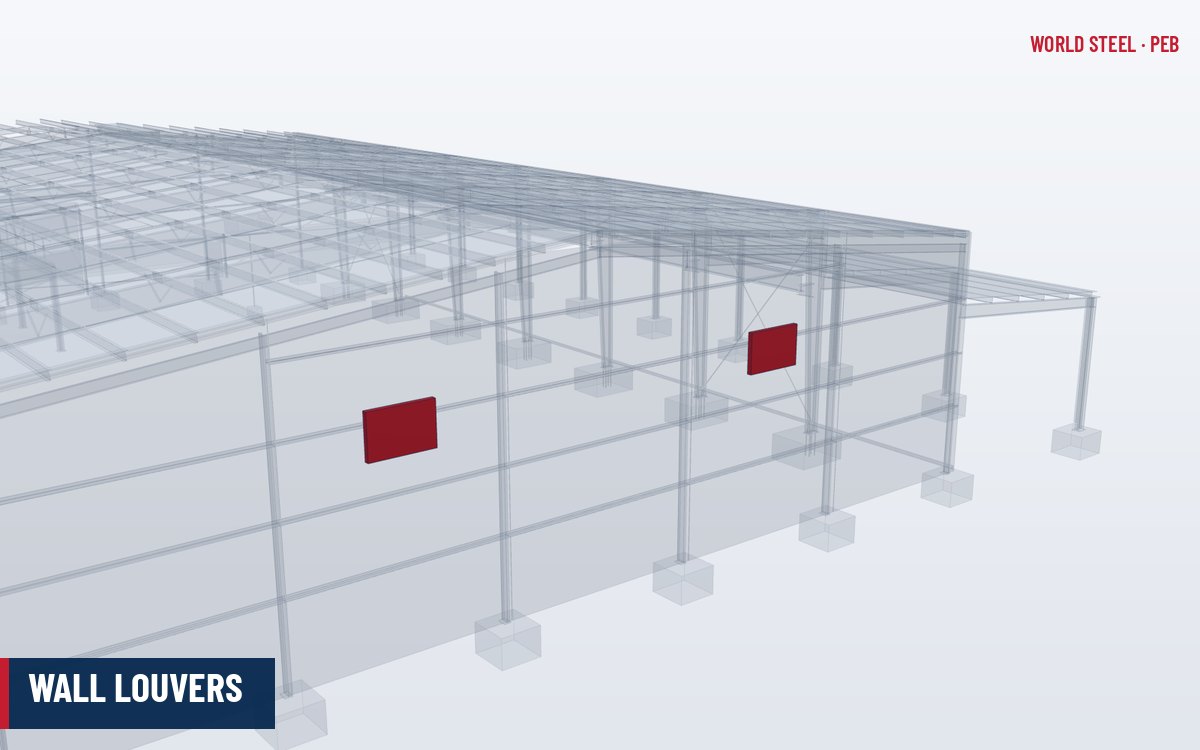
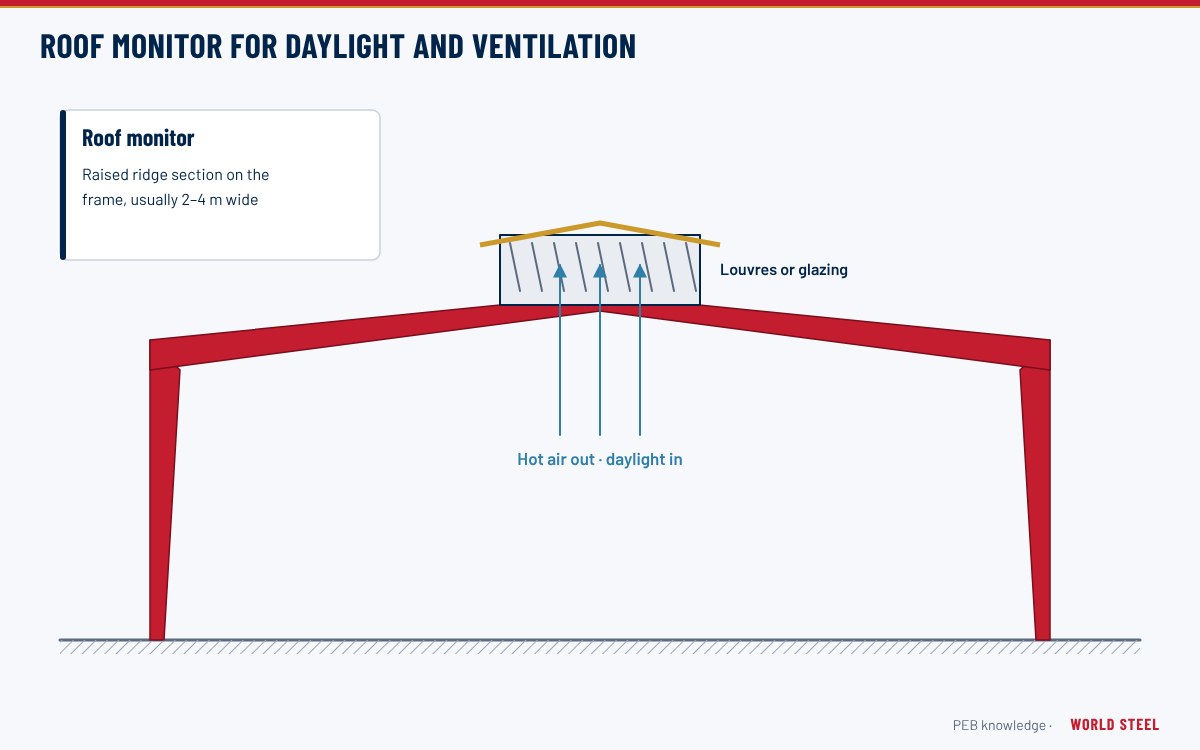
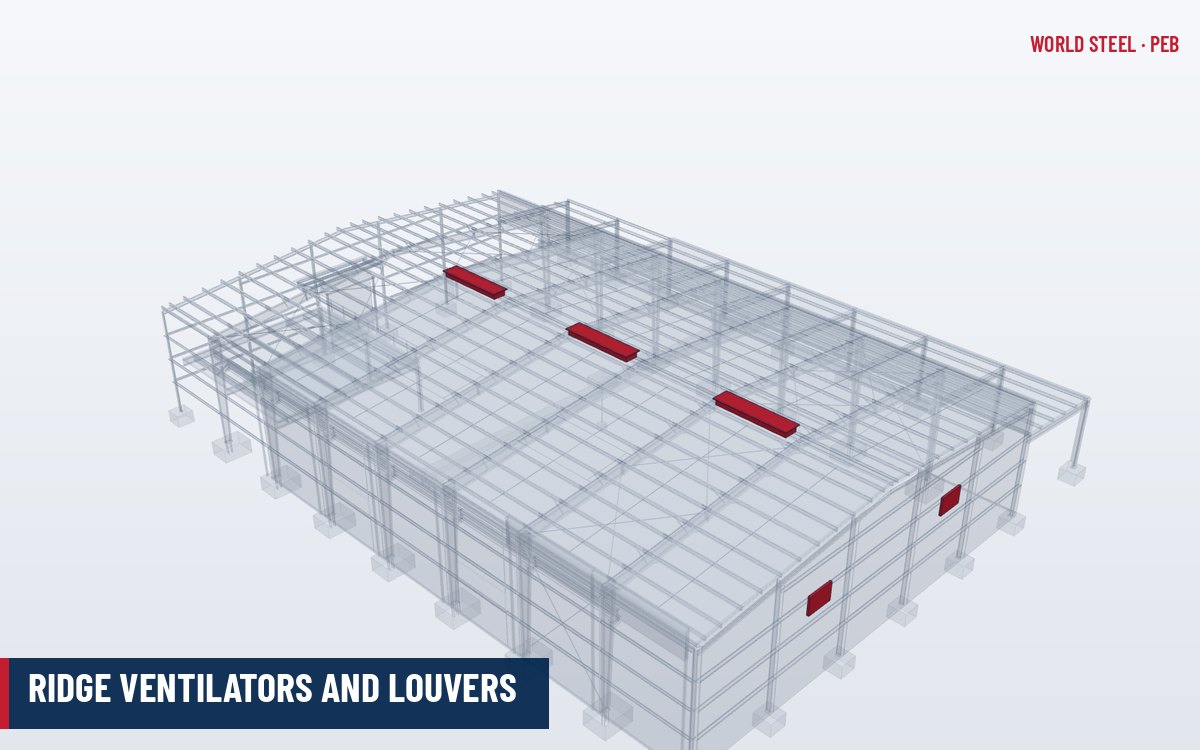
Natural ventilation removes heat, fumes and moisture without running costs. In a pre-engineered building it is usually provided by ridge ventilators on the roof and wall louvers low on the walls, so that warm air rises and exits at the ridge while fresh air enters below. World Steel supplies both as part of the accessories package, with framed openings and trims detailed in the drawings.
- Continuous ridge ventilators in steel, with bird screen and weather baffles.
- Individual gravity ridge ventilators placed at selected bays.
- Turbine (wind-driven) roof ventilators where the market favours them.
- Fixed-blade wall louvers with bird or insect screen and framed opening members.
- Trims, flashings, closures and dampers where specified.
Options and variants
| Product | Typical sizes | Use |
|---|---|---|
| Continuous ridge vent | Throat about 300–600 mm, length as required | Factories, workshops, warehouses with heat load |
| Gravity ridge vent units | Sections about 3 m long | Localised extraction |
| Turbine ventilator | Throat about 300–900 mm diameter | Small buildings, agricultural buildings |
| Fixed-blade louver | Made to framed opening size | Fresh air inlet, plant rooms |
The required free area depends on the heat load, the stack height between inlet and outlet and the air change rate the process needs; a ventilation engineer or the client sets the target and World Steel sizes and positions the units. Mechanical extraction can be combined with natural ventilation.
Materials and finishes
Ventilators and louver blades are typically made from aluminium-zinc coated or pre-painted steel matching the cladding colour, with aluminium or stainless steel used for corrosive atmospheres such as fertiliser stores or coastal plants. Bird screens are galvanized or stainless mesh. The supporting framed openings are part of the secondary framing.
Compliance by market
| Market | Design code | Fabrication / welding | Materials | Certification notes |
|---|---|---|---|---|
| United States | IBC / IMC ventilation provisions, ASCE 7-22 wind on appurtenances; AMCA 500-L louver ratings where specified | AWS D1.3 for welded sheet parts | ASTM A792 / A653 or aluminium | WSC holds IAS AC472 accreditation for metal building systems; welding qualified to AWS D1.1 (structural) and AWS D1.3 (sheet steel). AISC Certification is not held – confirm acceptance if specified. |
| Canada | NBC 2020 Part 6 / provincial requirements | CSA W59 where welded | Coated steel or aluminium | Designed to CSA S16 / CSA S136 by WSC or the engineer of record. CSA W47.1 (CWB) company certification is a market requirement, arranged per project. |
| Australia / New Zealand | AS 1668.2 ventilation where applicable, AS/NZS 1170.2 wind | AS/NZS 5131 for supporting steel | AS 1397 coated steel | WSC is certified to AS/NZS 5131 Construction Category CC3; welding to AS/NZS 1554.1. For New Zealand, SFC certification is not held – confirm acceptance per project. |
| Europe | EN 1991-1-4 wind, EN 13030 louver performance where specified | EN 1090-2 / EN 1090-4 | EN 10346 coated steel | WSC is certified to EN 1090-2 Execution Class EXC3 and ISO 3834-2. CE marking via EN 1090-1 factory production control to be confirmed per project. |
Ratings and test references
| Product | Reference | What it shows |
|---|---|---|
| Wall louvers (North America) | AMCA 500-L; AMCA 550; AMCA 540; certified under AMCA 511 | Free area, pressure drop, water penetration, wind-driven rain, impact |
| Wall louvers (Europe) | EN 13030 | Rain-rejection class A–D and discharge coefficient |
| Natural smoke and heat exhaust ventilators | EN 12101-2; NFPA 204 design; AS 2665 | Certified aerodynamic area and reliability for smoke control |
| Gravity and turbine ventilators | Manufacturer free-area and wind-rating data | Capacity and resistance to the design wind speed |
Comfort ventilators and smoke vents are different products: a gravity ridge vent is not a certified smoke vent unless it is tested and designed as one. See ridge ventilators and wall louvers.
Documentation, packing and quotation
Deliverables include ventilator and louver positions on the roof and wall layouts, free-area calculations where requested, framed opening details and product data. Units are packed in crates or boxed kits to protect blades and screens.
A quotation can be prepared quickly when the enquiry states the project location and the code to be used. Please send:
- Building use, process heat load or required air changes per hour.
- Preferred product type and finish.
- Site environment (coastal, chemical, agricultural).
- Any fire damper or weather rating requirements.
World Steel returns a priced scope with a clear inclusions and exclusions list, the design basis assumed and a typical lead time. Enquiries go through the export supply team in Ho Chi Minh City.
各地区标准
| 地区 | 规范 | 范围 |
|---|---|---|
 United States |
AMCA 500-L | Laboratory methods of testing louvers |
 Australia / NZ |
AS 1668.2 | Ventilation design for indoor air contaminant control |
 Europe |
EN 13030 | Ventilation – performance testing of louvres |
 Canada |
NBC 2020 | Ventilation provisions |
| International | ISO 12944 | Corrosion protection for steel parts |
常见问题
How many ridge ventilators does a building need?
It depends on the heat load and the air change rate required; the free area is calculated and the units are spread along the ridge.
Do louvers let in rain?
Fixed-blade louvers are designed to shed rain, but wind-driven rain can enter; weather-rated louvers are used where this matters.
Can natural ventilation replace mechanical ventilation?
For many warehouses and workshops it can, but processes with fumes or tight temperature control usually need mechanical systems.