ENEnglish
 VITiếng Việt
 ZH中文
 KO한국어
 JA日本語
 FRFrançais
 ITItaliano
 PTPortuguês
 ESEspañol
 HEעברית
 ARالعربية

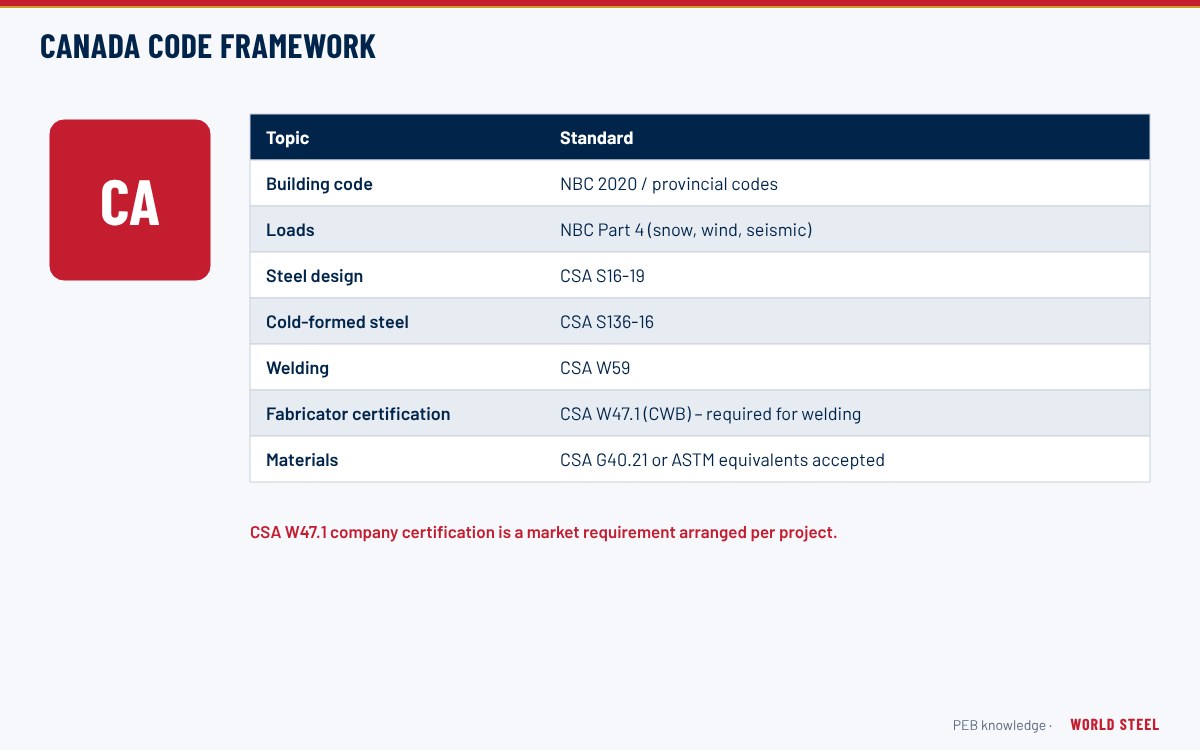
The Canadian framework
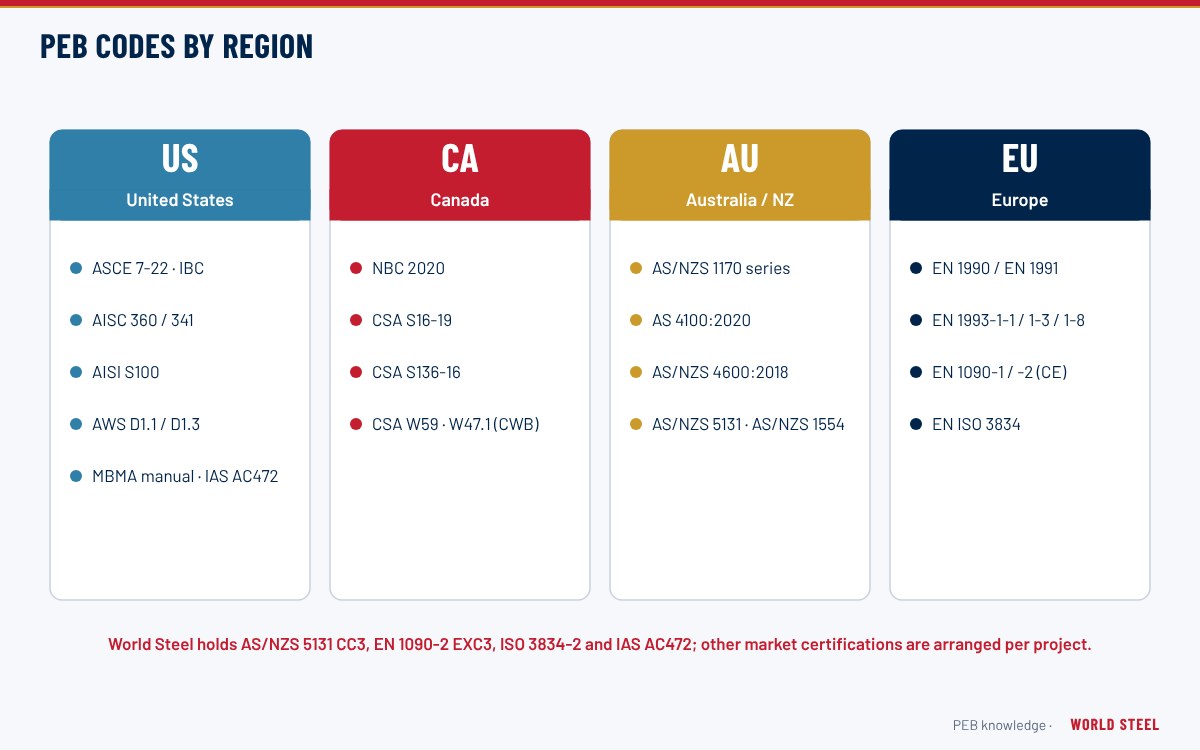
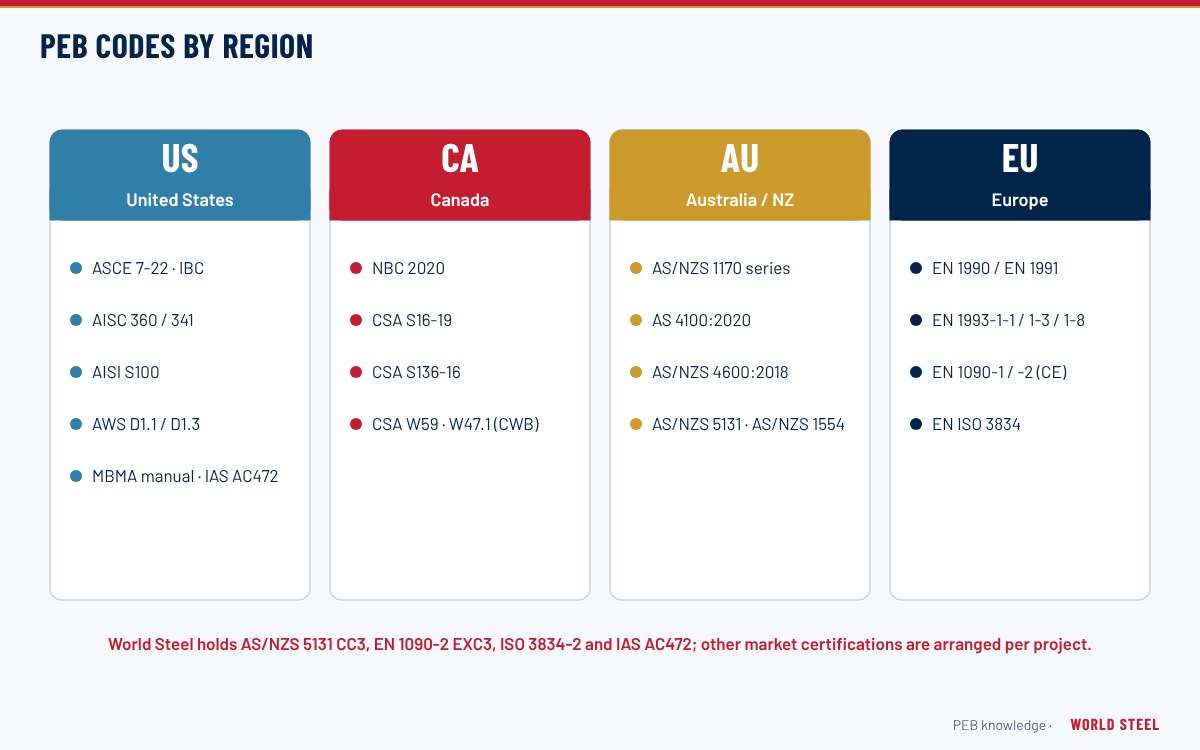
Canada's model code is the National Building Code of Canada (NBC), currently the 2020 edition, published by the National Research Council. Provinces and territories adopt it directly or through their own codes – for example the Ontario Building Code, the BC Building Code, the Alberta Building Code and Quebec's Construction Code – sometimes with a delay and with local changes. Structural design follows NBC Part 4, which references CSA Group standards for steel design, cold-formed steel, welding and fabricator certification.
Two features make Canada distinctive for steel building exporters: mandatory company certification for welding under CSA W47.1, and a specific certification standard for manufacturers of steel building systems, CSA A660.
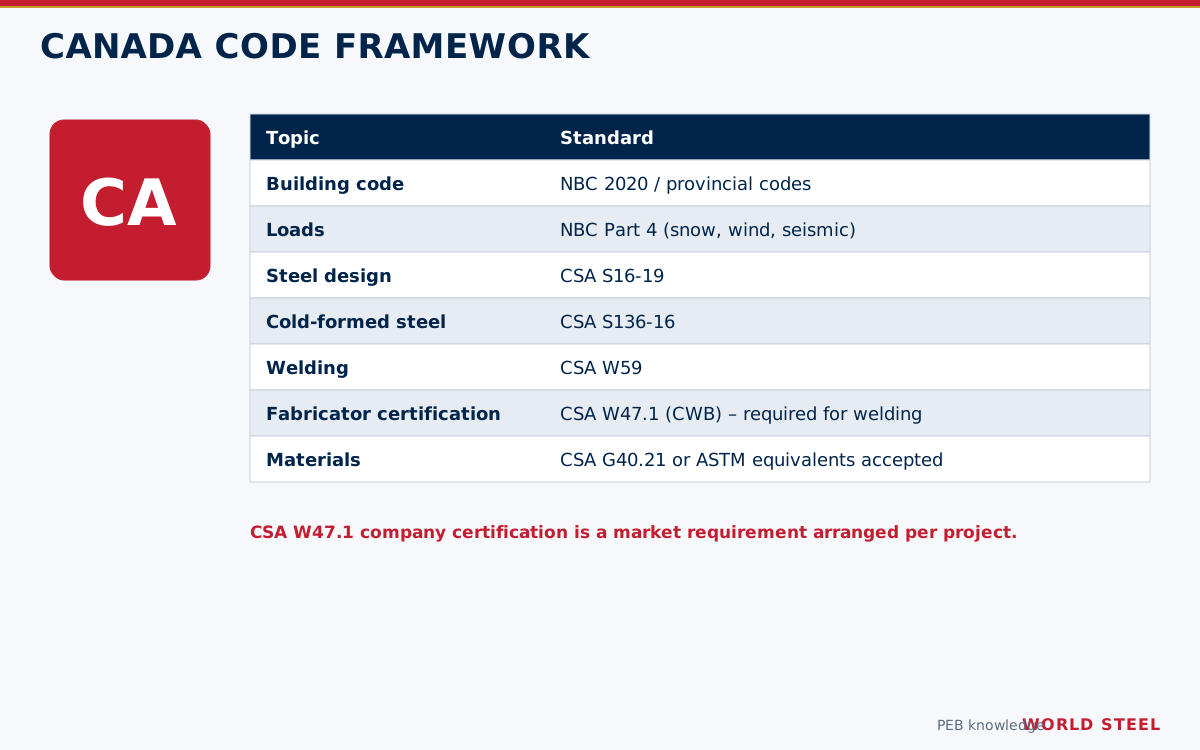
Code mapping
| Topic | Standard | Notes |
|---|---|---|
| Building approval | NBC 2020 and provincial building codes | Drawings sealed by an engineer licensed in the province |
| Loads | NBC 2020 Part 4, climatic data, Structural Commentaries | Limit states design; snow and wind by location; seismic from the national hazard model |
| Steel design | CSA S16-19 (S16:24 is the latest edition) | Includes seismic design clauses and crane-supporting structures |
| Cold-formed design | CSA S136-16 | North American Specification with Canadian provisions |
| Welding | CSA W59 | Welded steel construction |
| Welding company certification | CSA W47.1 (administered by CWB) | Required by CSA S16 for welded structural steel |
| Steel building system manufacturers | CSA A660 | Referenced in NBC Part 4 for steel building systems |
| Materials | CSA G40.20/G40.21 (e.g. 350W); ASTM equivalents | ASTM A572, A653, A792, F3125, F1554 commonly accepted |
Loads and design
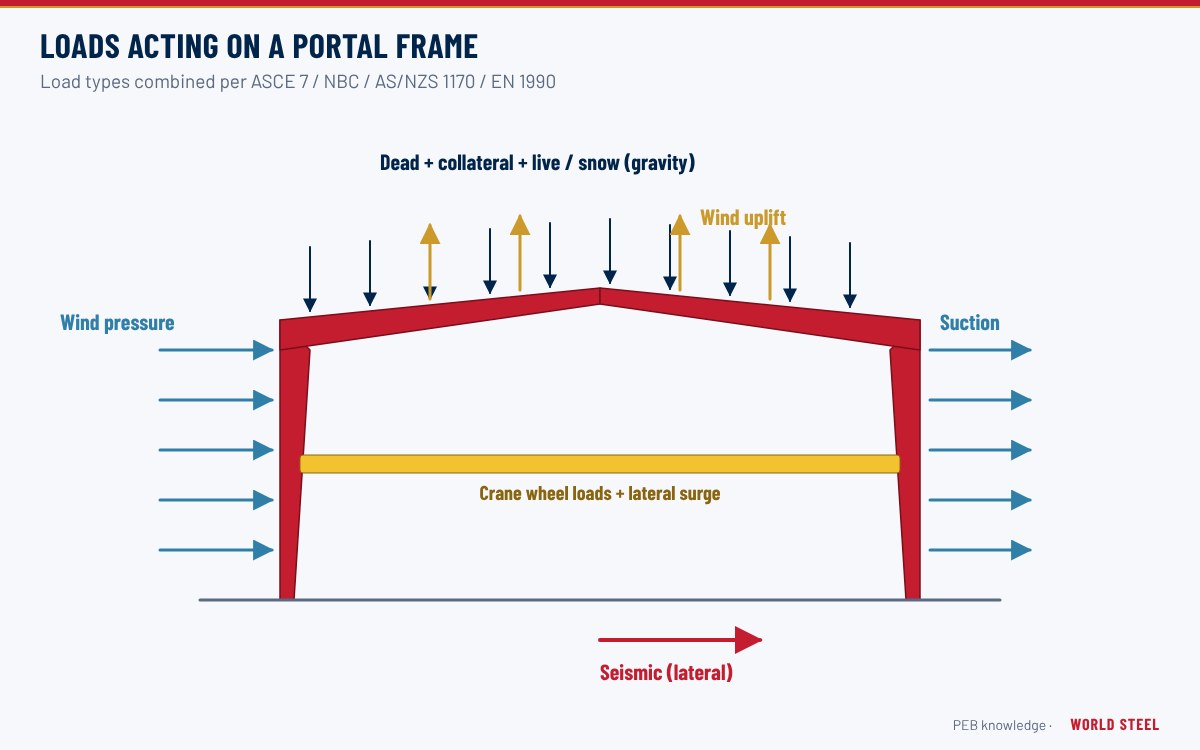
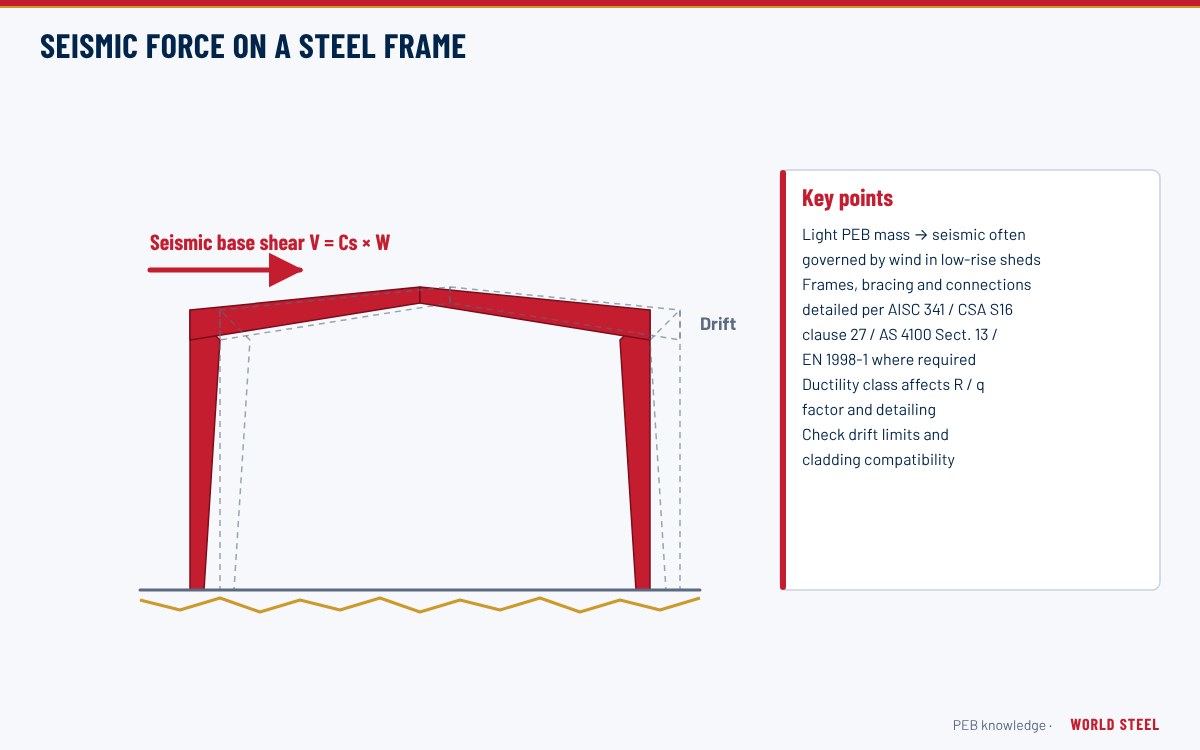
NBC 2020 Part 4 uses limit states design with importance factors for snow, wind and earthquake. Snow loads are significant across most of Canada and drift at roof steps, parapets and lean-tos often governs purlin and rafter design – see lean-to extensions. NBC 2020 introduced an updated seismic hazard model, which raised design values in some locations.
- CSA S16-19 covers member and connection design, frame stability and seismic force-resisting systems. Light buildings may use the conventional construction category with limits on seismic forces.
- CSA S136-16 covers purlins, girts and other cold-formed members.
- Cold climate. Notch toughness requirements for steel and consumables may apply for low service temperatures; thermal bridging and vapour control affect cladding and insulation design.
Importance categories and climatic loads
NBC 2020 classifies every building into an importance category, which scales the snow, wind and earthquake loads through importance factors. Most warehouses and factories are Normal; low-occupancy farm and storage buildings may be Low; schools and buildings used as shelters are High; and emergency facilities are Post-disaster.
| Importance category | Snow (Is) | Wind (Iw) | Earthquake (IE) |
|---|---|---|---|
| Low | 0.8 | 0.8 | 0.8 |
| Normal | 1.0 | 1.0 | 1.0 |
| High | 1.15 | 1.15 | 1.3 |
| Post-disaster | 1.25 | 1.25 | 1.5 |
Climatic design values – ground snow load Ss with the associated rain load Sr, the 1-in-50-year reference velocity pressure, and seismic spectral accelerations – are taken for the specific location from NBC Appendix C and the national seismic hazard values. Roof snow is then derived with basic, wind exposure, slope and accumulation factors, and drift loads at lean-tos, parapets and adjacent higher roofs frequently govern metal building purlins and rafters. For low service temperatures, impact-tested CSA G40.21 steels (for example category 350WT) may be specified, which affects how plate and fasteners are sourced. Recommended deflection limits are given in CSA S16-19 Annex D; see serviceability and deflection limits.
Certification route: CSA W47.1 and CSA A660
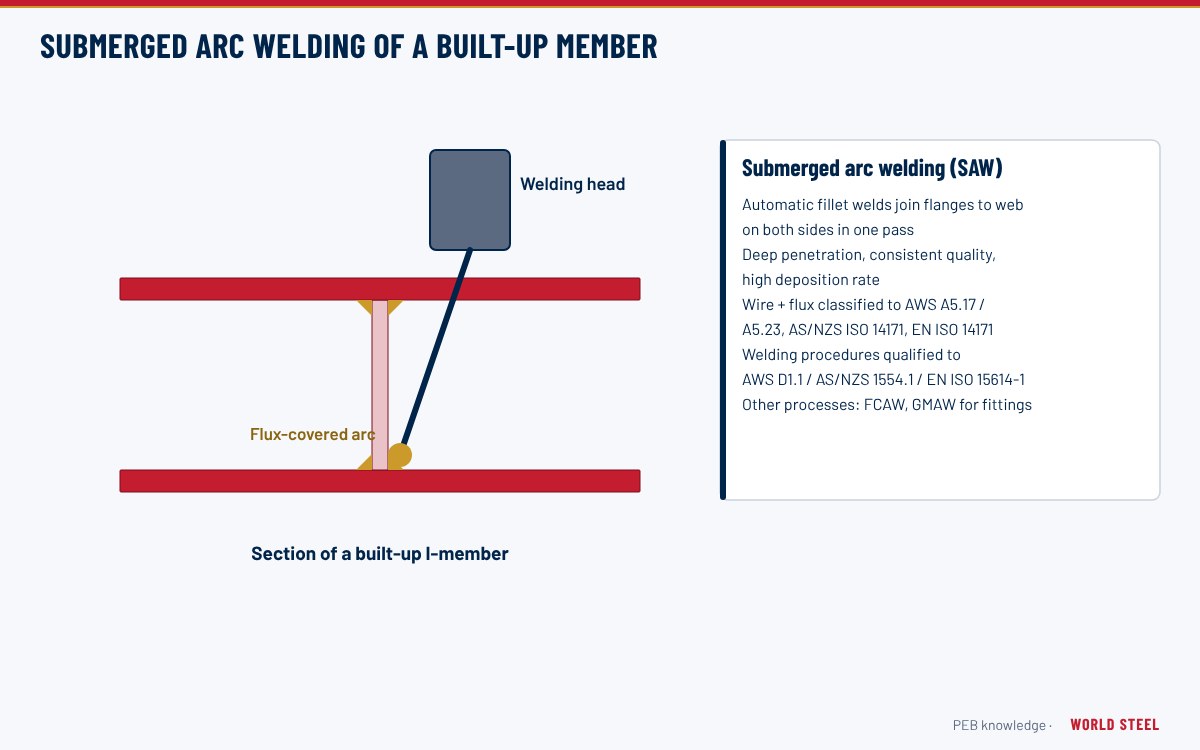
CSA W47.1 certifies companies that perform fusion welding of steel. Certification is issued by the Canadian Welding Bureau (CWB) in three divisions: Division 1 requires a full-time professional engineer responsible for welding, Division 2 a retained part-time engineer, and Division 3 none. All divisions need qualified welding supervisors, CWB-approved welding procedures and qualified welders, and audits continue throughout certification. CSA S16 requires fabricators of welded structural steel to be certified to CSA W47.1, and the requirement applies equally to foreign fabricators.
CSA A660 certifies manufacturers of steel building systems. It audits the whole system – engineering methods and personnel, materials control, fabrication, packaging, shipping, erection documentation and quality assurance – and NBC Part 4 requires steel building systems to be manufactured by companies certified to it. Certification audits are also conducted through CWB.
Certification takes time to obtain. For Canadian projects, confirm the fabricator's W47.1 and A660 status before design starts, not at shop drawing stage.
World Steel in the Canadian market
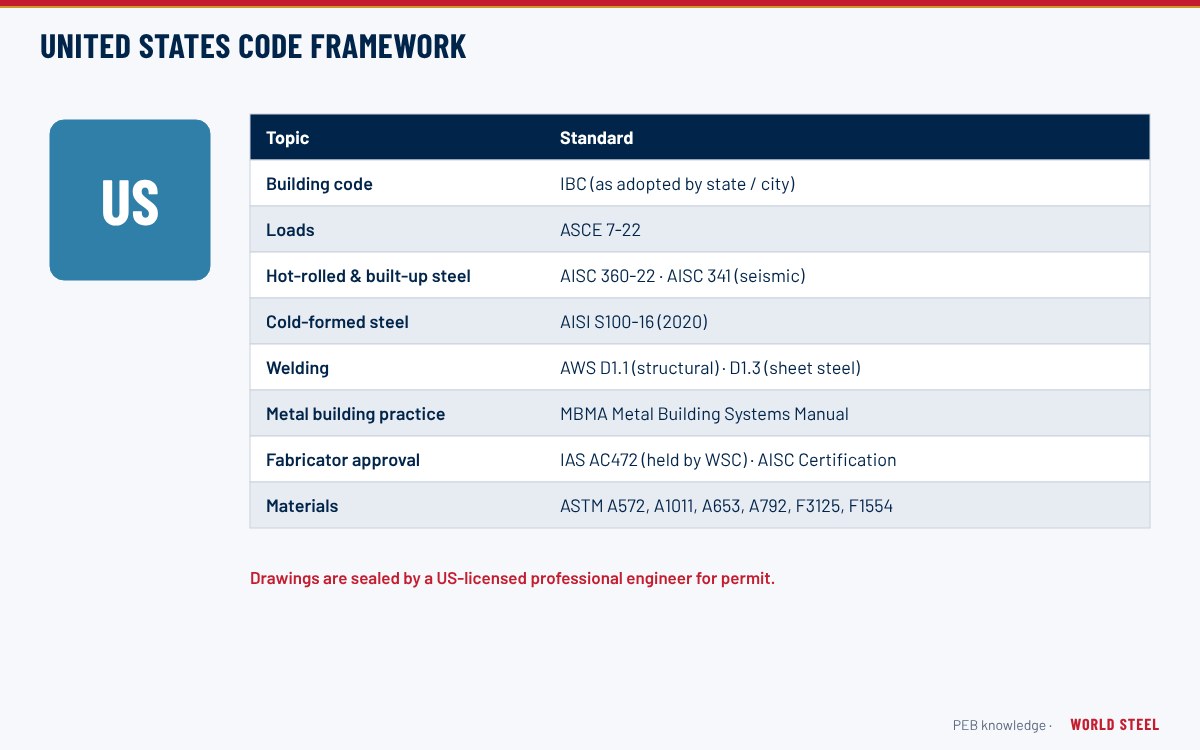
World Steel designs to NBC 2020, CSA S16 and CSA S136 and fabricates under ISO 3834-2 and EN 1090-2 EXC3. WSC does not currently hold CSA W47.1 or CSA A660 certification; for Canadian projects these requirements must be arranged or confirmed with the client and the authority having jurisdiction before award. Engineering seals are provided by engineers licensed in the relevant province. See market compliance and certification, the US standards for comparison, and the global overview.
Normes par région
| Région | Norme | Périmètre |
|---|---|---|
 Canada |
NBC 2020 | National Building Code of Canada – Part 4 structural design |
| Canada |
CSA S16-19 | Design of steel structures |
| Canada |
CSA S136-16 | North American Specification for cold-formed steel structural members |
| Canada |
CSA W59 | Welded steel construction |
| Canada |
CSA W47.1 | Certification of companies for fusion welding of steel |
| Canada |
CSA A660 | Certification of manufacturers of steel building systems |
| Canada |
CSA G40.21 | Structural quality steel |
Questions fréquentes
Is CSA W47.1 certification mandatory for foreign fabricators?
Yes, for welded structural steel designed to CSA S16. The standard applies to the company doing the welding regardless of where it is located, and certification is issued by CWB.
What is CSA A660?
It is the Canadian standard for certifying manufacturers of steel building systems, covering design, materials, fabrication and documentation. NBC Part 4 requires steel building systems to come from A660-certified manufacturers.
Can ASTM steel grades be used in Canada?
Generally yes, when the design standard permits and the grade's properties are documented with mill certificates; many Canadian projects accept ASTM A572 Grade 50 alongside CSA G40.21 350W.
Which NBC importance category applies to a typical warehouse?
Most warehouses, factories and commercial buildings are in the Normal importance category, with importance factors of 1.0 for snow, wind and earthquake at ultimate limit states. Low applies only to buildings with low human occupancy, and High or Post-disaster to schools, shelters and emergency facilities.