ENEnglish
 VITiếng Việt
 ZH中文
 KO한국어
 JA日本語
 FRFrançais
 ITItaliano
 PTPortuguês
 ESEspañol
 HEעברית
 ARالعربية

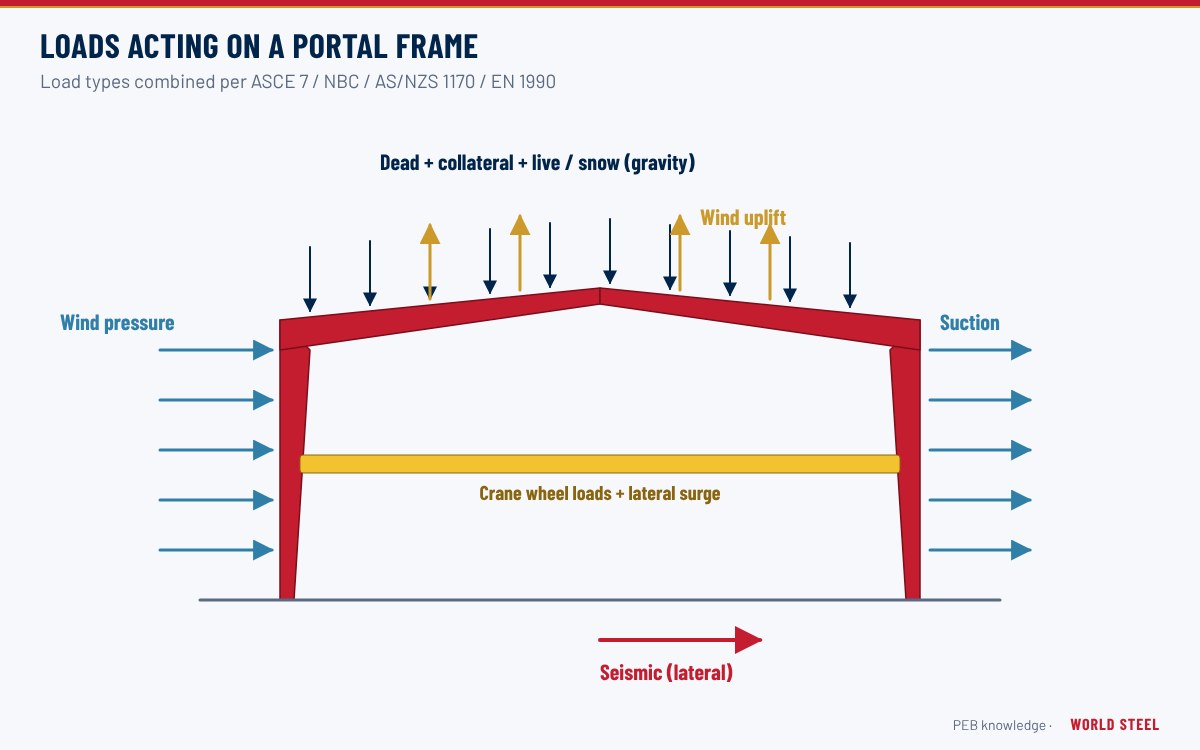
Load types acting on a PEB
A pre-engineered building is designed for the specific loads of its site and use, which is why accurate load data at the start of a project is essential. The main load types are:
- Dead load (D / G): self-weight of frames, purlins, girts, cladding and insulation – typically light, often 0.10–0.20 kPa for the roof system excluding frames.
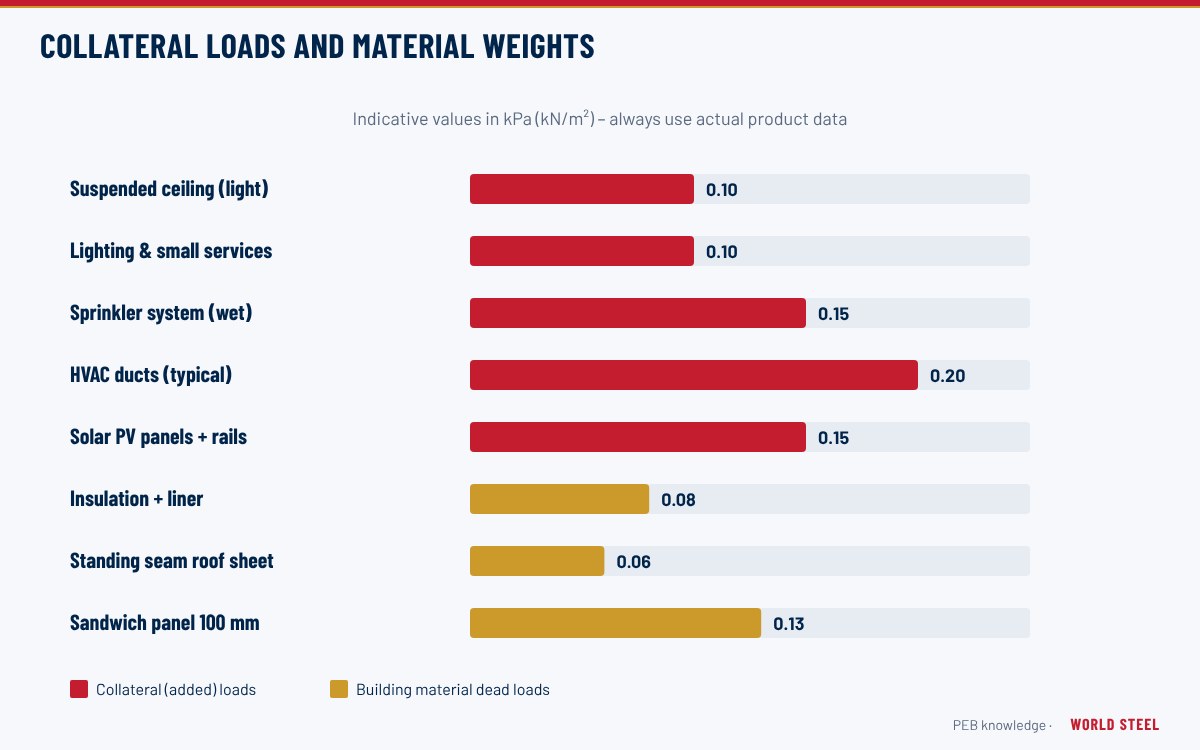
- Collateral (superimposed dead) load: permanent services, sprinklers, ceilings, lighting and ducts, commonly 0.10–0.25 kPa on industrial roofs; solar panels are added explicitly.
- Roof live load (Lr / Q): maintenance and construction load, for example 20 psf (0.96 kPa) reducible in ASCE 7-22 or an area-dependent load with a 0.25 kPa minimum for non-trafficable roofs in AS/NZS 1170.1 (plus concentrated loads).
- Floor live load (L): for mezzanines and platforms, by occupancy.
- Snow and rain loads (S, R): ground snow converted to roof snow with exposure, thermal and slope factors, plus drift at steps and parapets; rain ponding on low-slope roofs.
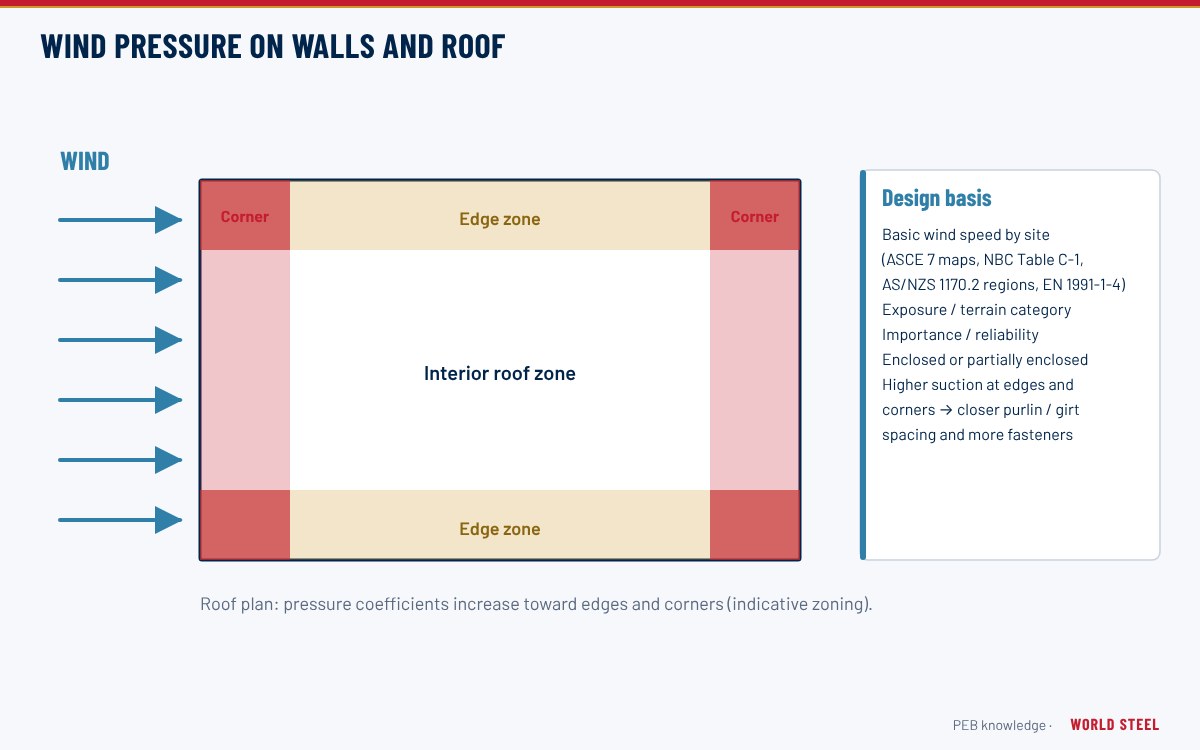
- Wind load (W): usually governs light PEB frames, cladding and anchor bolts – see wind design.
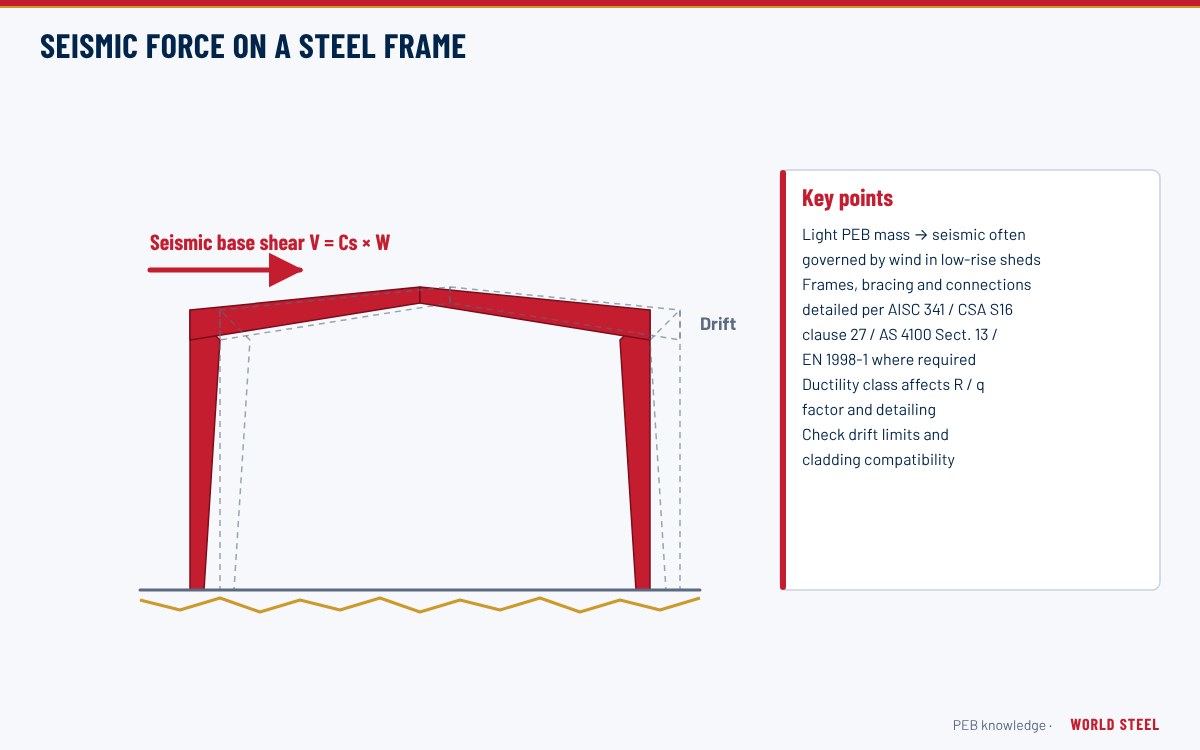
- Seismic load (E): governs heavy buildings, mezzanines and crane buildings in active zones – see seismic design.
- Crane loads: vertical wheel loads with impact, lateral and longitudinal forces – see crane runway systems.
- Temperature, notional and auxiliary loads: long buildings, imperfections, hung equipment.
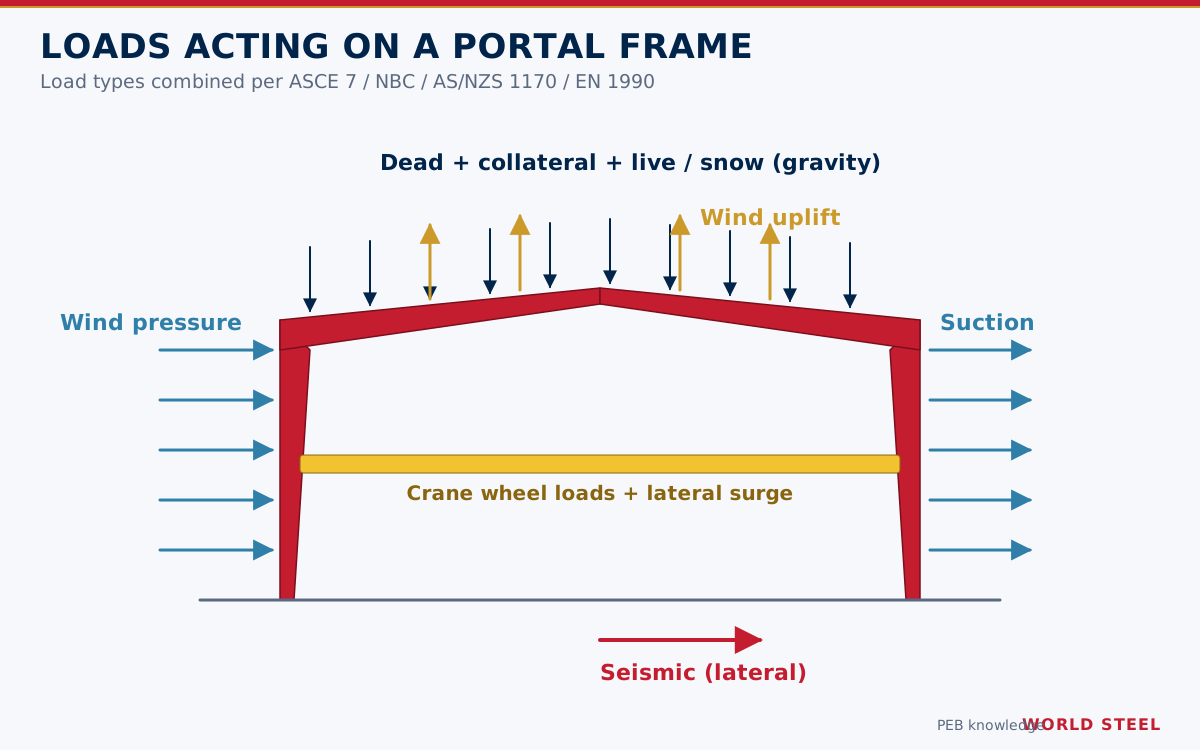
Load combinations by region
Each code combines loads with factors that reflect the probability of simultaneous occurrence. The table summarises the main strength (ultimate) combinations; each code contains further cases and companion factors.
| Region / code | Typical combinations |
|---|---|
| USA – ASCE 7-22 (LRFD) | 1.4D; 1.2D + 1.6L + 0.5(Lr or S or R); 1.2D + 1.6(Lr or S or R) + (L or 0.5W); 1.2D + 1.0W + L + 0.5(Lr or S or R); 0.9D + 1.0W; 1.2D + Ev + Eh + L + 0.15S; 0.9D − Ev + Eh |
| Canada – NBC 2020 | 1.4D; 1.25D + 1.5L + (1.0S or 0.4W); 1.25D + 1.5S + (1.0L or 0.4W); 1.25D + 1.4W + (0.5L or 0.5S); 1.0D + 1.0E + 0.5L + 0.25S; 0.9D used where dead load resists |
| Australia / NZ – AS/NZS 1170.0 | 1.35G; 1.2G + 1.5Q; 1.2G + 1.5ψl Q; 1.2G + Wu + ψc Q; 0.9G + Wu; G + Eu + ψE Q; 1.2G + Su + ψc Q |
| Europe – EN 1990 (Eq. 6.10) | 1.35Gk + 1.5Qk,1 + 1.5 Σ ψ0,i Qk,i; favourable permanent action 1.0Gk; seismic: Gk + AEd + Σ ψ2,i Qk,i |
US practice also allows ASD combinations (for example D + 0.6W) with allowable strength design under AISC 360-22. National Annexes in Europe may set different partial factors or choose Eq. 6.10a/6.10b.
Uplift combinations such as 0.9D + 1.0W (US) or 0.9G + Wu (AU/NZ) usually govern anchor bolts, purlin bracing and base plates in light PEBs.
Load cases analysed for a PEB frame
Combinations are built from individual load cases. For a typical gable frame the designer runs more cases than the short list above suggests, because the most severe effect on each member comes from a different pattern:
| Load case | What it represents | Members it often governs |
|---|---|---|
| Dead + collateral (full) | Self-weight and permanent services | Rafters, base reactions |
| Roof live, full and unbalanced | Maintenance load on the whole roof or on one side only | Rafter mid-span and ridge splice, multi-span rafters |
| Snow – balanced, unbalanced, drift | Uniform snow, wind-shifted snow, drift at steps, parapets and valleys | Rafters, lean-to and multi-gable frames |
| Wind transverse, left and right, with positive and negative internal pressure | Wind across the frames | Columns, knee connections, anchor bolts in uplift |
| Wind longitudinal | Wind along the building, roof suction on all frames | Rafter inner-flange bracing, bracing system |
| Seismic, each direction | Inertia of roof, walls, mezzanines and cranes | Bracing, connections in heavy or high-hazard buildings |
| Crane cases | Maximum wheel load at each column, lateral surge, braking | Crane columns, brackets, crane-bay bracing |
| Mezzanine live, pattern loaded | Floor load on alternate spans | Mezzanine beams, main columns |
| Temperature | Expansion and contraction of long or wide buildings | Bracing, frames near fixed points |
Roof live load and snow are alternative variable loads on the roof and are not normally applied together at full value. Thermal effects are usually controlled by detailing rather than design: steel expands by about 12 mm per 10 m length for a 100 °C change (coefficient about 12 × 10⁻⁶ per °C), so a 120 m building may move tens of millimetres between seasons, which is why expansion joints or flexible bracing layouts are used on long buildings.
Collateral allowances and the weights of typical roofing, flooring and wall materials are listed in collateral loads and building material weights; mezzanine live loads by occupancy are in buildings with mezzanine floors.
Serviceability combinations
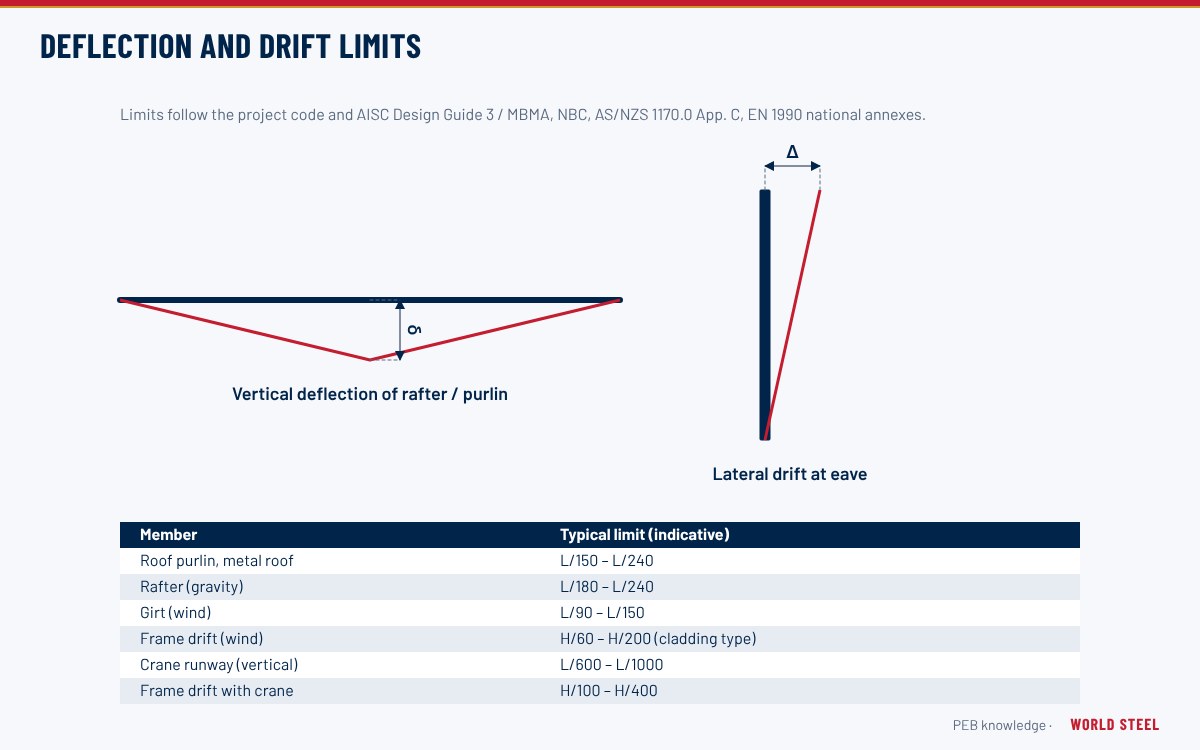
Deflection and drift are checked under unfactored or reduced loads, for example wind with a shorter return period. US practice (MBMA, AISC Design Guide 3) commonly uses a 10-year wind for drift; AS/NZS 1170.0 uses serviceability wind Ws; Eurocodes use characteristic, frequent or quasi-permanent combinations with limits in National Annexes. Details are given in serviceability and deflection limits.
Load data the designer needs
- Project location, applicable building code and edition, risk / importance category and design life.
- Basic wind speed or region, terrain and topography.
- Ground snow load and rain intensity (where relevant).
- Seismic parameters and site class / soil class.
- Collateral loads, hung equipment, solar panels and future expansion.
- Crane data, mezzanine uses and any special loads.
World Steel's engineering team establishes these parameters with the client at quotation stage, and the agreed design criteria appear on the drawing set and calculations – see design deliverables.
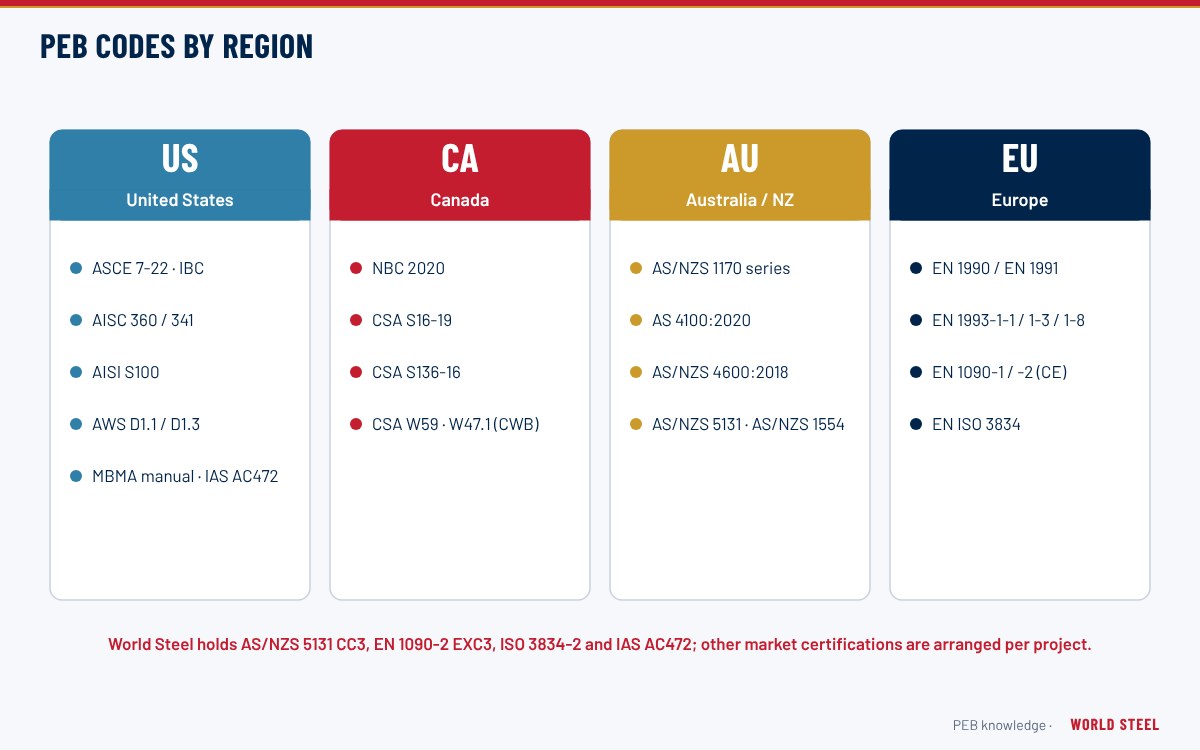
Standards by region
| Region | Code | Scope |
|---|---|---|
 United States |
ASCE 7-22 | Minimum design loads and associated criteria |
| United States |
IBC 2021 / 2024 | Chapter 16 structural design |
 Canada |
NBC 2020 Part 4 | Structural design – loads and combinations |
 Australia / NZ |
AS/NZS 1170.0 / .1 / .2 / .3 | General principles, imposed, wind and snow actions |
| Australia / NZ |
AS 1170.4 / NZS 1170.5 | Earthquake actions |
 Europe |
EN 1990 | Basis of structural design |
| Europe |
EN 1991-1-1 / -1-3 / -1-4 | Imposed, snow and wind actions |
Frequently asked questions
What is collateral load in a PEB?
Collateral load is the weight of permanent items other than the building structure itself, such as sprinklers, lighting, ceilings and ducts. It is specified as a uniform load and must be agreed before design.
Which load usually governs a light steel building?
Wind, especially uplift on the roof and lateral load on the frames, typically governs light PEBs. Snow governs in cold regions and seismic in heavy or high-hazard buildings.
Can a PEB designed to one country's code be used in another?
Only if it is checked against the destination code's loads and combinations. Load factors, wind speeds and snow and seismic maps differ, so redesign or verification is normally needed.
Are roof live load and snow load applied at the same time?
Not at full value. Codes treat roof live load and snow as alternative roof loads: ASCE 7 combinations use "Lr or S", and the larger effect governs. Snow drift and unbalanced snow are, however, checked as separate cases in addition to uniform snow.