ENEnglish
 VITiếng Việt
 ZH中文
 KO한국어
 JA日本語
 FRFrançais
 ITItaliano
 PTPortuguês
 ESEspañol
 HEעברית
 ARالعربية

How steel behaves in fire
Steel does not burn, but it loses strength and stiffness as it heats. Structural steel retains roughly half of its room-temperature yield strength at around 550–600 °C, and the thin cold-formed sections used for purlins and girts heat faster than heavy members. How quickly a member reaches its critical temperature depends on its section factor – the heated perimeter divided by the cross-sectional area (Hp/A or A/V in Europe and Australia, W/D in the US). Thin, open sections with high section factors heat fastest and need more protection.
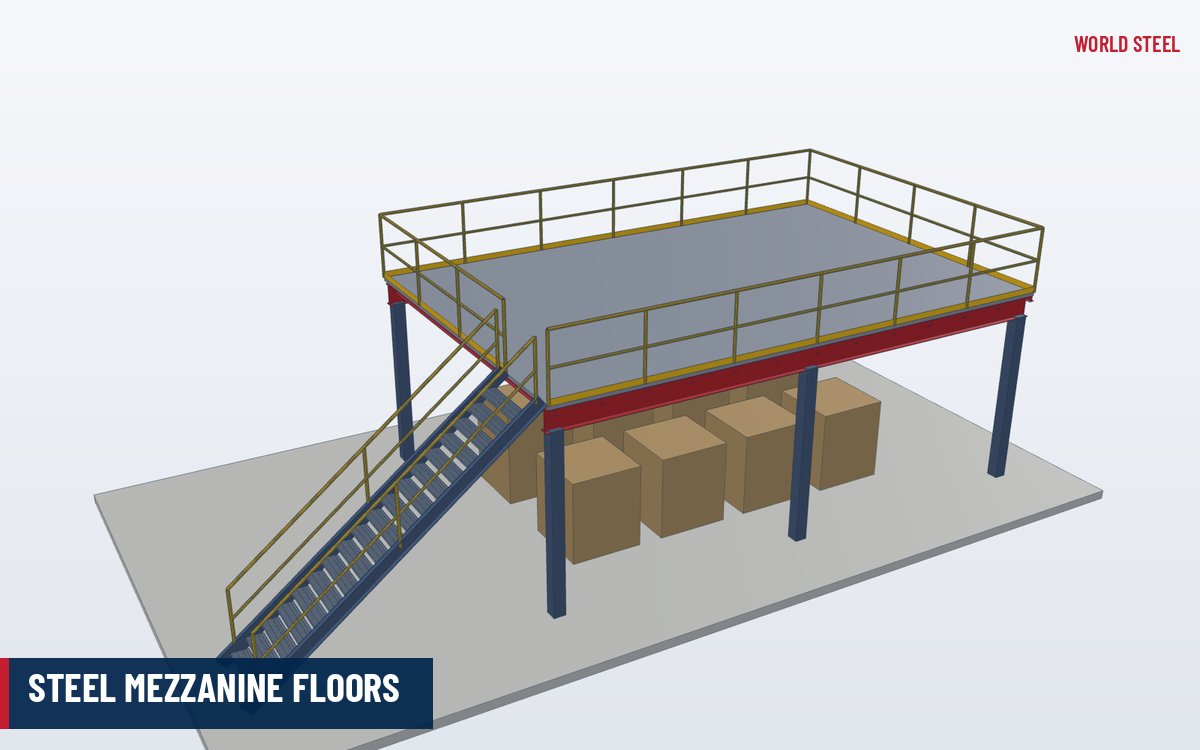
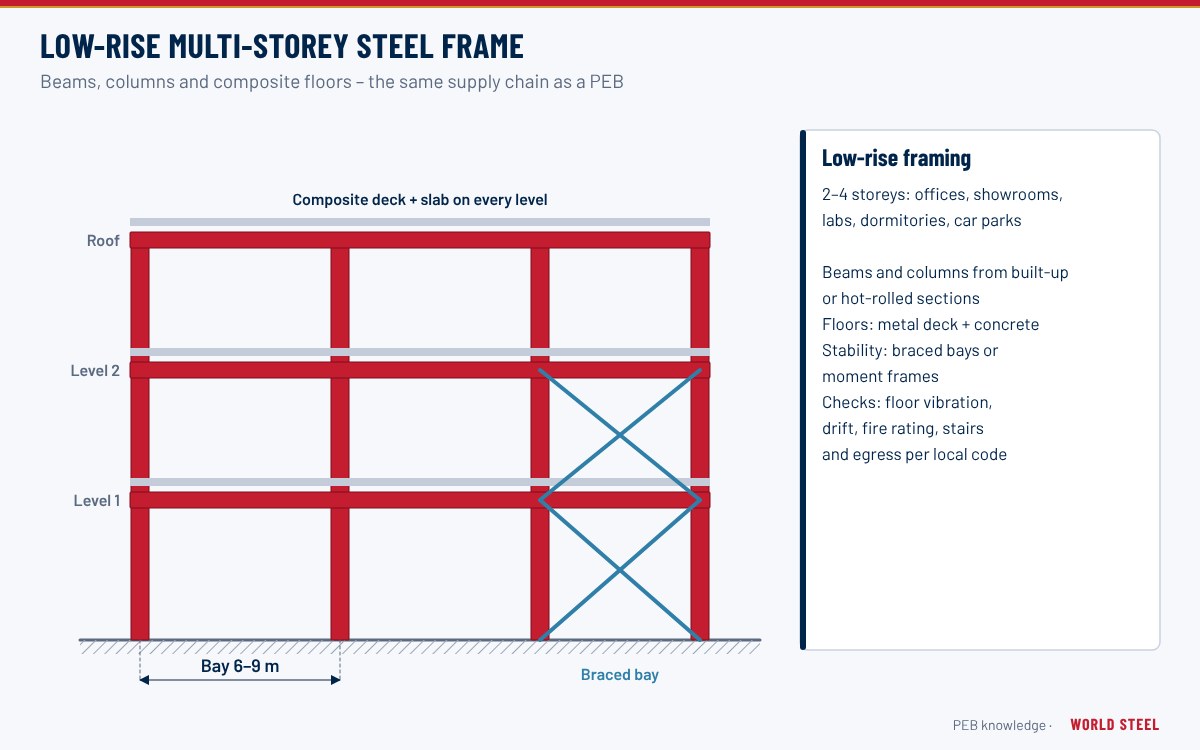
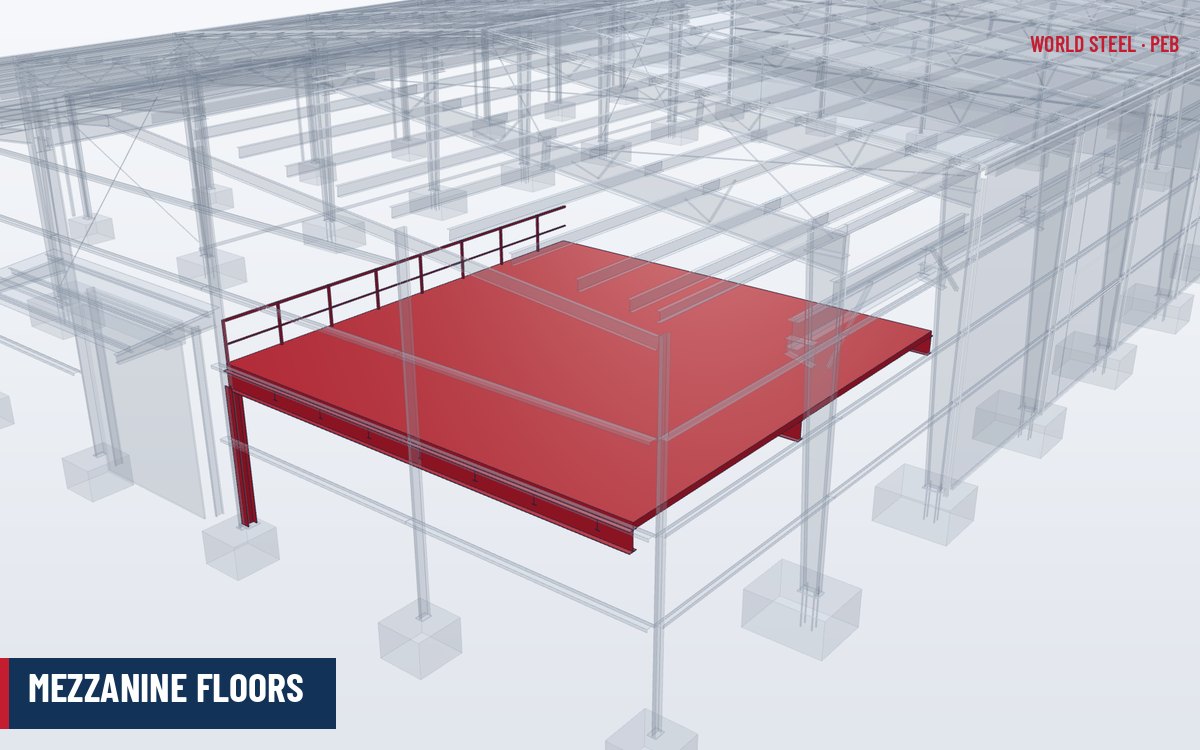
Many single-storey PEB warehouses and factories need no fire-resistance rating for the frame at all: building codes accept unprotected steel for single-storey buildings of many occupancies when the building area, separation distances and sprinkler provisions satisfy the code. Fire protection becomes necessary for multi-storey or low-rise buildings, mezzanines used for occupancy, buildings close to boundaries, fire walls between compartments and certain high-hazard or assembly uses.
Fire-resistance requirements by region
| Region | Code framework | Rating format | Test standard |
|---|---|---|---|
| United States | IBC Chapter 6 (construction types) and Chapter 7 | Hours, e.g. 1 h, 2 h; listed designs (UL directory) | ASTM E119 / UL 263 |
| Canada | NBC 2020 Part 3 | Minutes / hours (e.g. 45 min, 1 h) | CAN/ULC-S101 |
| Australia | NCC Volume One, Section C | Fire Resistance Level structural adequacy/integrity/insulation, e.g. 120/–/– | AS 1530.4; steel design AS 4100 Section 12 |
| New Zealand | NZBC C1–C6 and Acceptable Solutions/Verification Method | FRR in minutes | AS 1530.4 or equivalent |
| Europe | National regulations with EN 13501-2 | R 30, R 60, R 90, REI… | EN 1363-1, EN 13381-8 (reactive coatings); design EN 1993-1-2 |
In the US a typical single-storey steel warehouse is classed as Type IIB (unprotected non-combustible) construction, and IBC Section 507 allows unlimited-area single-storey buildings for several occupancies where the building is sprinklered and surrounded by open yards. Equivalent concessions exist in the other codes. The required rating is always set by the architect or fire engineer for the specific building – the steel supplier then provides members and coatings to match.
Passive protection options
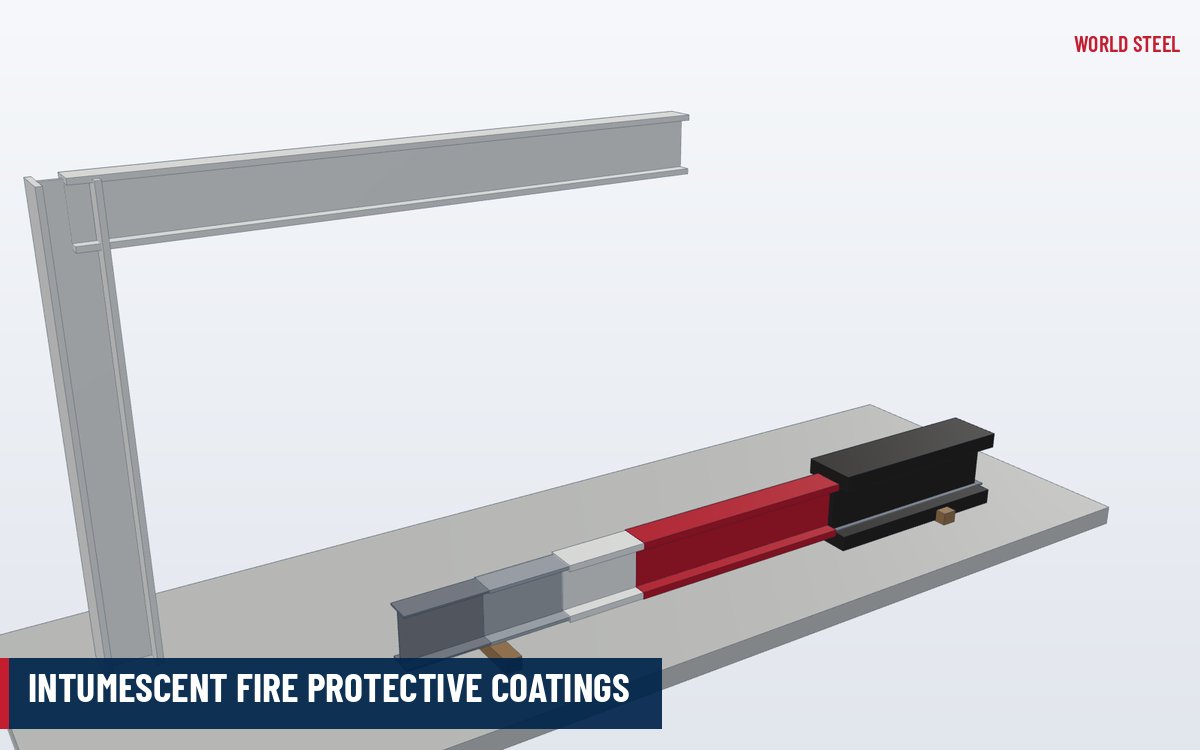
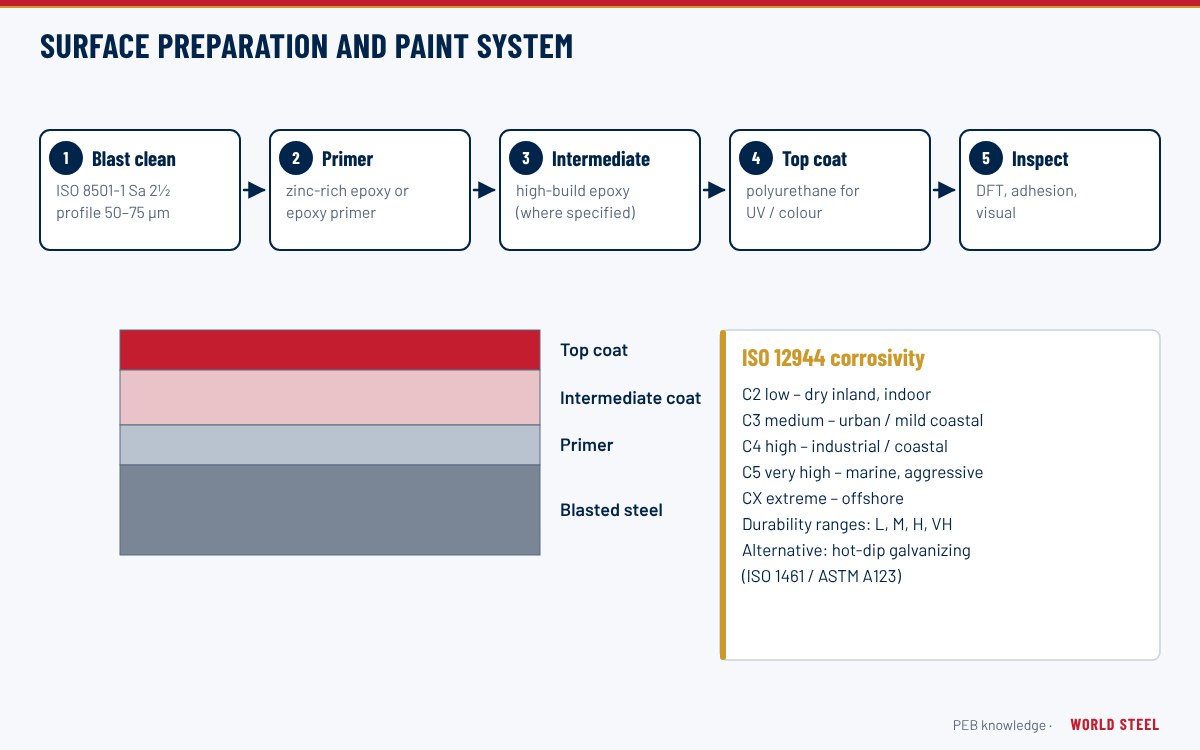
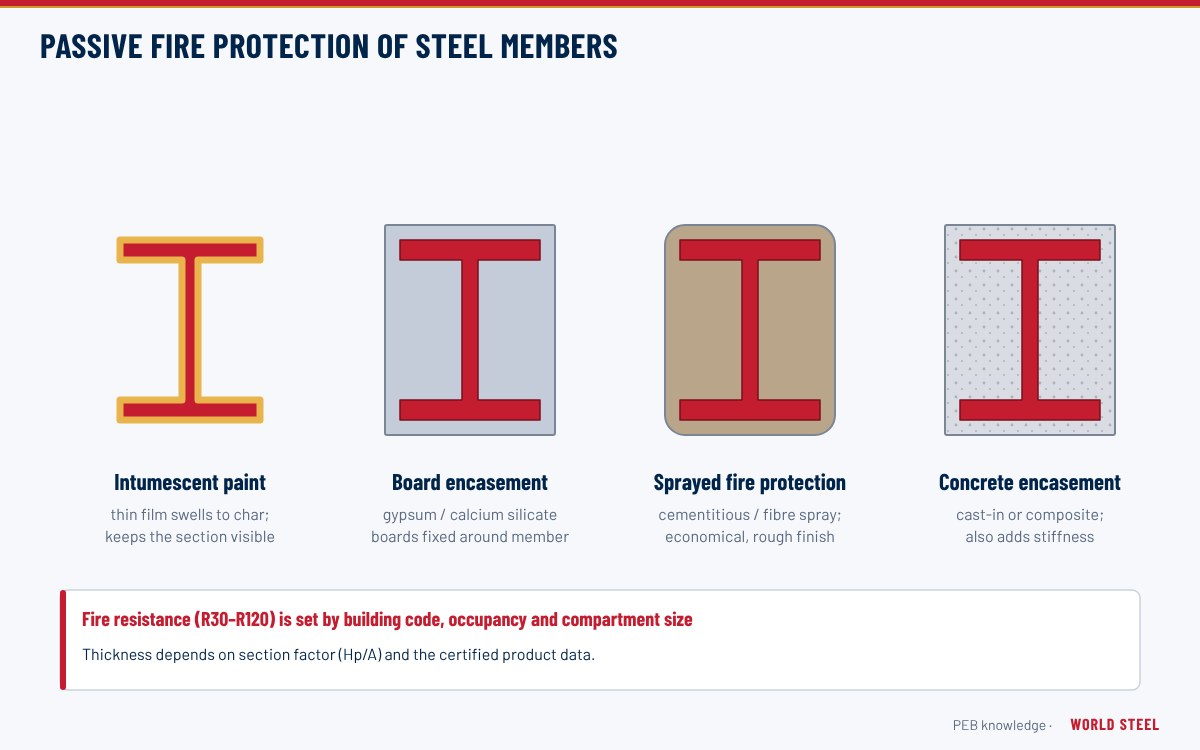
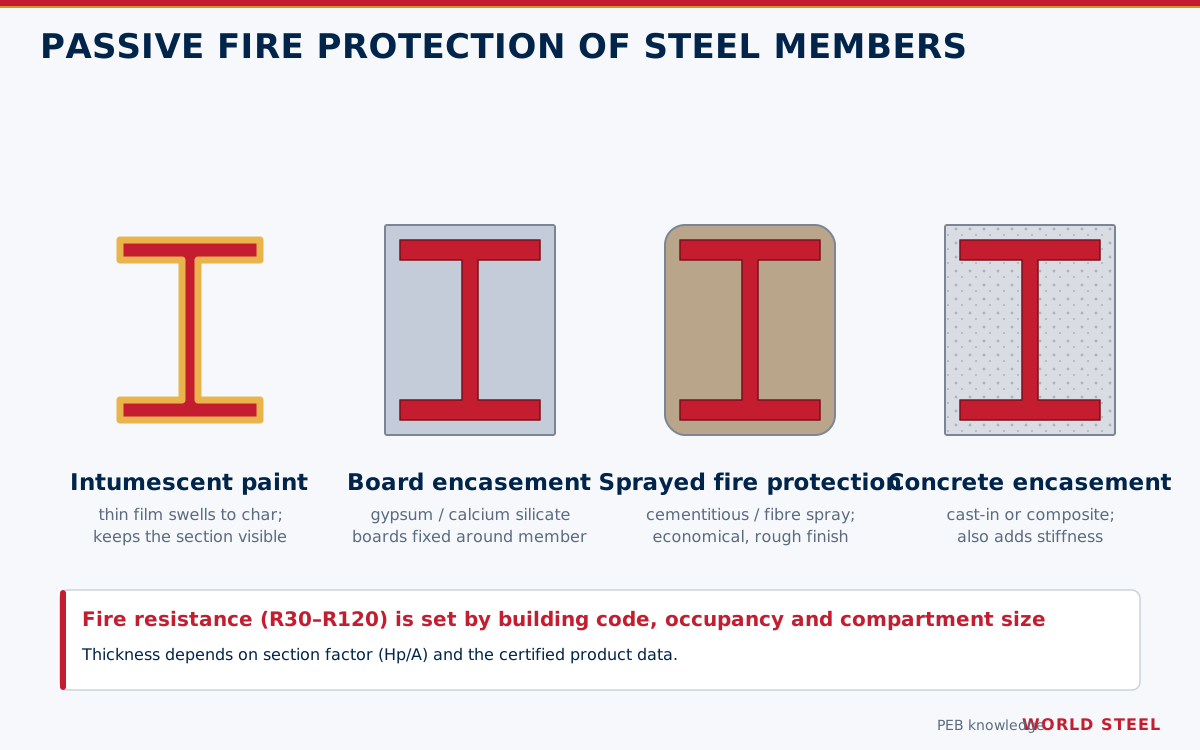
- Thin-film intumescent coatings – paints that swell into an insulating char when heated. Typical dry film thickness runs from a few hundred microns for R30 to several millimetres for R120, depending on section factor and critical temperature. Shop application at the fabricator gives the best quality control; the product must be compatible with the primer of the paint system and protected by a topcoat in humid or exterior conditions.
- Sprayed fire-resistive materials (SFRM) – cementitious or mineral-fibre sprays applied on site; economical for long ratings but not decorative, and vulnerable to impact.
- Board encasement – gypsum, calcium-silicate or mineral boards around columns and beams; clean, dry and predictable.
- Concrete encasement or filling – used for columns in multi-storey frames and for impact-prone locations.
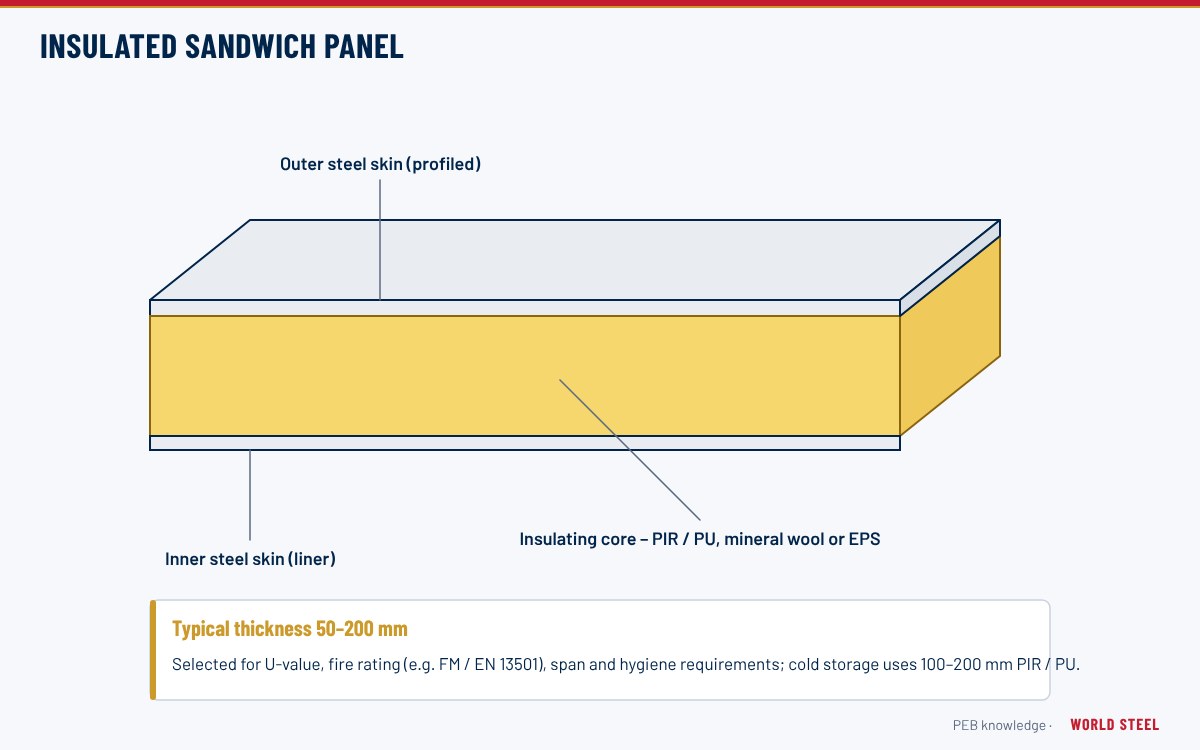
- Fire-rated envelopes – mineral-wool sandwich panels tested as fire walls or external walls, and rated ceiling or partition assemblies.
Performance-based design using AISC 360-22 Appendix 4, AS 4100 Section 12 or EN 1993-1-2 can calculate the actual critical temperature of each member under its fire-load level, which often reduces coating thickness compared with prescriptive tables.
Fire walls and boundary walls in steel buildings
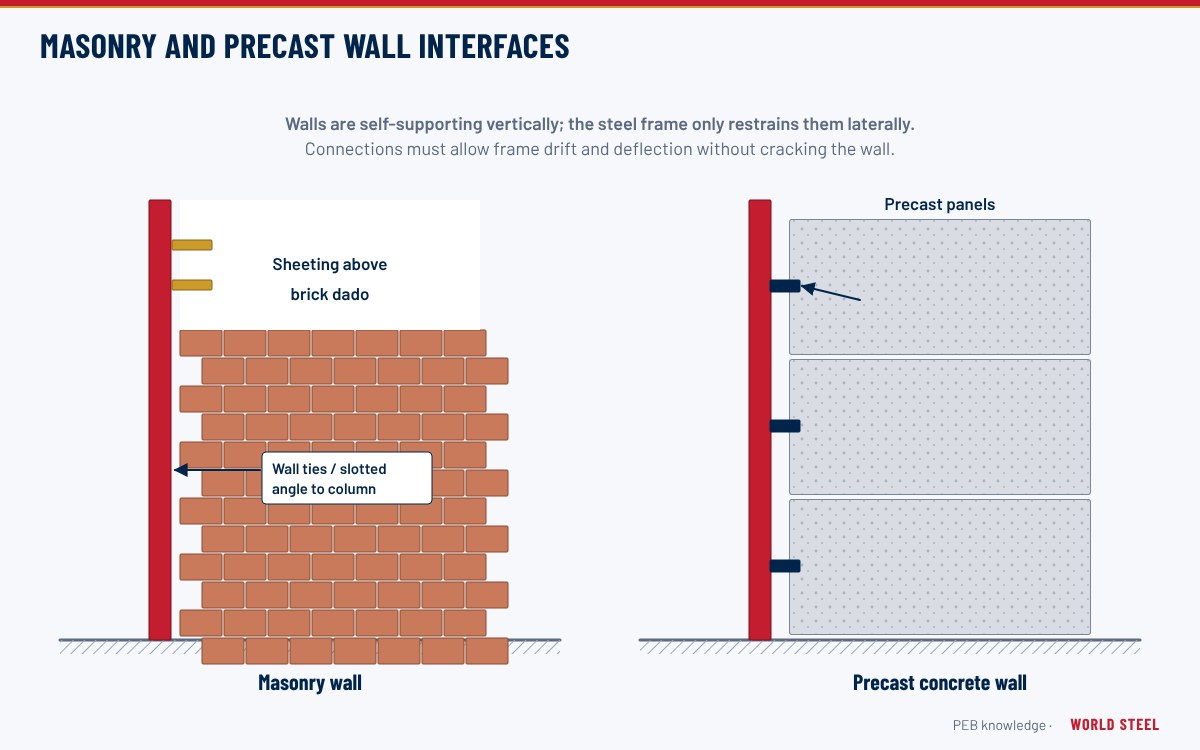
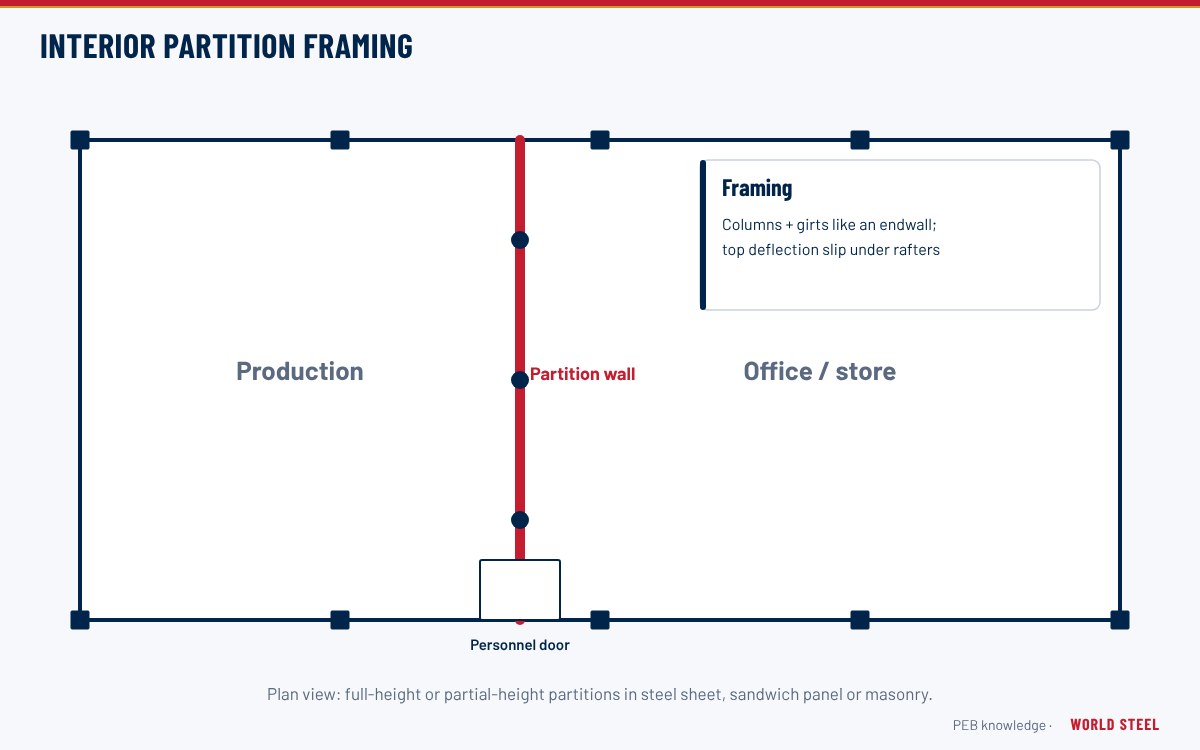
Large buildings are divided into fire compartments, and walls near a site boundary may need a rating to stop fire spreading to neighbours. In a PEB the critical issue is that a fire wall must remain standing when the steel on the fire side collapses. Common solutions are an independent masonry or precast wall with its own stability, or a steel-framed wall where the frame next to the wall is protected and the roof framing is detailed so that collapse on one side does not pull the wall over. Interfaces with masonry and precast walls are discussed in masonry and precast interfaces.
Active systems and the steel structure
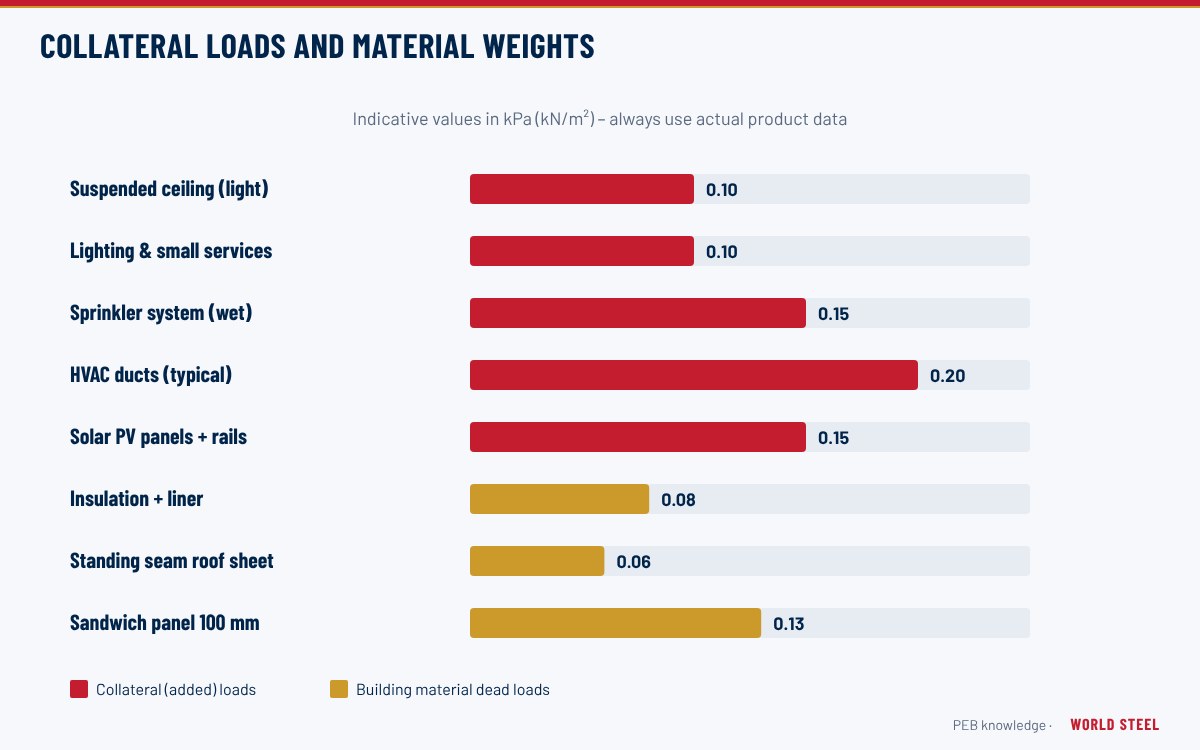
Sprinklers (NFPA 13, AS 2118.1, EN 12845), smoke vents and detection systems (NFPA 72, AS 1670.1, EN 54) are designed by others, but they affect the steel. Filled sprinkler mains and ESFR systems in high-bay storage add significant collateral load; smoke and heat vents are roof openings to be framed; and pipe hangers need defined fixing points on purlins. World Steel coordinates these loads during design, can apply shop intumescent coatings during fabrication where specified, and documents coating systems and thicknesses in the quality records.
Standards by region
| Region | Code | Scope |
|---|---|---|
 United States |
IBC 2021/2024 Ch. 6–7 / ASTM E119 / UL 263 / AISC 360-22 App. 4 | Construction types and fire-resistance ratings; fire tests; structural design for fire |
 Canada |
NBC 2020 Part 3 / CAN/ULC-S101 / CSA S16-19 Annex K | Fire separations and ratings; fire test; structural design for fire |
 Australia / NZ |
NCC Vol. One Section C / AS 1530.4 / AS 4100 Section 12 | Fire resistance levels; fire test; steel design for fire |
 Europe |
EN 13501-1/-2 / EN 1993-1-2 / EN 13381-8 | Reaction to fire and resistance classification; structural fire design; reactive coatings |
| International | ISO 834 | Fire-resistance tests – standard time–temperature curve |
Frequently asked questions
Does a steel warehouse need fireproofing?
Often not. Many single-storey warehouses and factories are permitted with unprotected steel when area, separation and sprinkler rules are met. Ratings are needed for multi-storey parts, fire walls, boundary walls and some occupancies.
Can intumescent coating be applied in the factory?
Yes. Shop application gives controlled thickness and curing; members then need careful handling and site touch-up at connections, and the coating must be compatible with the primer and protected from weather.
How does a fire wall stay up when the steel frame collapses?
It must be self-stable or tied to protected structure, and the adjacent roof framing must be detailed so its collapse on the fire side does not pull the wall down.