ENEnglish
 VITiếng Việt
 ZH中文
 KO한국어
 JA日本語
 FRFrançais
 ITItaliano
 PTPortuguês
 ESEspañol
 HEעברית
 ARالعربية

Why sundries matter
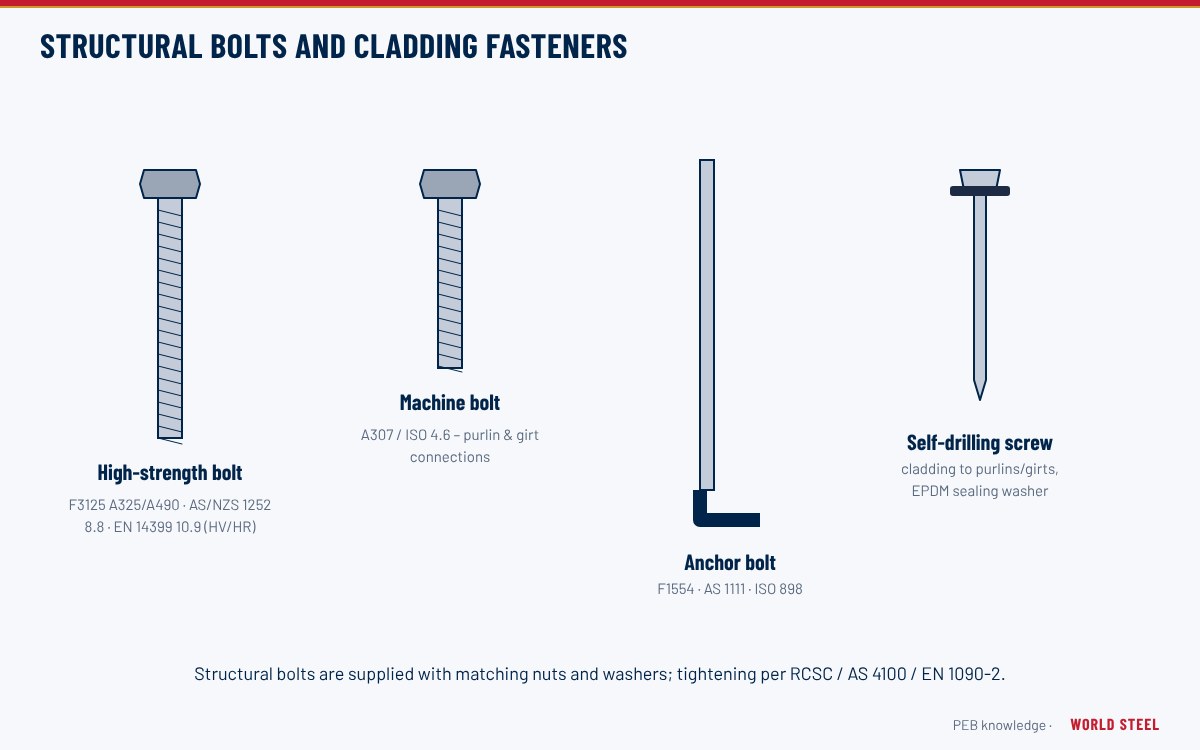
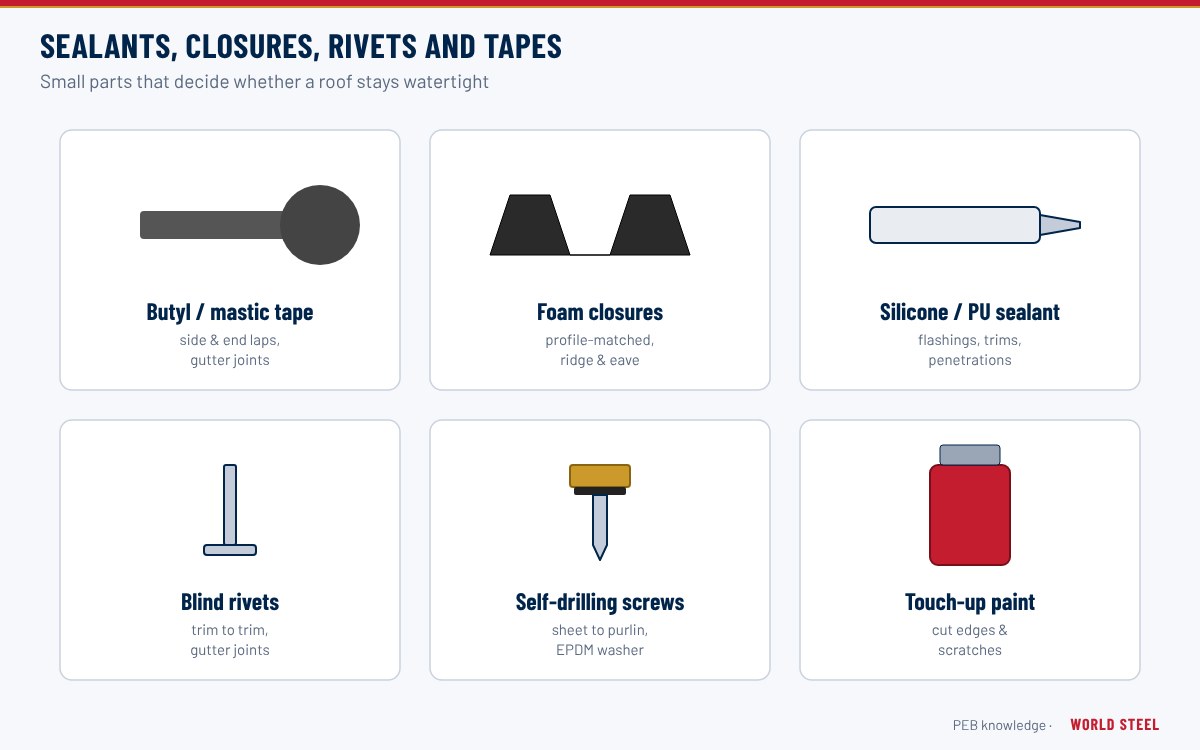
Sundries are the small consumable items supplied with a steel building to make the envelope weathertight and finish the details: foam closures, mastic tapes, sealants, blind rivets, flashing tapes, touch-up paint and the like. They are a tiny fraction of the building's cost, but most envelope complaints – leaks at laps, dust or birds entering at the eave, rust stains, rattling trims – trace back to a missing or wrong sundry item. A complete PEB kit therefore lists sundries by type and quantity on the bill of materials, matched to the specific sheeting profiles and coatings, and ships a small spare allowance for site losses. Structural and cladding fasteners are covered separately in structural bolts and cladding fasteners.
Foam closures
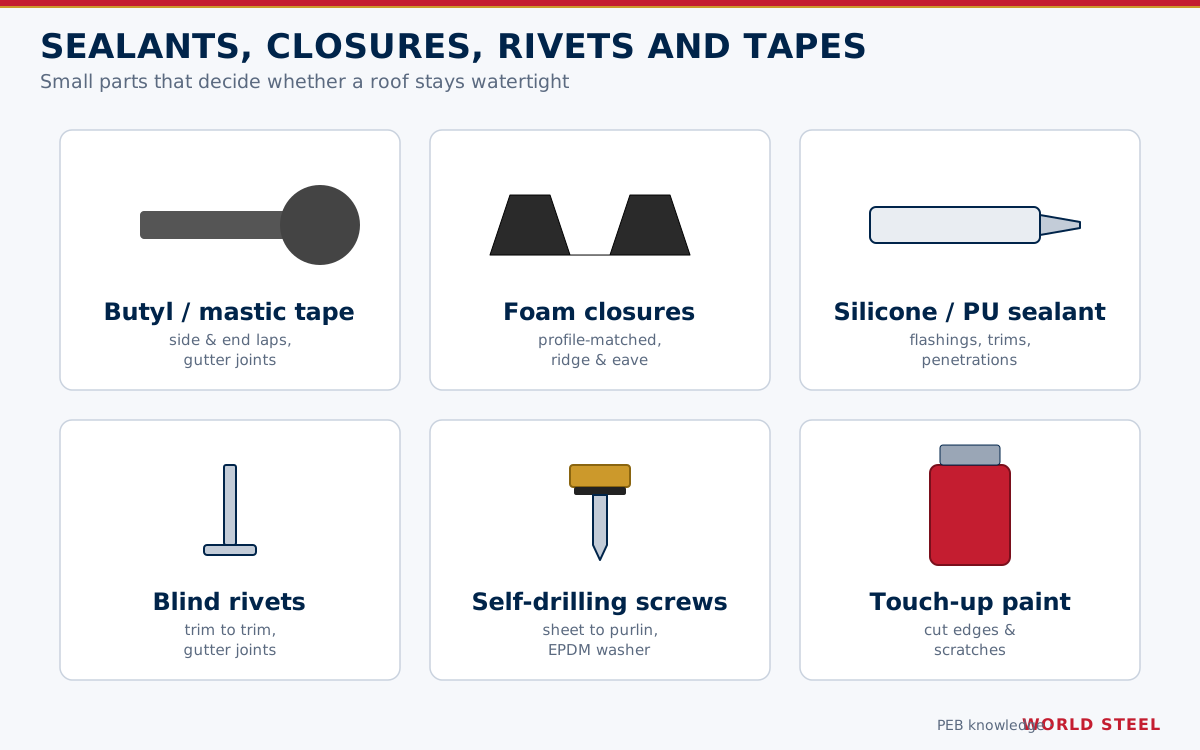
Profiled sheeting leaves open voids at the eave, ridge, base of walls, above block walls and at canopy junctions. Foam closures – strips of closed-cell polyethylene (or EPDM for higher temperatures) cut to the exact rib shape of the sheet – fill these voids and keep out wind-driven rain, dust, insects, birds and rodents. Inside closures sit between the sheet and the supporting member; outside closures sit between the sheet and the trim. Key selection points:
- The closure must match the specific profile – a closure for a different rib spacing leaves gaps.
- Closed-cell, UV-stabilised material that does not absorb water; open-cell foam holds moisture against the steel.
- Self-adhesive or mastic-bedded closures at the high end of standing seam roofs; vented closures where roof-space ventilation is required.
- Fire-rated closures (mineral wool or intumescent) where the wall or roof forms part of a fire-rated assembly.
Mastics, sealants and tapes
| Product | Typical use | Notes |
|---|---|---|
| Butyl mastic tape (single or double bead) | Roof end laps, side laps in low slopes, gutter joints, closure bedding | Non-curing, stays tacky; compressed by the fasteners |
| Neutral-cure silicone | Trim laps, flashing joints, penetrations | Use neutral cure only – acetic (acid) cure attacks metallic coatings |
| MS polymer / hybrid sealant | Joints to concrete and masonry, overpaintable seals | Good adhesion to many substrates, low odour |
| Polyurethane sealant | Movement joints, floor and wall joints | Needs UV protection or a UV-stable grade outdoors |
| Butyl or bitumen flashing tape | Repairs, window and door perimeters, wrap-around details | Bitumen grades are not for exposed long-term use |
| EPDM gaskets and washers | Under fastener heads, around pipe boots | Supplied bonded to fasteners or in flashing kits |
Sealants work only on clean, dry, oil-free surfaces and within their movement capability, which is classified in ASTM C920, EN 15651 or ISO 11600. Sealant is a back-up to correct lapping, not a substitute: water must always be shed by laps facing downslope, as explained in trims and flashings.
Blind rivets, touch-up and other items
- Blind (pop) rivets – typically 4.0–4.8 mm aluminium or stainless steel, used to stitch trim laps, gutter joints and flashings where a self-drilling screw would be unsightly or could not grip. Aluminium rivets suit aluminium-zinc coated sheet; stainless rivets suit stainless trims; avoid copper or steel-mandrel rivets that can leave rust or galvanic stains.
- Touch-up paint – matched to the sheeting colour and the frame primer, used for minor handling damage only. Large damaged areas should be replaced, not painted.
- Stitching screws and lap screws – short self-drilling screws for side laps of sheeting.
- Insulation tapes – foil or vapour-retarder tapes to seal joints in facing films, essential for condensation control.
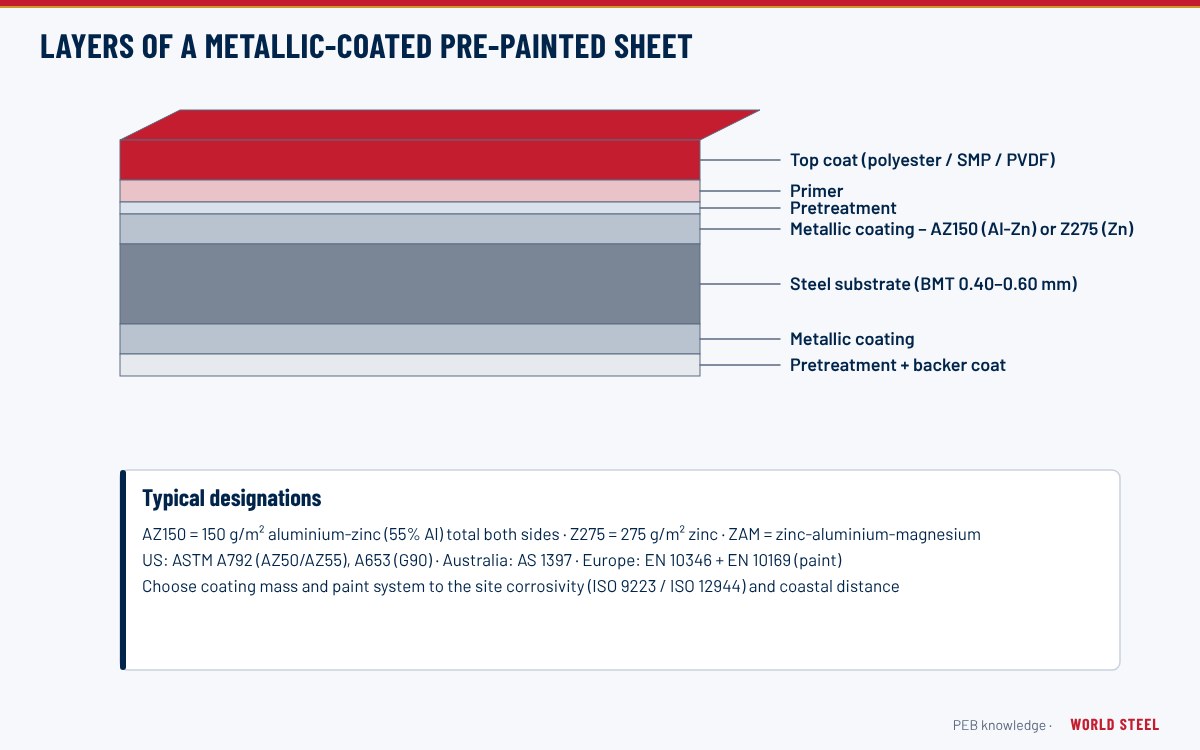
Compatibility is the hidden risk: copper, lead, green timber, wet concrete and acid-cure sealants all damage zinc and aluminium-zinc coatings. Check every sundry against the sheeting manufacturer's compatibility guidance.
Supply and site practice at World Steel
World Steel lists sundries per elevation and per sheeting profile on its erection drawings and packing lists, sources sealants and fasteners from established manufacturers such as Sika, SFS and EJOT where specified, and packs them in sealed, labelled cartons with the cladding so that nothing is lost in transit. Sundries are part of the accessories and cladding packages and are checked in final inspection before export.
Standards by region
| Region | Code | Scope |
|---|---|---|
 United States |
ASTM C920 / IFI-114 | Elastomeric joint sealants; break-mandrel blind rivets |
 Canada |
CAN/CGSB-19.13 / NBC 2020 Part 5 | Elastomeric sealing compounds; environmental separation |
 Australia / NZ |
HB 39 / AS 3566.1 | Installation of metal roof and wall cladding; self-drilling screws |
 Europe |
EN 15651-1 / EN ISO 15977–15984 | Sealants for facade elements; blind rivets |
| International | ISO 11600 | Classification of building sealants |
Frequently asked questions
Why must neutral-cure silicone be used on metal roofs?
Acid-cure (acetic) silicones release acetic acid while curing, which attacks zinc and aluminium-zinc coatings and can cause corrosion along the sealant line. Neutral-cure grades avoid this.
Are foam closures really necessary?
Yes. Without closures the open ribs at eaves, ridges and wall bases let in wind-driven rain, dust, birds and insects, and allow insulation to be damaged.
Can sealant fix a leaking lap?
Only temporarily. Most lap leaks come from wrong lap direction, missing mastic or loose fasteners; the lasting fix is to correct the lap and re-seal with the right mastic and fasteners.